
“There is antisemitism for its own sake and a huge lie in the story of the ultra-Orthodox,” declared Dudi Amsalem, the Likud minister for Regional Cooperation, at a conference on Sunday.
It is hardly an original take when the head of the United Torah Judaism party accuses a political rival of antisemitism; most Israelis hardly bat an eye. Perhaps if Likud ministers are leveling the accusation, it warrants a serious assessment.
It is undeniable that political depictions of the haredim (ultra-Orthodox) occasionally dip into the bucket of antisemitic tropes. Haaretz contributors have referred to specific sects as “parasites,” and TV personality Galit Gutman notoriously labeled them “bloodsuckers” on live TV.
As the most visibly Jewish community in Israel, haredim face a reality mirrored on the streets of Brooklyn and London: those who look the “most Jewish” are often the most targeted. Haredim have even been victims of hate crimes. In one infamous case last year, a haredi couple near an anti-government demonstration in Tel Aviv were physically assaulted due to their appearance.
The defense that Israel is a Jewish state provides no immunity. There is a plethora of historical evidence to testify that Jews have never been immune from jew-hatred by dint of heritage.
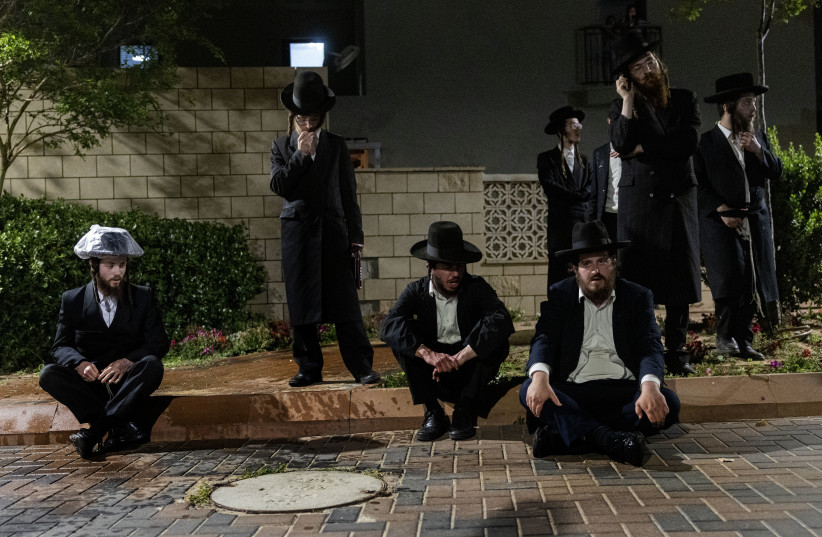
Yet, despite these flashes of bigotry, anti-haredi rhetoric is fundamentally distinct from antisemitism, and treating it as such concedes haredim much more than a narrative of victimhood.
Antisemitism generally operates through two lenses: the conspiracy, which frames Jews as disproportionately powerful; and the bigotry, which asserts they are inherently inferior or biologically lesser. Few in Israel believe in the existence of a cabal like the Elders of Zion, and fewer still believe that if it existed, it would manipulate the country from using kosher phones.
The accusation is firmly of the second type that Israelis harbor antisemitic bigotry, what Isaiah Berlin described as “hating Jews more than is necessary.”
Where criticism ends and 'antisemitism' begins
Therefore, the question must be asked: What is it, inherently, about haredi Jewishness that so infuriates their critics?
Take what is perhaps the most cited statistic in Israeli public discourse: the 15,000-shekel gap between the average haredi and non-haredi family’s contribution to the state. Or consider the widespread fury over the refusal to serve in the IDF. Notice what is absent from both of these grievances? Any inherently Jewish element.
To test this, let’s substitute the haredim with an entirely different demographic group. Suppose secular Ashkenazi Jews occupied this exact socio-economic position, maintaining this same rejection of civic duty as a conscious, collective lifestyle choice.
What would society call them? I imagine “parasites” would be one of the milder labels used, their devout commitment to secularism and heritage notwithstanding.
While there may very well be some anti-religious sentiment mixed into the public outrage, that does not equate to antisemitism. The hostility has nothing to do with the particularities of Jewish practice itself; it is a reaction to a civic imbalance. The ultimate proof? Neither this intensity of opposition, nor these supposedly antisemitic tropes, are ever weaponized against Religious Zionists.
Ultimately, labeling mainstream Israeli criticism as “antisemitism” betrays a much deeper ideological pathology within the haredi worldview.
First, it assumes their specific lifestyle is completely synonymous with Judaism itself, granting them an absolute monopoly on authentic Jewish expression. This monopoly warps their understanding of the draft and of Israeli society.
In their worldview, the state isn’t demanding they serve out of a basic need for civic equality. Rather, as Rabbi Moshe Sternbuch of the hardline Badatz (Eda Haredit Rabbinical Court) recently claimed, secular Israelis see the haredi brand of authentic Judaism and are “fiercely jealous of us.”
Second, and more profoundly, weaponizing the charge of antisemitism fundamentally denies the nature of the Jewish state. By branding their tax-paying, military-serving Jewish neighbors as antisemites, haredi leadership rhetorically excommunicates the rest of the country.
It signals a refusal to accept the reality of a sovereign Jewish society, choosing instead to operate as if they are living in an alien, hostile diaspora where the “outside world” and “antisemitic persecutor” are one and the same.
Policing the language of secular critics will not solve the underlying friction. This tension is not born of an irrational pathology or anti-Jewish bigotry; it is the unavoidable result of mathematically unsustainable socio-economic realities.
Coddling the haredi narrative of victimhood does nothing to fix the problem – it only legitimizes the distorted worldview that is driving the crisis in the first place.
The writer serves as the English director of the Ribo Center and the editor of Amit Segal’s newsletter, It’s Noon in Israel.