
Amid the dire reports from the ongoing fighting on our borders, the political scrambling, and the disturbances over the draft issue, there is a cheery item on Israel’s evening news. Israeli pop Mizrahi singer Peer Tasi has created his first album for children. Ask your children or grandchildren if you don’t know who he is.
This new album has been welcomed as a happy addition to the tradition of popular Israeli singers producing music for children, among them Arik Einstein, Chava Alberstein, Shlomo Artzi, Uzi Hitman, and Gidi Gov.
Tasi, 42, like all these singers, is a parent. His musical career began when he was a child in his family’s Yemenite synagogue. The album is called Yaldei Hashetach, literally “children of the field,” but closer in modern Hebrew to “Children of the Real World.”
Israeli children of the real world deserve all the light-hearted music and celebration we can provide, always, but this year in particular. Tasi’s songs are full of puns and humor. I particularly like “The Biggest Salad in the World,” but the top hit is Tasi’s version of an alphabet song, which reportedly had more than 200,000 online views in the first three days alone.
In this month of school graduations, end-of-year performances, and landmark events that were postponed amid the current missile attacks, I am relieved, impressed, and proud of our Israeli children.
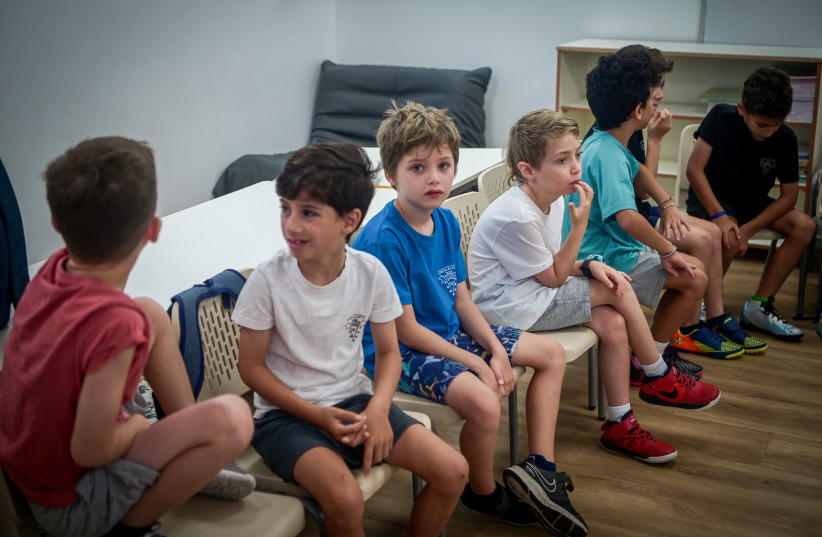
I am not fooling myself that the year of war and terror, the canceled class trips, and the lack of loving families arriving from abroad have not hurt our children.
When I look out at each class or group of youngsters with whom I have been this month, I assume that most of them know someone who was injured or killed, and that all of them have sprinted to shelters and safe rooms.
But there they are, dressed in leotards and karate suits, or elegantly coiffed for graduations in Jerusalem, Modi’in, Binyamina, Tel Aviv, and Mitzpe Yeriho. I kvell over their stunning achievements and strength, despite the year’s challenges.
This realization struck me when I managed to get a seat on a towering bleacher in a Modi’in neighborhood gym. There was the end-of-year performance of Snunit Acrobatics – a display of acrobatics, gymnastics, trio pyramids, and aerial duos.
Mostly girls, from preschoolers to graduating high school seniors, performed aerial cartwheels, leaps, and tumbling to complex musical choreography.
There are 2,000 participants in this program, so the final performances have to take place over three days. To take part in this program, each participant had to show up after kindergarten or school for about six hours a week, even when they had tests or birthday parties. Okay, the younger students only came for four hours a week, but that is still an impressive commitment.
This year, their classes and practice sessions were, of course, interrupted by war. Nevertheless, to my admittedly untrained eyes, the junior gymnasts and acrobats looked good enough for international competitions.
Indeed, when I poked around the Internet, I learned that the Modi’in group had won 21 medals in a February 2025 Dubai competition. After competing respectably in the June 2025 Tbilisi Cup, they had trouble getting home because flights from Georgia were canceled.
Bar mitzvah gets rescheduled
Then, in my Jerusalem synagogue on Shabbat, a boy named Gili looked too tall to be chanting his bar mitzvah portion. Suddenly, I remembered why. His bar mitzvah, scheduled for a year ago, had been canceled when synagogues were closed and we were all huddling in shelters from Iranian missile attacks. So, with aplomb, at age 14, he chanted his bar mitzvah portion six inches taller than a year ago.
Gili almost missed this bar mitzvah, too, because he had just returned from volunteering in Tanzania, where he helped build a greenhouse for a public school. To qualify for the volunteering, he had to attend six hours a week of training in public diplomacy through the PICO Kids Ambassadors program, so he could promote Israel’s good name.
Here, too, though not because of the war, there were transportation snafus on the way home. But he managed to arrive in time and get ready for Shabbat.
The two high school graduations I am attending are for our grandchildren in Modi’in and Zichron Ya’acov. Both teens have gone to too many funerals of friends, and siblings of friends, in their school years. Both have volunteered for at least one extra year of commitment, in pre-army service, in addition to the years they will serve in the IDF.
One of my granddaughters is singing in the Hazamir musical grand finale, if it’s not canceled because of the latest missile attacks. She and the other singers weren’t able to take part in the Lincoln Center concert in Manhattan because their flight was canceled at the last minute during Operation Roaring Lion.
A SPECIAL invitation to Mitzpe Yeriho took me to an English-language, end-of-year book fair by first- to sixth-graders, who take part in the after-school program A.H.A.V.A. – learning English the natural way.
The CEO is master teacher Gaila Cohen Morrison, a grandmother who lives out in the boondocks and is obviously a gifted teacher with a touch of both Mary Poppins and Amelia Bedelia.
The students wrote the books at the fair themselves; lovely stories in pencil on lined paper, bound with string, with impressions from their lives, about books they had read, and even from poetry.
Visitors were encouraged to stick silver stars on their favorites. The students came from as far away as Beersheba. For nearly all these children, even those who come from fully English-speaking homes, Hebrew is their school language. Yet they created these books in English.
As part of their studies, the sixth graders had read my book Ilan Ramon: Israel’s Space Hero, and I had a chance to talk to them about the writing process. I explained that in Israel, we have the advantage of being able to hear true stories from original sources, even pilots and generals, to supplement or replace anything we might read on the Internet.
I encouraged them to keep writing, stressing that their own stories are unique and important. Even a year from now, they will be fascinated by what they are writing today.
I asked them if they minded hearing stories with a sad ending, like the biography of the late astronaut Ilan Ramon.
“That’s the real world,” someone answered.
Just like the new album of children’s songs.
Snunit, the acrobatics program, is the Hebrew name of the swallow, a bird known for covering enormous distances during its migratory journeys, and for returning each year to the same nest. Therefore, in Israeli culture, the swallow is an emblem of loyalty, renewal, flight, and return.
What better symbol could there be for our children? They have covered enormous distances this year, sometimes frightened, sometimes delayed, sometimes forced into shelters, but still returning to their music, their books, their gymnastics, their volunteering, their Torah readings, and their dreams.
Mazal tov to all the graduates. Hail to the children of Israel.
The writer is the Israel director of public relations at Hadassah, the Women’s Zionist Organization of America. Her latest book is A Daughter of Many Mothers, co-written with Holocaust survivor and premier English-language witness Rena Quint.