
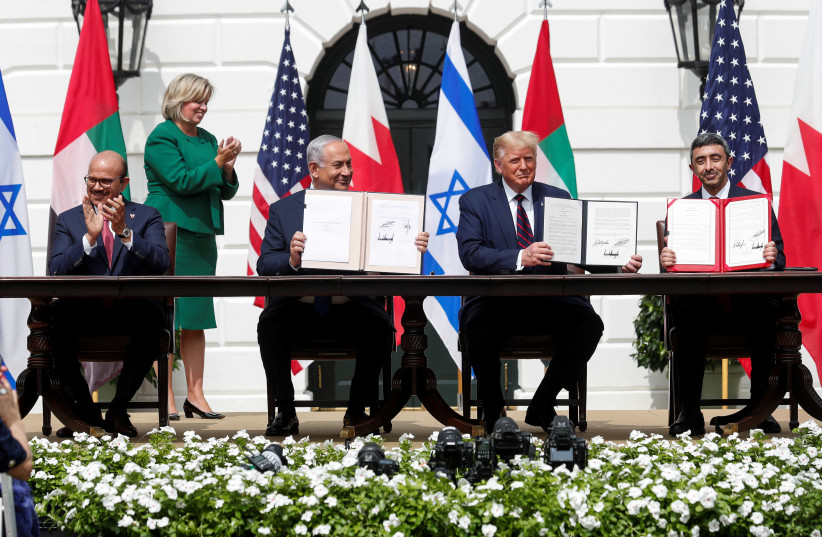
When Sudan signed up in 2021 to the Abraham Accords, they had been presented to the world as the foundation stone of a new architecture for the Middle East, bringing the prospect of peace, cooperation, and stability to the region.
That vision is being tested in Sudan, where General Abdel Fattah al-Burhan, the man who authorized Sudan’s Abraham Accords agreement with Israel, now presides over a country shattered by civil war.
It is one of the deadliest and most destructive conflicts globally and has created the world’s largest and most devastating displacement and humanitarian crisis. There is no end in sight, and it is getting worse.
Having embraced Burhan as a normalization partner, Israel and the other Abraham Accords states have at least a moral obligation to regard Sudan’s agony as a problem in which they have an interest. A member of the pact is in serious trouble. Joint action might help.
For three years, the Sudan civil war has been inflicting intolerable suffering on the nation, resulting in “the world’s worst humanitarian crisis,” according to the UN.
Rigorous estimates suggest that tens of thousands, and possibly well over a hundred thousand, people have already died in Sudan’s war, putting it among the deadliest conflicts of our time.
Sudan's infrastructure collapses
The nation’s basic infrastructure – water, electricity, transport, and health care – has more or less collapsed. Over 11 million people are internally displaced, and roughly 4 million have fled to neighboring countries, including South Sudan, where refugee camps also face severe food and water shortages.
Outbreaks of malaria, respiratory illnesses, and diarrheal diseases, linked to very poor sanitation and hygiene, are reported to be rampant in displaced-population areas.
How has this desperate situation come about?
It all began with Sudan’s popular revolution in April 2019 – described at the time as Sudan’s “Arab Spring moment” – and the collapse of the 30-year-long regime of the authoritarian Omar al-Bashir.
In the transitional democratic government that followed, Burhan, head of the Sudanese Armed Forces (SAF), became head of the ruling Sovereignty Council. Its members jointly pledged to move the country toward democracy and to parliamentary elections in 2023.
After some two years, the administration was clearly making no progress toward any form of democracy. It was, moreover, clearly failing to deal with the country’s severe economic problems. On October 22, 2021, national frustration erupted in a mass protest in the capital, Khartoum, in support of civilian rule.
Burhan, together with his deputy, General Mohamed Hamdan Dagalo (often referred to as Hemedeti), orchestrated a military coup and took over control of the country.
However, it was not long before the two fell out. Dagalo headed the powerful paramilitary Rapid Support Forces (RSF). Burhan considered such a strong force outside the army a source of instability and announced plans to merge the RSF with the nation’s formal armed services.
This was enough for the two former colleagues to take up arms against each other.
On April 15, 2023, the RSF launched coordinated attacks on key SAF sites in Khartoum, claiming early control of major airports. By early 2025, the SAF had pushed the RSF out of Khartoum and most of Omdurman, giving Burhan control of the greater part of Sudan, including the capital region.
In February 2025, Burhan’s Transitional Sovereignty Council announced the formation of a new transitional government. In May, Kamil Idris, a civilian, was appointed prime minister.
This administration is accepted by the UN, the African Union, Egypt, and a number of other states as the legitimate government of Sudan.
In April, Dagalo, still in control of significant parts of western and southwestern Sudan, established a rival “Government of Peace and Unity” to administer the territories under their control. This body lacks international recognition.
Meanwhile, the civil conflict continues to inflict unprecedented misery on the people.
International humanitarian agencies, reporting in mid-April 2026, put the number of people in need of assistance at roughly 34 million, with about 26 million facing acute food insecurity, over 20 million requiring health assistance, and around 14 million displaced.
In a report published in March 2026 by Doctors Without Frontiers, sexual violence was found to be “part of everyday life” in large areas of Sudan.
Researchers documented more than 3,396 cases of sexual violence in 2024 and 2025. Women or girls reported being assaulted by armed individuals. In South Darfur, 41 children under the age of five were assaulted.
A REPORT published by the Mercy Corps on May 4 traces how disruption in the Strait of Hormuz is affecting Sudan. The country is already inside the planting periods that will shape harvests through late 2026 and into 2027.
If farmers have to reduce fertilizer use, switch crops, or plant less land, those losses cannot be reversed by a later political settlement. The result will be even greater food insecurity.
After more than 1000 days of civil war, the two sides are entrenched. The SAF appears to have the upper hand in central Sudan, but the RSF remains resilient in its western strongholds.
There is no effort to achieve a ceasefire. It seems like a fight to the death by the warlords, who apparently remain indifferent to the horrendous impact of their conflict on the people they both claim to represent.
Efforts have been made by some states to intervene. The Jeddah process (a US‑ and Saudi‑led mediation platform to broker ceasefire and humanitarian arrangements) produced several short‑lived agreements but failed to stop the war.
The “Quad” of Egypt, Saudi Arabia, the UAE, and the US failed to secure even a temporary ceasefire. Could the Abraham Accords nations, in a collaborative partnership, exercise a stronger influence and achieve a positive outcome?
Israel has maintained contacts with both Burhan and Dagalo; the UAE is known to have direct channels to Dagalo.
In principle, a joint push for de-escalation by Israel, the UAE, Bahrain and Morocco might carry weight with both camps, especially if accompanied by a package of tangible political and economic benefits for a post-war Sudan.
The Abraham Accords are undoubtedly much more than a mere branding exercise. Given an unprecedented crisis, the signatories should surely be willing to act together to foster peace and regional stability.
The writer, a former senior civil servant, is the Middle East correspondent for Eurasia Review. Follow him at: www.a-mid-east-journal.blogspot.com.