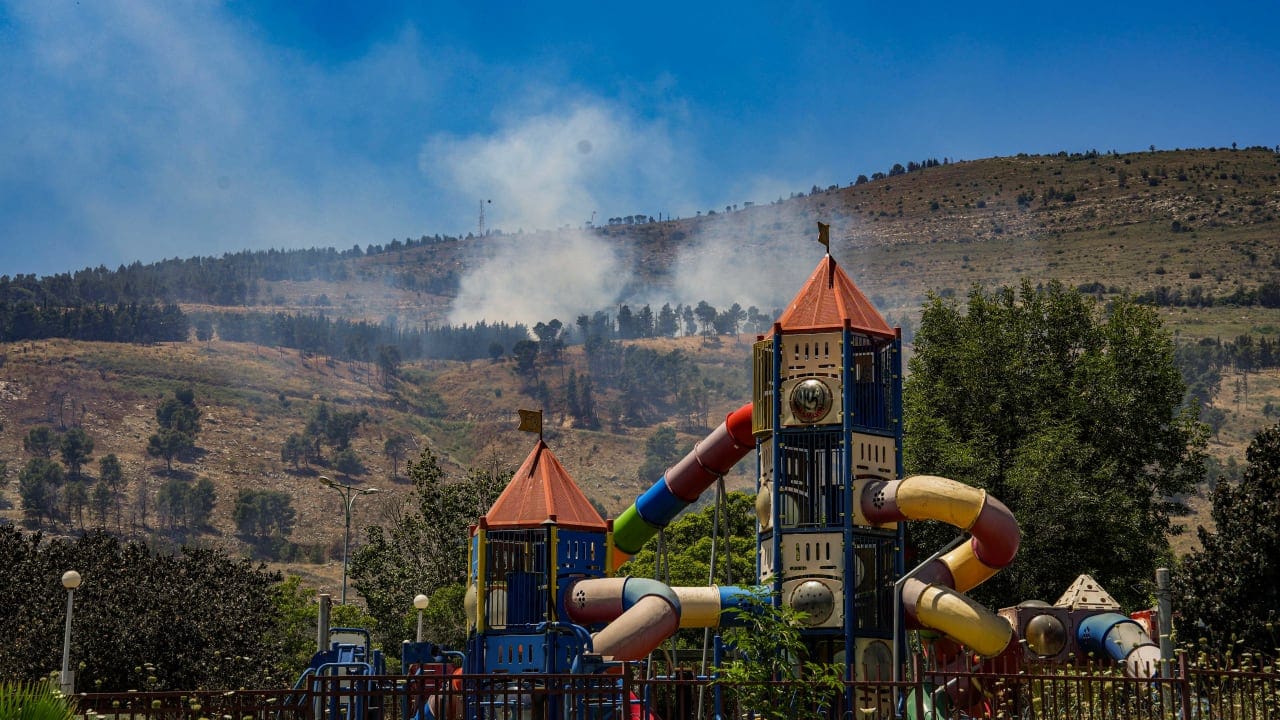
In the last few years, while most Israeli citizens try to maintain some semblance of normal life under constant security pressure, two populations have continued to experience the war at full intensity: reserve soldiers and their families, and the residents of the northern conflict zone.
And then some are both – families whose breadwinner has spent months at the frontlines while their children sleep in a safe room a kilometer from the Lebanese border.
For the members of community rapid-response units in northern villages, this is not a hypothetical. It is Tuesday. For the latter, routine is an impossible daily dilemma.
In the absence of a government decision to organize structured evacuations during the recent rounds of fighting, these communities were left exposed to rocket and drone fire, sometimes with only seconds to reach shelter.
For young families, this has meant living indefinitely inside safe rooms, with the sound of artillery explosions as the permanent backdrop of their home.

The decision by many northern communities not to evacuate during these last months of war was not rooted in indifference to danger. It grew directly from the trauma of the previous evacuation at the start of the Israel-Hamas War.
The numbers tell the story: the city of Kiryat Shmona, for example, was dispersed across more than 55 local authorities and over 300 hotels and facilities nationwide.
As Elad Kozokaro, director of the city’s community center, cried out in real time, that dispersal was not merely geographic. It was the dismantling of a community’s social fabric, atom by atom.
When a city scatters across dozens of locations, educational continuity breaks down, support networks collapse, and the bonds holding people to their place begin to fray. In practice, a significant share of evacuees never returned home even after the official evacuation period ended.
Life outside the threatened zone revealed the possibility of a more stable and secure existence, far from the geographically distanced, politically isolated, and security-exposed north.
The painful familiarity with the cost of evacuation, combined with a deep ethos of “we do not abandon our community,” drawing inspiration from the historic Battle of Tel Hai, led regional councils and communities to choose staying over yet another uprooting.
But that choice carries its own psychological toll.
This is where two sacred values collide head-on: the welfare of the child versus national resilience. Children on the northern border continue to live under a reality of sirens, explosions, and daily existential tension.
The figures coming from resilience centers and trauma coalitions along the conflict zone reveal a disturbing picture: a spike of more than 300% in parents seeking treatment for their children, with roughly 68% of children who remained in combat zones showing clear symptoms of anxiety, severe sleep disturbances, constant hypervigilance, and behavioral regression.
Years of rocket fire on the Gaza envelope communities, alongside life under constant security threats on the roads of Judea, Samaria, and the Jordan Valley, have already taught us that prolonged exposure to combat conditions carries a cumulative and long-term psychological cost, one that strikes at a child’s most basic sense of security.
A moral dilemma without easy answers
Are we permitted to sacrifice our children’s mental health on the altar of holding the land? And yet, is the answer to protect the child by turning him into a refugee in his own country, spending months in a hotel lobby without any stable framework?
Are we not simply trading the trauma of sirens for the trauma of displacement?
This moral dilemma has accompanied Israeli society since its founding.
During the War of Independence, “Operation Baby” saw the children of Kibbutz Nitzanim in the Negev evacuated together with their mothers and caregivers under Egyptian fire in May 1948, while the kibbutz’s fighting members stayed behind to hold the line.
The same thing happened in those days in Gush Etzion, where women and children were evacuated to Jerusalem just days before the final battle and the devastating massacre from the hands of the Jordanian Arab Legion.
But then, evacuation was understood as a tactical and localized measure, a breathing space designed to allow defenders to hold the line without children becoming an operational burden.
Today, evacuation has become a sweeping civilian retreat strategy that effectively moves the border southward. Within this reality, a legitimate demand has emerged from young families for structured “respite” periods.
This is not without precedent: during the 2006 Lebanon War, Israel implemented structured short-term respite rotations for children and elderly residents, allowing families several days of relief outside the combat zone before returning home.
The model worked. This intermediate approach would allow families to take several organized days of relief in hotels outside the combat zone, without fully dismantling the community and without being drawn back into the spiral of long-term evacuation.
The debate over conflict zone communities must no longer be framed in the binary terms of “staying or leaving.”
The home in the North is the last fortress of Israeli sovereignty, and if the children are not there, ultimately the state will not be there either. We should also remember that for some families, these are not separate burdens.
The same household sending a reservist to the front is also the household counting seconds to the shelter. For them, this is not a policy debate. It is daily life.
The time has come for the government to stop managing evacuations and start investing in community resilience and respite models with the same seriousness and budgets it invests in Iron Dome.
Only then can we protect, at the same time, Israel’s human shield and the children living within it.