
On the night of February 28, President Donald Trump addressed the American people to announce the launch of military strikes against Iran. He ended his remarks with a direct message to the Iranian people:
“To the great proud people of Iran, I say tonight that the hour of your freedom is at hand.”
He told them to stay at home while the bombs were falling and that, “when we are finished, take over your government. It will be yours to take. This will probably be your only chance for generations... No president was willing to do what I am willing to do tonight.”
Those were extraordinary words. No American president had ever said anything like them. Trump was giving hope to tens of millions of people who have lived under the most brutal theocratic regime in modern history.
He was telling them: This time, America is with you.
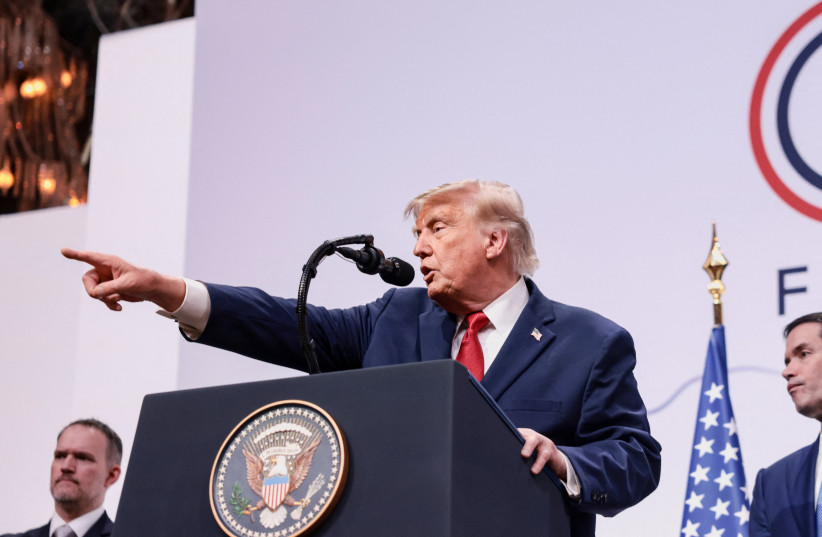
A few days ago, at the G7 summit, a reporter asked Trump whether the Iranian regime’s ongoing killing of its own people would affect his willingness to pursue a deal.
His answer was curious, to say the least: “The majority of that took place during the first and second regimes, much more so than now. It was much more severe, but it’s a terrible thing.”
The first and second regimes? Much more severe than now?
On June 2, Amnesty International’s X/Twitter account posted a grid of 41 faces – protesters executed for political reasons since February 28, the night the war began, following show trials in Islamic Revolutionary Courts conducted under what the regime calls “wartime conditions.”
On June 8, the Center for Human Rights in Iran reported that executions are occurring “at a pace unmatched in decades,” with prisoners across 56 Iranian prisons sustaining a weekly hunger strike in protest.
Just days ago, on June 16, Iran International reported two more executions at dawn – Javad Zamani and Abolfazl Saedi, arrested during the January protests and charged with “waging war against God.”
The regime published videos of their forced confessions.
Forty-three political executions since Trump told the Iranian people their hour of freedom was at hand. And now he tells us the killings are not as bad as they were under the previous regime.
Trump would have us believe the people running Iran today are a different, new regime – that the architects of the January massacres are gone, replaced by new, more reasonable people.
New people who just happen to be executing their own citizens at a rate not seen in decades. Whether Trump believes his own words is an open question, but his talk of “the first and second regimes” insults our collective intelligence.
The same regime, the same hands
The most prominent figure on the Iranian side of these negotiations is Mohammad Bagher Ghalibaf, Speaker of the Iranian Parliament.
He is not a new face of a new, more reasonable, “third” regime. As all Iran watchers and the Iranian people know, Ghalibaf built his career on excelling at the brutal suppression of peaceful protest.
In 1999, during mass student protests, he was already a senior Islamic Revolutionary Guard Corps commander. He told the supreme leader directly: if you don’t shoot these protesters, I will stage a military coup. A massacre ensued.
Ghalibaf boasts that early in his career, he rode around on a motorcycle with a club, beating demonstrators. He later became police chief of Tehran, responsible for the deaths of more protesters.
During the Green Movement of 2009 – the largest pro-democracy uprising Iran had seen in decades – he was mayor of Tehran, bearing direct responsibility for brutal police suppression in the capital.
And in January of this year, during the protests that triggered this war, Ghalibaf was part of the leadership that authorized the killing of tens of thousands of Iranian protesters. The executions still ongoing today lie at his feet as well.
The Iranian people are not confused about who this man is. To them, he is the butcher – the man who rose to power by demonstrating again and again that he would murder Iranians seeking freedom.
This is not a new regime. This is the same regime, with the same hands, making the same deals it has always made with its people’s blood.
I want to be fair to Trump. He is deliberately unpredictable and doesn’t telegraph his moves.
It’s possible his public comments about the regime’s behavior are not a genuine assessment but a diplomatic maneuver – a face-saving narrative for the Iranians as he works toward an agreement.
I’ve argued this point before and remain open to it.
But there is another possibility: that people around Trump have convinced him that a soft regime change has already occurred – that the removal of top military figures has fundamentally altered Iran’s power structure, that Ghalibaf represents a new military pragmatism the West can work with, and that he is Iran’s Gorbachev or Deng Xiaoping.
The US president told the Iranian people on February 28: “No president was willing to do what I am willing to do tonight.”
If the deal being negotiated leaves Ghalibaf – or anyone like him – holding power in Tehran, then what Trump was willing to do is exactly what every previous president did: use Iran’s people as leverage and leave them behind.
The writer is the executive director of Israel365 Action and co-host of the Shoulder to Shoulder podcast.