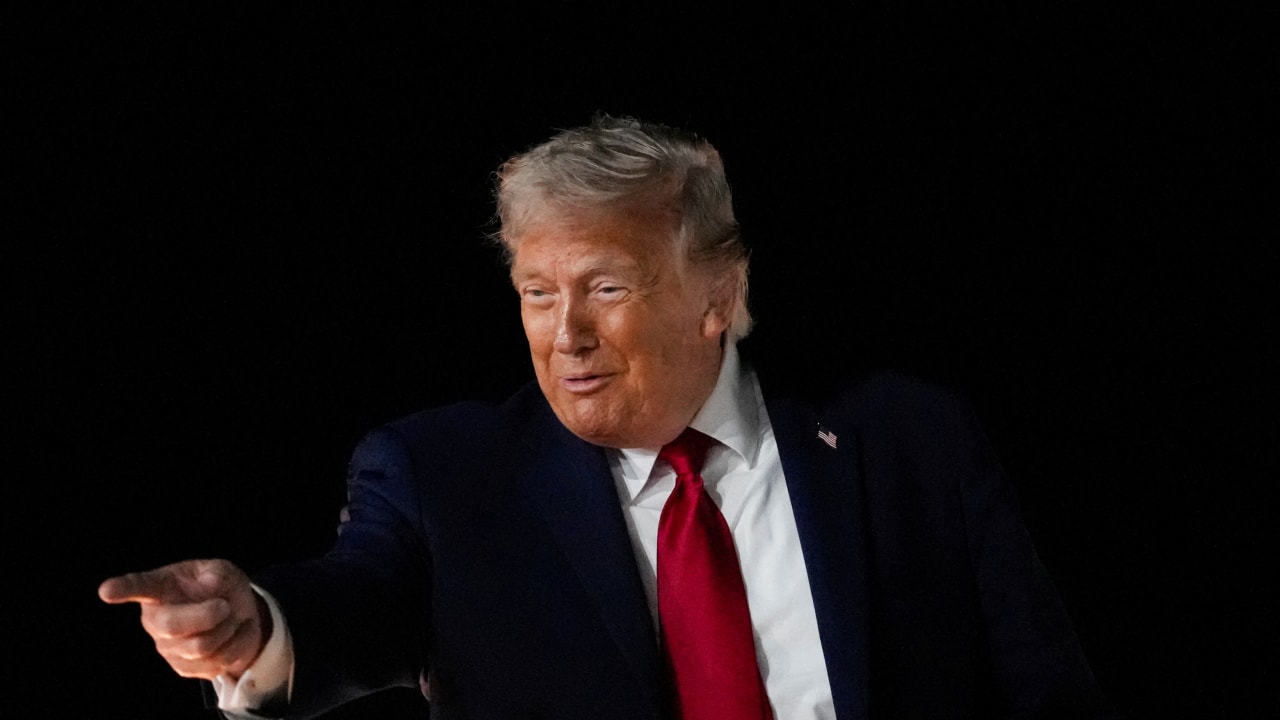
A president willing to confront Iran
President Donald Trump has done what no modern American president has been willing to do: confront the Islamic Republic of Iran directly.
For nearly half a century, Iran has waged war against the United States, Israel, and the civilized world through terrorism, proxy armies, hostage-taking, and revolutionary fanaticism.
Administration after administration chose accommodation, appeasement, or delay. He chose confrontation.
The results of that decision are impossible to ignore. The Iranian regime enters these negotiations weaker than at any point since the Islamic Revolution of 1979. Its military infrastructure has been battered.
Its air defenses have been exposed. Much of its command structure has been disrupted, with senior military and intelligence leaders killed. Its economy, already crippled by years of sanctions, corruption, and mismanagement, is struggling to survive.

He also stood firmly with the State of Israel when many others wavered.
He recognized Jerusalem as Israel’s capital and Israeli sovereignty over the Golan Heights, moved the American embassy, consistently affirmed Israel’s right to defend itself, ended the Israel-Hamas War, and brought the hostages home.
For that, the Jewish people and millions of Christians around the world will always be grateful.
Before Trump ran for president, he met with a small delegation of Evangelical believers and asked for our support. We told him yes but asked for two things: that he would support our Christian values and support the State of Israel.
He said yes to both and exceeded our expectations. I do not believe he is going to turn his back on Israel now or ever.
No American president would confront Iran, and under no circumstances would any do so during a midterm election. That would be political suicide, but Donald Trump had the courage to do it.
God bless you, Mr. President, for your courage and your willingness to confront a danger that so many others chose to ignore. I was with the Marines when they were killed in Beirut on October 23, 1983. I slept on the beachhead that night.
They were murdered by Hezbollah, an Iranian proxy. Former US president Ronald Reagan, a great president, did nothing. Instead, he sold Iran weapons and sent funds to the Contras.
Trump’s long game
I have received a flood of calls and texts from Trump-supporting US Evangelical leaders and many from high-level Israeli leaders who are deeply concerned about the reported Iranian Memorandum of Understanding (MoU).
My message to them is simple: Do not underestimate Donald Trump. Be patient; the dance is not over yet. He is playing a long and patient chess match with the Iranian regime, and he understands the art of the deal.
When Trump first came to Jerusalem, many people told me, “Donald Trump is not going to recognize Jerusalem.” I replied, “You do not recognize Donald Trump’s potential. He will recognize Jerusalem. Be patient.”
I have always believed that Trump is the greatest president in Israel’s history, and I still believe that today. Trump is opposed to an unending war. He opposed the wars in Afghanistan and Iraq. So did I.
Before the Iraq War, I met with Dick Cheney and warned him that invading Iraq would create an explosion of sectarian violence, ignite a Shi’ite-Sunni revolution of suicide bombers, and result in the deaths of countless Americans.
He was so angry with me that he cursed at me and threw me out of the meeting.
If the United States were to go to war with Iran, it could last at least eight years and produce the equivalent of a quarter of a million American body bags.
This is the last thing Trump wants and the last thing the American people want.
Hope for peace, grounds for caution
Now, a new peace agreement has emerged between the United States and Iran. I pray that it succeeds. No one desires peace more than those who have witnessed the horrors of war.
This is not Obama Deal 2.0. Unlike the 2015 nuclear agreement, Iran’s key nuclear facilities now lie in ruins, and its uranium enrichment program has been halted in a way not seen in more than two decades.
At the same time, the most difficult issues remain unresolved. It appears that many of the toughest questions, particularly Iran’s nuclear program and the future of US sanctions, have once again been deferred to future negotiations.
Those talks are expected to begin immediately and are scheduled to conclude within 60 days of the agreement’s signing on June 19. Negotiations of this magnitude rarely end on schedule. They could continue for months, if not years.
What Trump has achieved, at least for now, is a window for diplomacy to accomplish what military action alone could not. The agreement provides breathing room and reduces the immediate risk of a wider regional war.
But no one should mistake a pause in hostilities for permanent peace. While neither side appears eager to resume a full-scale conflict, there is no guarantee that another round of confrontation will not emerge.
After spending more than 50 years in the Middle East and meeting with well over one hundred Iranian leaders, officials, and power brokers through the years, I do not believe for a moment that the Iranian regime can be trusted simply because it signs a document.
According to Iranian statements, further negotiations would begin only after Tehran verifies that the US has fulfilled its obligations under the current agreement, including the unfreezing of Iranian assets and the lifting of restrictions.
American officials, however, maintain that Iranian assets will not be released until Iran demonstrates full compliance. That disagreement illustrates how far apart the two sides remain on the most consequential issues.
The MoU is an “if” document. If Iran does this, and if Iran does that, then the process moves forward. The memorandum postpones the most difficult issue – the Iranian nuclear program – for 60 days of negotiations.
If those talks do not result in the dismantling of Iran’s path to a nuclear weapon, the entire agreement will collapse.
Most striking is what the memorandum does not contain. There is no requirement that the regime cease funding and arming its terrorist proxies throughout the Middle East.
Whether economic incentives and future negotiations can succeed where decades of pressure have failed remains an open question.
Will $300 billion be enough to motivate an Islamic terror regime that kills its own people and believes it can usher in the Twelfth Imam through an apocalyptic confrontation?
Economic incentives appear to be at the heart of the agreement.
But what has the Iranian regime done to deserve $300b., even if it is technically their own frozen money? That is an enormous carrot to offer a regime that has spent nearly half a century sponsoring terrorism, threatening its neighbors, and chanting “Death to America.”
I do not believe Trump is going to hand over that kind of money simply because Tehran has decided to put on a smile.
During the 60-day negotiating period, the Strait of Hormuz is expected to remain open without tolls. Yet reports suggest that once that period ends, Iran could seek a role in administering maritime traffic through the Gulf and potentially impose substantial fees on commercial shipping.
Can a regime dominated by the Islamic Revolutionary Guard Corps (IRGC), whose primary business has been terrorism and revolutionary expansion, be expected to operate in good faith?
To believe that requires enormous faith in the regime, faith that I do not possess, nor do the 80 million Persians who have suffered unspeakable horrors under its rule. I do not believe Trump possesses that faith either.
I believe that after 60 days, there will be another 90-day extension, and that 2027 will begin with a fireworks display unlike anything the world has ever seen, with Trump bankrupting Iran, taking Kharg Island, and selling its oil to China.
We are preparing to celebrate America’s 250th birthday, but Israel was born 3,682 years before America’s founding. Israel was God’s idea. Every nation that has lifted its hands against Israel throughout history has ended up in the dustbin of history.
To those who have contacted me with fear that Iran is simply buying time and will never fully comply with the final agreement – I share that concern.
At the same time, I have confidence in Donald Trump. I do not believe he is prepared to hand Iran a $300b. blank check.
There is no question that the IRGC would use such resources to rebuild its military capabilities, expand its ballistic missile program, and strengthen terrorist proxies such as Hezbollah.
Iranian officials themselves have stated that any funds released under the agreement would be directed toward Iran’s defense establishment, attempting to fulfill its apocalyptic mission of killing the “Little Satan,” the Jews, and the “Great Satan,” America.
I do not believe that Iran intends to surrender its enriched uranium.
At best, the regime may claim it has diluted or weakened its stockpiles while actually doing the opposite: preserving its long-term nuclear ambitions and fast-tracking its program to obtain a nuclear weapon, modeling itself after North Korea.
Iran’s revolutionary ideology still matters
Beyond the unresolved details of this agreement lies a deeper concern: the ideology of the Islamic Revolution has not changed.
For decades, the leaders of Iran have referred to Israel as the “Little Satan” and America as the “Great Satan.”
Israel is hated because it represents everything Iran’s revolutionary leaders despise: freedom, democracy, and a close alliance with the United States. America remains their ultimate target because it stands as the greatest obstacle to their vision of regional domination.
If Iran continues funding terrorist proxies, supplying weapons, launching attacks through its surrogates, and threatening the State of Israel, then we will know that its promises were never sincere. Words are easy; actions reveal the truth.
Let Israel defend itself
Even if I am wrong and Trump chooses not to return to war with Iran, I believe he will give Israel the freedom to do what it must to defend its people. In doing so, Israel will also be helping to defend the United States.
America does not need to send young men and women into another endless Middle Eastern conflict. Israel has repeatedly demonstrated that it is willing to bear the burden of defending itself against those who seek its destruction.
The Israeli people understand the threat. They live with it every day.
In America, we kill a fly and rejoice. In the Middle East, you kill one, and a hundred come to the funeral.
Radical Islam is the only culture that celebrates death rather than life. Israel is the firewall between radical Islam and America. If that firewall is weakened, radical Islam will strike the West as it did on September 11.
The three heads of the Iranian dragon
Yet there is another question that few are asking.
Will the three heads of the Iranian dragon devour one another?
Iran is not a monolith. The elected political establishment, the ruling clerics, and the IRGC do not always share the same interests.
Even if the mullahs and political leaders of Iran agree to this deal, there is no guarantee that the Revolutionary Guard will be satisfied with it.
The IRGC is not simply a military organization. It is the beating heart of Iran’s terror network and one of the most powerful economic forces in the nation.
For decades, the Revolutionary Guard has built an empire worth hundreds of billions of dollars. It controls major sectors of the Iranian economy while directing terrorist operations across the Middle East through Hezbollah, Hamas, the Houthis, and countless other proxy organizations.
Peace threatens that empire.
The men who profit from perpetual conflict may not be eager to surrender the power, influence, and wealth they have accumulated through years of revolution and terror.
Vigilance in the pursuit of peace
Revolutionary movements often struggle to coexist with peace. The coming months will reveal whether Iran is truly prepared to abandon its path of aggression or whether this agreement is merely another pause before the next confrontation.
I personally believe that Trump is a genius and one of the most brilliant chess players on the planet. He will exceed all of our expectations at the end of the day.
The writer has written 120 books and is a #1 New York Times bestselling author and Nobel Peace Prize nominee. He is the founder of the Friends of Zion Museum in Jerusalem, the Ten Boom Museum in Holland, and Churches United with Israel, the largest Christian Zionist network in America, with more than 30 million followers.