
I was approaching the Orient Hotel on June 17, carefully walking through the construction-plagued and obstacle-strewn Emek Refaim Street, on my way to the first day of a conference.
The staff officer of Archaeology in the Civil Administration of Judea and Samaria sponsored, for the second time, an International Conference on Archaeology and Site Conservation, and I was to attend.
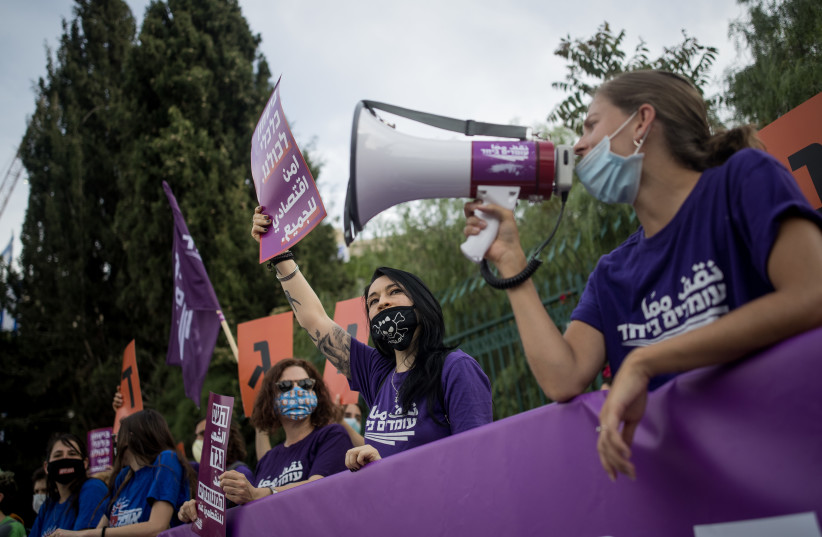
Noise, amplified by a megaphone, greeted my ears. A group of no more than 20 protestors was gathered opposite the hotel, with police observing near the hotel’s entrance. They were from Standing Together, a progressive group (not to be confused with the newer Place for Us All party, although their T-shirts were a similar shade of purple). Their slogan was “No silence in the face of ethnic cleansing,” and, for a moment, I needed to contemplate.
Were they talking of removing clay sherds, jewelry, pits, and other remnants from ancient days from the ground?
Googling, I learned that they desire “peace and independence for Israelis and Palestinians, full equality for everyone in this land, and true social, economic, and environmental justice.” They think that the “occupation is corrupting academe,” that “archaeology is serving Messianism,” and “research is serving transfer.”
I was aware that the Emek Shaveh NGO also works “to defend cultural heritage rights and to protect ancient sites as public assets that belong to members of all communities, faiths and peoples.” They “object… that the ruins of the past have become a political tool in the Israeli-Palestinian conflict.”
Emek Shaveh seems to have a strong financial peace chest. NGO-Monitor found that it received NIS 11,474,455 from foreign governmental bodies in 2015-2025 and, during 2020-2023, donations from foreign governments comprised 81% of its total donations. For example, in 2020-2022, Emek Shaveh received €292,091 from the European Union for “safeguarding the indigenous heritage in public spaces.”
200 years of archeology in Israel
Think about that. To prevent Israel from engaging in the scientific labor of archaeology in Judea and Samaria, the Jewish people’s heartland, they require funding from countries thousands of kilometers away that truly colonized others. And Standing Together sees in excavating historical sites a form of ethnic cleansing instead of an act of proving that Jews in Hebron or Shiloh are not in some foreign land but are at home.
If their goals were worthy, why not demonstrate at other, similar conferences or cause them to be boycotted? One such gathering is the upcoming International Conference on Archaeological Heritage Conservation. It will be held July 4-5, 2026, in Birmingham, UK, and one of its committee members is Mohammad Reza Naghavi of the University of Tehran.
Another, to be convened July 6-7, is the International Conference on Indigenous Archaeology and Community Heritage in Damascus, Syria. Much ethnic cleansing occurred there recently.
As she explained on Facebook, for example, tour guide Shulie Mishkin felt that the people present at the Jerusalem conference “got right what all the politicians – left and right – get wrong.” It’s not “about who ‘owns’ the land and who can control it…[but] to connect to the land, to learn about it, to feel our deep roots in it, and to respect it.”
Indeed, interest is a key theme.
Archaeology in this country is almost 200 years old. During Napoleon’s march through the country in 1799, his scientific staff recorded ancient ruins and inscriptions and produced drawings of archaeological remains while proceeding through Gaza, Jaffa, Ramle, Acre, Tabor, and the surrounding Galilee region.
Tourists, like John Lloyd Stephens in 1835, came and suggested identifications of biblical sites. Then Edward Robinson, biblical scholar and explorer, arrived in 1838. He is known as the “father of biblical geography.” He altered the study of the land from a religious activity to a more systematic scientific and geographical enterprise.
In 1847–48, US naval commander William Francis Lynch led the first truly scientific expedition of the region, although no digging was involved; rather, measurements of the Jordan River and the Dead Sea were made.
It was the British Palestine Exploration Fund (PEF), founded in 1865, that went underground to discover what centuries of foreign occupation covered up. Next was the 1871–1878 Survey of Western Palestine conducted by Claude Conder and Horatio Kitchener, including a clash with local Arabs near Safed.
Interestingly, the October 1875 attack echoes the nature of the false claims the Standing Together protestors made.
Arab settlers from Algeria, who transferred to Syria as a result of French rule in their country, suspected the British of secretly preparing for foreign, that is, a non-Muslim, occupation. Local leaders exploited these suspicions and stirred up opposition against the surveyors.
Preserving and protecting
The claims hurled at the conference and in general against the Heritage Ministry’s plans for historical sites in Judea and Samaria are rather baseless. Furthermore, they avoid the real issue of who is better at preserving and supervising the archaeology of this land.
Who will properly protect locations from looting or illegal construction upon them? Who will prevent destruction and damage? Who will assure scientific attention to all layers of the country’s history, throughout all the periods of settlement?
We can recall the burning of Joseph’s Tomb in 2000. Even Salah Hussein al-Houdalieh of Al-Quds University, Jerusalem, and Hasan Said Jamal, of the Tourism and Antiquities Police Directorate in Ramallah, in a recent Palestine Exploration Quarterly article, noted: “an unprecedented scale of looting and destruction of archaeological sites in the West Bank… for personal financial gain.”
Cultural heritage is crucial to a people’s identity. The protestors, in their overzealousness and one-sided partisan stance, are harming the Jewish factor of the Land of Israel in favor of their subjective political goals of creating a Palestine.
Let all dig, in all places, and assure all finds are protected.
The writer is a researcher, analyst, and commentator on political, cultural, and media issues.