
There is an old saying: insanity is doing the same thing over and over again while expecting different results.
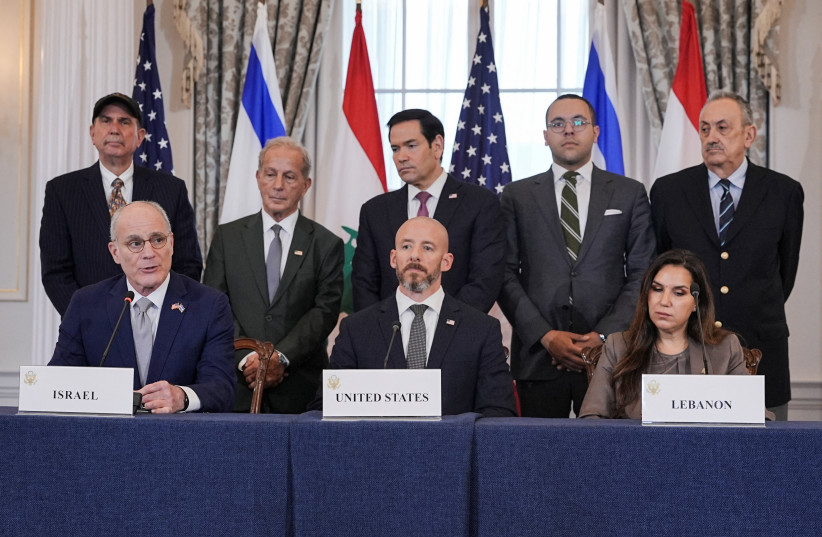
As Israel, Lebanon, and the United States celebrate their newly signed Trilateral Framework, Israelis naturally ask whether this agreement marks a genuine turning point – or whether we have simply returned to familiar ground.
After nearly three decades in which Hezbollah has dominated southern Lebanon, no reasonable person should oppose an opportunity for peace. Jewish tradition teaches us to seek peace, and every Israeli who has lived under the threat of rockets would welcome the day when our northern border is known for tourism rather than bomb shelters.
The question is not whether peace is desirable.
The question is whether this agreement has learned the lessons of the past.
The shadow hanging over every discussion of this framework is the United Nations Security Council Resolution 1701.
Adopted in 2006 after the Second Lebanon War, Resolution 1701 promised many of the same objectives we are hearing today: the Lebanese government would exercise sovereignty over its territory. Armed groups would not operate south of the Litani River. The Lebanese Armed Forces would deploy throughout the south. An international force would monitor compliance. Israel’s northern communities would finally enjoy security.
On paper, it sounded convincing.
In practice, Hezbollah transformed itself into perhaps the most heavily armed non-state military force in the world. It dug tunnels, stockpiled precision-guided missiles, embedded itself deeper into civilian communities, and effectively became a state within a state. UNIFIL watched. The international community issued statements. Israel absorbed the consequences.
That history demands humility from everyone now praising the new agreement.
Yet this framework is not simply a reprint of Resolution 1701.
There are meaningful differences.
Unlike previous arrangements, Lebanon explicitly committed to the complete and verified disarmament of all non-state armed groups. American financial and military assistance has been tied to measurable performance rather than unconditional support. Israel’s redeployment was described as a phased process linked to implementation rather than an arbitrary deadline.
The agreement repeatedly affirmed that only the sovereign Government of Lebanon has the authority to make war or peace and that no armed organization may exercise that power independently.
Those are not insignificant improvements.
Heading
Just as importantly, Israel entered these negotiations from a far different position than it did 20 years ago.
Hezbollah has suffered severe military setbacks. Iran’s regional strategy has been challenged in ways that seemed unimaginable only a short time ago. Lebanon itself has paid an enormous price for allowing an Iranian proxy to dictate its future. Many Lebanese citizens understand that their country’s prosperity will remain elusive so long as Hezbollah retains its independent military power.
Those realities have created an opportunity that did not previously exist.
Still, opportunities are not guarantees.
The framework repeatedly refers to a Security Annex that has yet to be made public. That document may ultimately determine whether this agreement succeeds or joins the long list of well-intentioned failures in the Middle East.
Who determines whether Hezbollah has truly disarmed?
How is compliance verified?
What happens if violations are discovered?
What consequences follow if Lebanon fails to meet its obligations?
Can Israel act immediately to defend itself, or must it first seek international approval?
Until those questions are answered, “verified disarmament” remains more an aspiration than an operational plan.
History teaches that words alone do not prevent wars.
Verification does.
Enforcement does.
Credible consequences do.
Israel also cannot forget the central lesson of Jewish sovereignty. No foreign government – however friendly – can assume responsibility for defending Israel’s citizens.
American presidents change. International priorities shift. Diplomatic enthusiasm fades. But the obligation to protect Kiryat Shmona, Metula, Shlomi, and every Israeli community along the northern border will always belong to the state of Israel.
That is not a rejection of diplomacy.
It is recognition of reality.
There is genuine cause for cautious optimism. Lebanon may have perhaps its best opportunity in decades to reclaim its sovereignty from Hezbollah and to become a normal neighbor rather than a launching pad for Iranian aggression. If its leaders seize that opportunity, Israelis should welcome the development wholeheartedly.
Hope, after all, has always been part of the Zionist story.
But hope is not a security strategy.
Israel should support every sincere effort to achieve lasting peace with Lebanon. At the same time, it must insist that promises be verified, obligations be enforced, and experience – not wishful thinking – guide its decisions.
The people of Israel deserve nothing less.
The writer is an attorney and the father of Alisa Flatow, who was murdered in an Iranian-sponsored Palestinian terrorist attack in 1995. He is the author of A Father’s Story: My Fight for Justice Against Iranian Terror (now available in an expanded paperback edition on Amazon.com) and is the president of the Religious Zionists of America-Mizrachi. An oleh chadash, he divides his time between Jerusalem and New Jersey.