
Last week, as the world marked the International Day for the Elimination of Sexual Violence in Conflict, governments, United Nations bodies, and international human rights institutions gathered in Geneva to reaffirm their commitment to survivors.
I was there, at the invitation of UN Watch, to deliver a speech to the Human Rights Council and bring forward the findings of the Civil Commission’s historical archive and landmark report, “Silenced No More,” documenting the sexual atrocities committed by Hamas and other Palestinian terrorist organizations during the October 7 attacks and the ongoing abuse endured by hostages in captivity.
Before I traveled to Geneva, many have asked me why.
Why bring the voices of Israeli victims to institutions that have too often struggled to acknowledge their suffering? Why enter rooms where some may have already decided what they are willing, or unwilling, to hear?
Carrying victims' stories
My answer is simple.
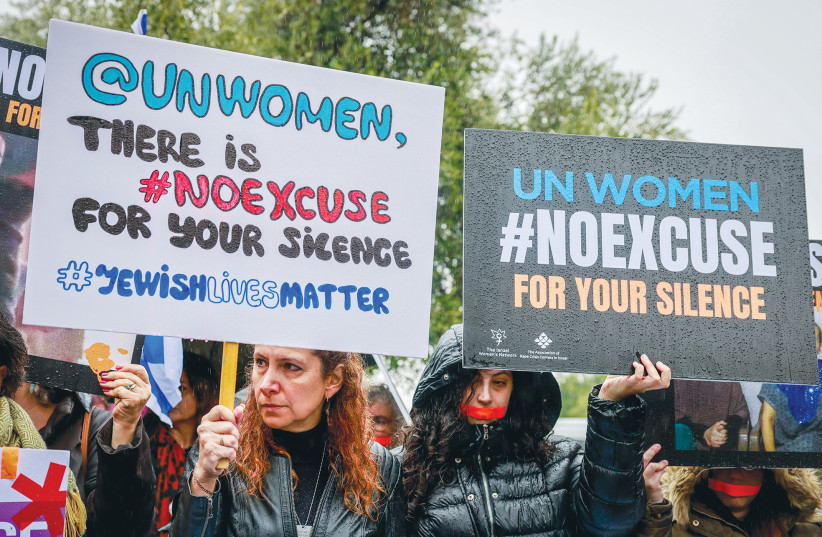
I went because truth matters. It matters most especially where it is contested. Because victims of sexual violence deserve to be heard wherever human rights are discussed. Because the measure of our commitment to human dignity is not how we respond to suffering that fits comfortably within existing narratives, but how we respond when it challenges them.
For more than two years, the Civil Commission has worked to document the suffering of those who endured unimaginable brutality. This painstaking effort was never solely about accountability. It was about preserving the historical record in the face of denial, distortion, and doubt, and ensuring that victims’ voices would not be lost to silence or inaction.
As former Supreme Court of Israel chief justice Aharon Barak remarked after reviewing the report, this may become one of the most important historical documents assembled on these crimes.
As no single tribunal or judicial proceeding, he noted, could fully capture the scope and human reality of what occurred, this comprehensive account bears unique significance. Its value extends beyond the present moment. History requires witnesses, and when victims can no longer speak for themselves, documentation itself becomes an act of justice.
We undertook this work because many of the victims whose stories appear in our report were silenced forever, and others continue to live with profound trauma. Some remain haunted by experiences of captivity and abuse.
Their suffering imposes a responsibility on all of us.
When victims cannot testify, we must carry their stories. Everywhere.
Geneva reminded me that it is more than a city. It is a symbol. It is one of the places where the world has pledged to defend human dignity, protect the vulnerable, and uphold universal rights.
As I said there, if those principles are truly universal, then they must apply to all victims. If women’s rights are universal, then Israeli and Jewish women are not an exception to that universality, and we will be there to ensure that their voices are heard.
Ensuring human rights are universal
Over the past two years, too often, I have watched individuals speak the language of human rights while denying empathy to Israeli victims, or invoke the language of peace while tolerating calls for Israel’s destruction.
That is neither a vision of peace nor a commitment to human rights. Peace cannot be built on the denial of other people’s right to exist, and human rights cannot remain universal if they are used to silence and exclude victims.
Such contradictions do not advance peace. They deepen hatred and undermine the values they claim to uphold.
True peace requires something far more difficult: it requires compassion. It demands a deep respect for the dignity and rights of all people. It represents the courage to imagine coexistence rather than elimination. Above all, it must be built on a foundation of care for one another, hope for future generations, and a shared, genuine commitment to our common humanity.
Compassion is not weakness. It is the foundation of human rights. It is the ability to recognize suffering without hesitation, to extend empathy without conditions, and to defend victims regardless of politics, nationality, religion, or identity.
In this sense, the aftermath of October 7 exposed profound failures within the international human rights system. Institutions and mechanisms created to give voice to victims too often hesitated, remained silent, or failed to respond with the moral clarity the moment demanded. Some actively abused the global system from within. Those failures continue to reverberate across our region and beyond.
Yet the answer to failure cannot be despair. Across the world, countless victims continue to suffer from violence and persecution. Their stories still need witnesses, and their rights still require defenders.
That is why we will continue to speak these truths, even where they are inconvenient. We will continue to insist on the dignity of every victim. And we will continue to choose compassion, even in the face of those who seek our destruction.
I believe that compassion is not only a moral principle but also an act of resistance against hatred itself. It offers an alternative to cycles of violence and creates the possibility of a more hopeful future.
This is where repair begins.
I believe change is coming. We are creating it.
The writer is a 2024 Israel Prize laureate, an expert in human rights and international law, and the founder and chair of the Civil Commission on October 7th Crimes by Hamas against Women and Children.
After October 7, she represented the Israeli women’s rights movement at the United Nations and is the recipient of the Peres Center for Peace and Innovation’s Medal of Distinction.