
This year, the Fourth of July not only marks the 250th anniversary of the United States’ Declaration of Independence. It also commemorates a turning point in Western religious history, one that provided a blessing to Jews worldwide.
Eight years after the American Revolution ended and three years after the Constitution was ratified, the new nation in 1791 added the Bill of Rights, the Constitution’s first 10 amendments. The first, among other things, prohibited any single religion from receiving state support or favor.
“Congress shall make no law respecting an establishment of religion, or prohibiting the free exercise thereof,” states the First Amendment. That clause not only made religious liberty a fundamental right immune from royal fiat. It enabled Jewish immigrants to escape European persecution and build new lives without sacrificing their religious identity.
Those immigrants followed the transatlantic course British Christians took in fleeing the Church of England and its royal patrons. Calvinists established the Plymouth and Massachusetts Bay colonies in 1620 and 1628, respectively. Cecil Calvert created Maryland as a Catholic haven in 1632. William Penn followed by founding Pennsylvania in 1681. Though Penn started the colony for his fellow Quakers, he extended religious liberty to all Christians and Jews.
About 50 years before Penn arrived, Roger Williams fought fellow Calvinists in Massachusetts Bay over the symbiotic relationship between his fellow clergy and the colonial government, which enforced church doctrine at the expense of personal conscience. That activism motivated John Winthrop, the colony’s founder and governor, to expel Williams for heresy and subversion in 1636.
Williams responded by founding Providence Plantations, which eventually became Rhode Island, the first colony not to link its government to a particular religion. Any group, including Jews, could worship freely. As a result, Providence Plantations became one of the fastest-growing colonies.
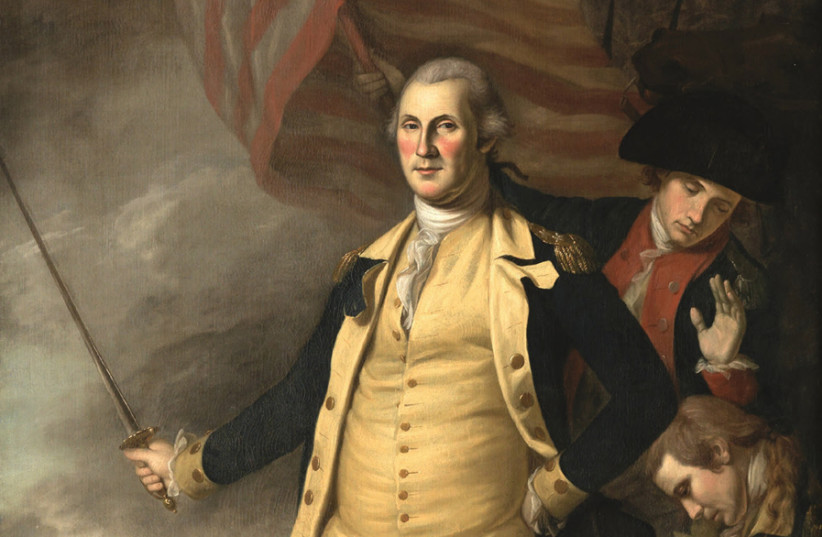
So it was natural in 1790 for Rabbi Moses Seixas, a synagogue leader in Newport, to express his support to President George Washington in a letter. Excerpts from Washington’s response revealed the values for which his troops fought.
“The Citizens of the United States of America have a right to applaud themselves for having given to mankind examples of an enlarged and liberal policy: a policy worthy of imitation: All possess alike liberty of conscience and immunities of citizenship,” he wrote. “It is now no more that toleration is spoken of, as if it was by the indulgence of one class of people, that another enjoyed the exercise of their inherent natural rights.”
Washington added that his new government would provide “to bigotry no sanction, to persecution no assistance.”
Migration of Jews to America
European Jews reacted dramatically. The United States’ Jewish population exploded from about 2,500 in 1800 to nearly 280,000 in 1880. Immigration played an even bigger role during the ensuing five decades, when the Jewish population surged to more than 4 million Americans in 1927.
By the early 20th century, Jews had become such strands in the American fabric that a prominent Jewish philanthropist opposed the nascent Zionist movement. Jacob Schiff, who emigrated from Germany as an 18-year-old in 1865 and entered banking, told the Jewish Telegraph Agency in 1907 that Jewish immigrants should embrace their new homeland.
“Speaking as an American, I cannot for a moment concede that one can be at the same time a true American and an honest adherent of the Zionist movement,” he said. “The Jew should not for a moment feel that he has only found ‘asylum’ in this country. He must not feel that he is in exile and that his abode here is only a temporary or passing one.”
At that time, the Ottoman Empire owned the territory that would constitute the future Israeli state. More than a century later, the Ottomans’ religious descendants pose a sober threat to American religious liberty.
Islamophobia and Democratic leaders
As New York’s Democratic primary proved on June 23, such Muslims as New York Mayor Zohran Mamdani, Cenk Uygur, and Hasan Piker (the latter two of Turkish ancestry) joined the Democratic Party’s radical socialists in an alliance that regards the nation’s political values with contempt.
Like their socialist allies, all three oppose the joint Israeli-American attacks against Iran. All three define Hamas and Hezbollah as legitimate “resistance” to alleged Israeli “genocide” and support a “free Palestine” while downplaying or ignoring the atrocities of October 7.
Yet behind their progressive facade lie disturbing connections. The Council on American-Islamic Relations (CAIR), a front for the Muslim Brotherhood, works extensively with Uygur and supports Mamdani vigorously. Political action committees linked to CAIR gave about $120,000 to his mayoral campaign.
All three dismiss criticism of immigration, concerns about imposing Sharia law, or increasing antisemitic tension in heavily Muslim areas such as Dearborn, Michigan, as “Islamophobic.”
Moreover, Mamdani belongs to the Shia Twelver sect that rules Iran. His allies include imams who either support terrorists or demand Israel’s destruction. Piker’s extremism is more blatant. He declared that “Hamas is a thousand times better than a fascist settler colonial apartheid state” and that “America deserved 9/11, dude.”
No wonder the United Kingdom banned both Piker and Uygur – Piker’s uncle – from speaking there.
Though Piker and Uygur promote themselves as secular, they could be employing the Islamic tactics of taqiyya and kitman to infiltrate and sabotage the Democratic socialists. Both involve strategic deception to facilitate a takeover that would promote Islam. Mamdani appears to have used that approach to win support from fellow Democratic socialists.
“Taqiyya is my religion and the religion of my forefathers,” wrote Ayatollah Ruhollah Khomeini.
Iran illustrates the ultimate fate of a revolutionary alliance between leftists and Islamists. Both helped depose Shah Mohammed Reza Pahlavi in favor of Khomeini, who endorsed women’s rights, democracy, and freedom of expression to Western media while in exile. But once he secured power, Khomeini imprisoned and executed the leftists who helped him.
While many Americans view their Independence Day more as relaxation than reflection, George Santayana’s words provide a powerful warning: Those who do not remember the past are condemned to repeat it.
The author is a freelance writer from California who publishes on religion and morality.