
When US President Donald Trump recently declared that Saudi Arabia and Qatar should join the Abraham Accords “immediately” and suggested that even Iran could eventually become part of a broader regional framework, many dismissed the remarks as political theater. Sen. Lindsey Graham’s suggestion that a future US-Iran understanding could complement, rather than undermine, the accords appeared equally ambitious.
However, beneath the rhetoric lies a more consequential question: Five years after their signing, what exactly have the Abraham Accords become?
Most discussions still treat the accords primarily as an Arab-Israeli normalization initiative, with success measured by one simple metric: who joins next. Saudi Arabia dominates the conversation, while Qatar, Oman, and Kuwait are assessed according to their respective political constraints. But this has become the wrong question.
The Abraham Accords are entering a second phase. Their long-term significance will depend less on attracting additional signatories than on whether they can evolve into something more ambitious: an informal framework for regional governance.
What began in 2020 as a diplomatic breakthrough has steadily expanded into cooperation on artificial intelligence, cybersecurity, logistics, renewable energy, food security, tourism, maritime connectivity, higher education, and investment. Increasingly, the accords are about creating networks of economic, technological, and institutional cooperation rather than simply exchanging ambassadors.
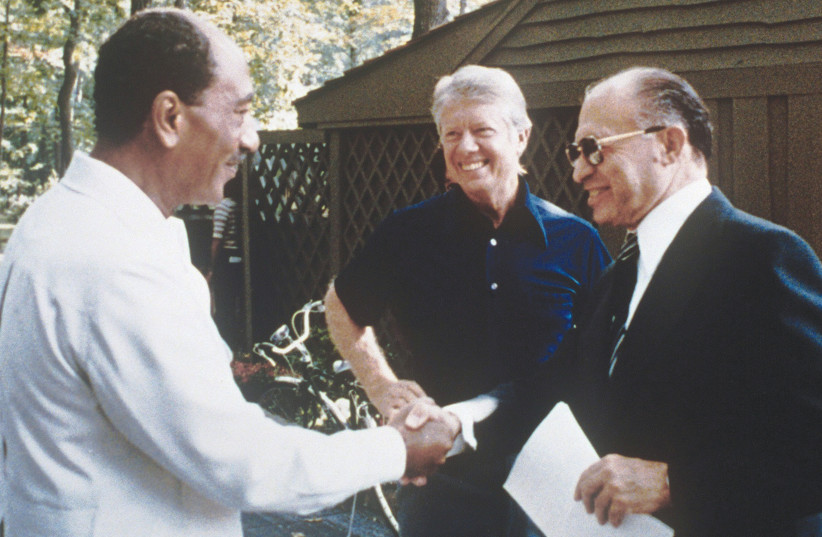
That evolution makes them fundamentally different from both earlier Arab-Israeli peace treaties and conventional bilateral relationships. Egypt’s 1979 peace treaty and Jordan’s 1994 agreement normalized relations with Israel but remained largely bilateral arrangements.
The Abraham Accords instead provide a common political umbrella through which multiple governments, sovereign wealth funds, businesses, universities, investors, and research institutions can cooperate simultaneously. Their comparative advantage lies not merely in diplomatic recognition but in creating an ecosystem of regional connectivity that no collection of bilateral agreements could easily replicate.
Ironically, that success has also made the accords more politically vulnerable. As they have expanded beyond diplomacy into economics, technology, and governance, they have become increasingly entangled with the Middle East’s unresolved fault lines, above all the Palestinian question, the future of US-Iran relations, and the search for a more sustainable regional order.
Trump’s renewed enthusiasm for enlargement reflects a broader American objective. Expanding the accords would strengthen a regional network of partners capable of cooperating on trade, technology, intelligence, investment, and maritime security while allowing Washington gradually to reduce its own military burden in the region. Enlargement would also reinforce one of Trump’s most significant foreign policy achievements and frame any future accommodation with Iran not as a concession but as part of a wider strategy of regional stabilization.
But the political environment that made the Abraham Accords possible in 2020 no longer exists.
Challenges facing the agreements
The central assumption underpinning the original agreements, that normalization could advance while the Palestinian issue remained largely compartmentalized, has become increasingly difficult to sustain after Gaza. The war returned Palestinian statehood to the center of Arab diplomacy, forcing governments to balance growing strategic and economic ties with Israel against renewed domestic and regional demands for meaningful political progress.
Saudi Arabia best illustrates this shift. Before the Gaza conflict, Riyadh appeared to be moving cautiously toward normalization as part of a broader strategic bargain with Washington. Today, Saudi leaders continue to acknowledge the potential benefits of closer relations with Israel, but they have made clear that normalization requires an irreversible pathway toward Palestinian statehood.
The issue is no longer whether Saudi Arabia sees strategic value in joining the accords; it is whether normalization can be politically legitimized without addressing the Palestinian question.
Other Gulf states highlight different constraints. Qatar’s value lies in its ability to mediate among actors that rarely communicate directly with one another, making formal normalization potentially costly to its diplomatic role.
Oman’s long-standing policy of strategic neutrality similarly discourages alignment with initiatives perceived as favoring one regional bloc.
Kuwait, meanwhile, demonstrates that foreign policy remains inseparable from domestic legitimacy. Even after suspending parliament, its leadership continues to operate within a political culture where support for the Palestinian cause remains deeply entrenched.
Taken together, these cases point to a broader reality. Future enlargement will depend less on whether Arab governments recognize the economic and strategic advantages of engagement with Israel – most already do – than on whether they can persuade their own societies that normalization advances, rather than sidelines, Palestinian aspirations.
The first phase of the Abraham Accords demonstrated that Arab-Israeli normalization was possible without first resolving the Palestinian conflict. Their second phase will test whether normalization can remain politically sustainable without eventually confronting that conflict.
A framework for regional governance
What is often overlooked in debates about enlargement is that the Abraham Accords have already begun to change the way regional cooperation is organized. They are no longer simply an Arab-Israeli normalization initiative. Increasingly, they resemble an emerging, albeit informal, framework for regional governance.
Their importance today lies less in diplomatic recognition than in creating a common platform through which governments, sovereign wealth funds, technology companies, universities, investors, and research institutions cooperate across multiple sectors.
The practical consequences are already visible. Cooperation has expanded well beyond diplomacy into artificial intelligence, cybersecurity, renewable energy, food and water security, healthcare innovation, digital infrastructure, logistics, tourism, venture capital, and maritime connectivity.
These are not peripheral projects. Across the Gulf, economic diversification, technological competitiveness, and supply-chain resilience have become central components of national security strategies. The Abraham Accords increasingly provide a mechanism through which participating states pursue these shared priorities without requiring a highly institutionalized regional organization.
This evolution also explains why the accords have proven more resilient than many anticipated. Traditional peace agreements depend largely on the political relationship between two governments and often stagnate when diplomatic relations deteriorate.
The Abraham Accords, by contrast, are gradually generating a broader ecosystem of stakeholders. As investment grows, research partnerships deepen, tourism expands, and private sector collaboration becomes institutionalized, governments are no longer the only actors invested in preserving stability. Business communities, universities, financial institutions, technology firms, and civil society organizations all acquire tangible interests in maintaining cooperation.
That does not mean the framework has become a comprehensive regional security architecture. The Abraham Accords were never designed to become NATO for the Middle East. Their comparative advantage lies elsewhere. They cannot resolve Israeli-Iranian rivalry, negotiate Palestinian statehood, or provide collective defense guarantees against regional threats. Nor were they intended to.
Their strength lies in lowering political barriers to cooperation in areas where interests increasingly converge, creating habits of collaboration that can gradually strengthen regional resilience even as geopolitical competition persists.
This distinction matters even more in the aftermath of renewed US-Iran diplomacy. If Washington succeeds in reducing tensions with Tehran while encouraging deeper cooperation among its regional partners, the Abraham Accords are unlikely to become the defining security institution of the Middle East.
Instead, they may evolve into one pillar of a more complex regional order, one in which economic integration, technological innovation, and institutional connectivity complement, rather than replace, traditional diplomacy and security arrangements.
Whether that vision is realized, however, depends on resolving a fundamental contradiction. The accords have demonstrated that normalization can generate significant economic and strategic dividends. Yet their continued expansion increasingly depends on political legitimacy.
As the war in Gaza demonstrated, economic cooperation alone cannot insulate regional diplomacy from the unresolved Palestinian question. Prospective members must convince domestic audiences that engagement with Israel advances regional stability without abandoning Palestinian aspirations. Existing members must demonstrate that normalization provides leverage for diplomacy rather than simply rewarding the status quo.
Ultimately, the future of the Abraham Accords will not be determined by how many additional countries sign on. It will be determined by whether the framework can reconcile two competing realities: the region’s growing demand for economic integration and technological cooperation, and its enduring demand for a credible political horizon for the Palestinians.
The writer is a geopolitical analyst based in Dubai. He previously worked as a senior fellow and lead researcher at the Rabdan Security & Defense Institute, and as a senior fellow at Trends Research & Advisory, and before that as an assistant professor at the College of Humanities and Social Sciences at Zayed University in Abu Dhabi, UAE.