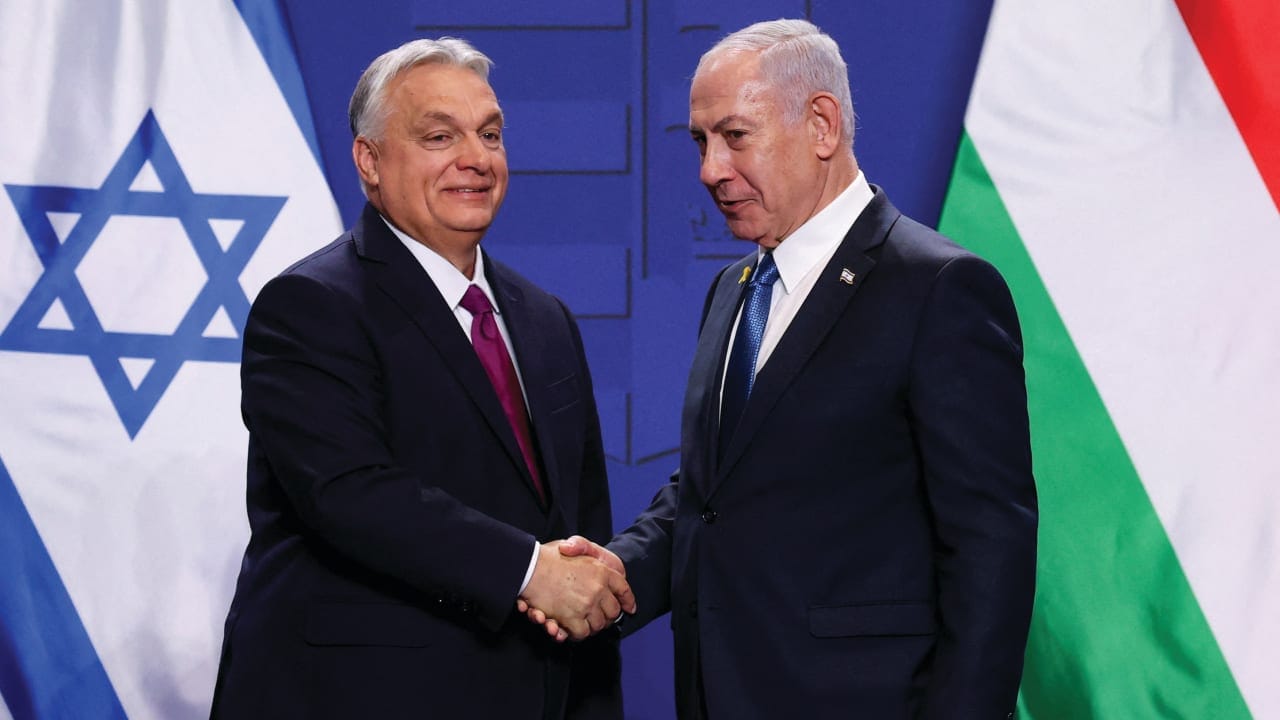
Viktor Orbán was Hungary’s version of Prime Minister Benjamin Netanyahu – a leader who pitted “the people” against “the elites,” the experts, and when necessary, the facts.
He persuaded the gullible to despise the courts and the institutional gatekeepers that protect their rights – the whole populist catastrophe. After nearly 20 cumulative years in power, many Hungarians could scarcely imagine the day he’d no longer be there.
Eventually, however, the opposition united behind an effective campaigner, Péter Magyar, who successfully channeled public exhaustion with corruption and poor governance. Three months before the election, polls showed Orbán trailing by some 20 points. He continued his campaign of falsehoods, but otherwise behaved like a conventional politician.
When he lost, in April, just as the polls had predicted, he conceded defeat and quietly went home. The new government immediately began dismantling the damage Orbán had inflicted, to cheers. A happy ending.
Can anyone realistically imagine such a scenario unfolding in Israel?

Today, Netanyahu’s bloc trails by roughly 20 seats – a similar gap. (Do not be confused; the Arab parties have always belonged to the anti-Likud camp.) The odious legislation pushed through in recent weeks has hurt Netanyahu politically, yet he appears oblivious.
Something doesn’t add up. Is this brilliant politician tired and unwell? Will he simply accept defeat? Almost nobody expects that. While opinions differ widely over how far he would be willing to go to avoid an “Orbán scenario” – the gentlemanly option is not one most Israelis associate with Netanyahu.
The baseline expectation is an all-out campaign against a “change government” dependent on Arab parties. As reasonable as that may sound to many Israelis, it’s worth recalling that with the sole exception of the unusual 2006 election following Ariel Sharon’s incapacitation, the Israeli Center-Left has never reached 61 seats – not even in Yitzhak Rabin’s 1992 victory – without passive Arab party support. It would be equivalent to Likud winning a majority without religious parties; an unprecedented sensation.
Expect efforts to disqualify Arab parties on the grounds that they are insufficiently Zionist. (Are the haredim Zionist? Not exactly. Is such a requirement democratic? Certainly not.) This spectacle repeats itself almost every election cycle, and each time the Supreme Court overturns the Central Elections Committee’s decision. It would also provide yet another opportunity to incite against the Supreme Court.
Expect more familiar ideas to arise: surveillance cameras around polling stations in Arab towns, efforts to intimidate voters, and attempts at suppression. Make no mistake: Netanyahu’s greatest advantage would come if Arab citizens simply stayed home altogether.
This could become turbocharged if the opposition wins but still falls short of 61 seats without Arab parties – a plausible scenario. Netanyahu would relentlessly attack Gadi Eisenkot while goading Avigdor Liberman into not supporting a “minority government.” Simultaneously, of course, he’d likely try to lure Arab parties into his coalition, as he tried to do with Ra’am in 2021. Hypocrisy is not a problem.
The next rung on the escalation ladder would resemble US President Donald Trump’s response to losing the 2020 US election: full-scale assault on the count. Expect an avalanche of false fraud allegations flooding the courts, with focus on Arab communities and opposition strongholds.
The objective would be undermining the incoming government’s legitimacy so severely that Netanyahu might remain at the head of a caretaker government – or even force the creation of a national unity government. Led by him, naturally.
So far, so unsportsmanlike, but nothing really new. But if matters escalated toward something resembling January 6, 2021 – when a mob of Trump supporters stormed the US Capitol, leading to several deaths – it would take on a criminal character. Yet if it worked for Trump, why not here? They’d hope to prevent the Knesset vote confirming the new government – the equivalent of blocking Congressional certification of the Electoral College.
From there we arrive at a possibility that’s both shocking and strangely common in public discourse: a manufactured security crisis with multiple goals. One would be shifting public opinion.
Imagine Hamas laying down its arms, or the Iranian regime collapsing as a consequence of Israeli military action. Such developments might appear legitimate until one recognizes that the government gambled with Israeli lives in a bid for political gain. Still, national interests may be served, however cynical the path.
Another benefit would be diverting public attention from the past weeks’ legislative blitz that most Israelis oppose – foremost among them the laws shielding ultra-Orthodox men from military service (plus laws encouraging gender segregation in higher education, weakening the media, weakening the rule of law, and more). A crisis could return the campaign to the security arena where Netanyahu’s offenses against Zionism are, in the eyes of some, less glaring.
Staying on high alert
At the farthest end of the spectrum lies a crisis so profound that elections themselves might be postponed, consistent with principles outlined last month by the Supreme Court’s Noam Sohlberg. The first condition he identified was a situation in which free and fair elections simply cannot be conducted.
In this context, it is worth recalling May 2021, when violent clashes erupted between Jews and Arabs, fueled by murky provocations by Arab criminals. The immediate political consequence was that Naftali Bennett abandoned his initial effort to join Yair Lapid in forming a change government supported by Ra’am, returning the mandate to Netanyahu. A benefit, if short-lived (Bezalel Smotrich scuttled a deal with Ra’am).
I write this knowing I’ll be accused of hysteria, but it would take only a wink for organized crime groups currently flourishing within Arab society to carry out terrorist attacks capable of igniting the streets and mobilizing Itamar Ben-Gvir’s armed supporters. It is not difficult to imagine weeks of Jewish-Arab riots across the country – a crisis fitting perfectly the conditions Sohlberg described.
Yes – though many suspect Netanyahu might launch a war to improve his electoral prospects, few believe he would deliberately ignite a full-scale internal Intifada.
Amichai Eliyahu of Otzma Yehudit recently dismissed such speculation in a radio interview as “mean-spirited and stupid.” Moments later, MK Efrat Rayten argued that “with Netanyahu, anything can happen,” because the national interest means nothing to him.
Who’s right? It doesn’t strike me as far-fetched to believe this government might seek to prevent genuinely fair elections. One need not literally falsify vote counts but just manufacture chaos, creating circumstances in which frightened voters flock back to the governing camp or conclude that voting has become pointless.
And yes, widespread Jewish-Arab violence could fundamentally reshape the climate. It could radicalize Jewish voters, drive wavering voters back toward the Right, and render cooperation with Arab parties politically toxic. It would be irresponsible to claim, without evidence, that Netanyahu is planning to provoke such violence. But it would be foolish to pretend there are no cynical political actors who could benefit from chaos.
What’s undeniable is that few expect Netanyahu to simply march into the political abyss, as Orbán did. Perhaps some other path will emerge – a resignation, a desperate last-minute plea bargain. Either way, Israel’s democratic camp must remain on high alert. So must the president. Let us not be naive.
The writer is the former Cairo-based Middle East editor and London-based Europe/Africa editor of the Associated Press, the former chairman of the Foreign Press Association in Jerusalem, and the author of two books.