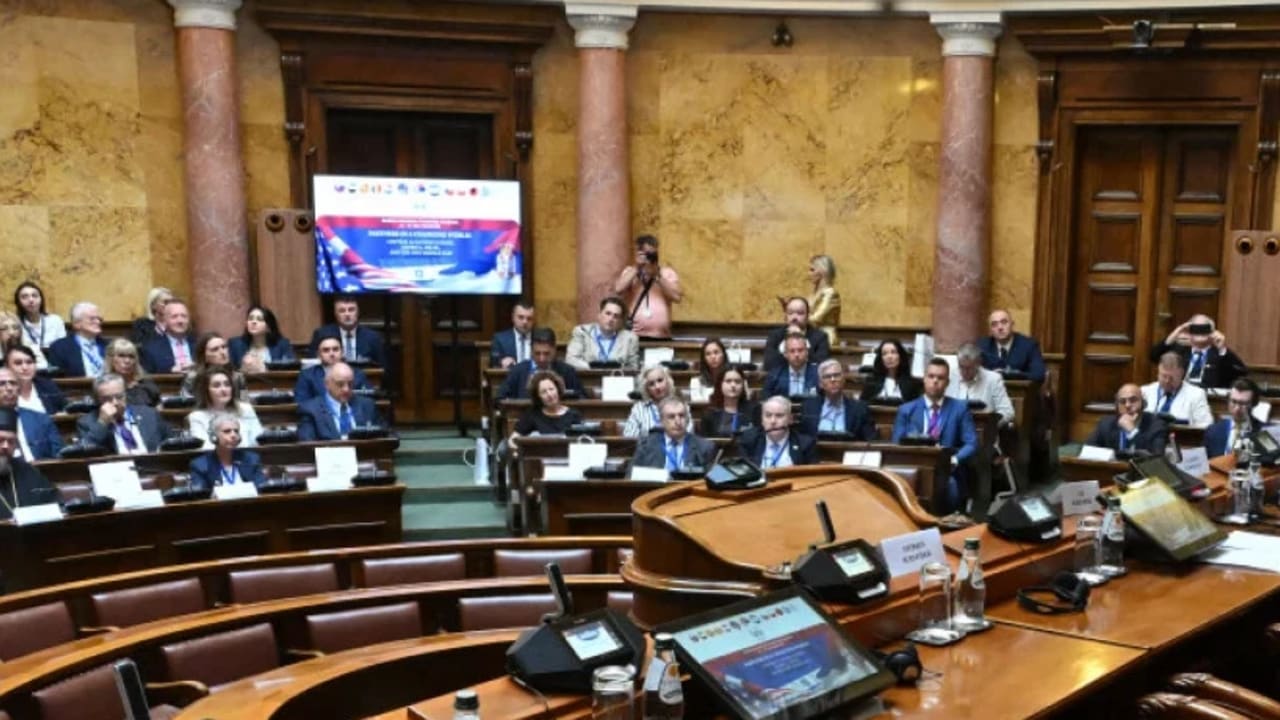
The highest level of bilateral relations ever between Israel and Serbia is also resulting in important multilateral events that convey significant messages.
One such event was held at the National Assembly in Belgrade on the eve of the launch of a strategic dialogue between Serbia and the USA, while a similar dialogue is already underway between Israel and Serbia.
Political leaders, security experts, Holocaust scholars, business executives involved in innovation ecosystems, and faith leaders from Israel, the United States, and across Central and Eastern Europe (CEE) participated in a three-day conference titled "Partners in a Changing World: Central & Eastern Europe, America, Israel, and the New Middle East."
The conference, hosted by the Serbian-American Friendship Congress under the patronage of parliamentary President Ana Brnabić, featured an exceptional roster of speakers. Lee Rosenberg, President Emeritus of the American Israel Public Affairs Committee (AIPAC), led the opening fireside chat on the US-Israel alliance and its significance for Central and Eastern Europe.
He explained in compelling detail why the United States and Israel have the closest possible strategic partnership, how Israel contributes directly to the advancement of American interests through intelligence sharing, military cooperation, and technology innovation, and argued forcefully that CEE nations that deepen their partnership with Israel simultaneously strengthen their relationship with the United States.

<strong>Israel and Serbia expand ties through landmark Belgrade summit</strong><br>
"We hope there will be more members of Congress who understand how important Serbia is for the United States," Rosenberg said, expressing support for deeper strategic dialogue between Washington and Belgrade.
Video remarks were delivered by President Isaac Herzog, Foreign Minister Gideon Sa'ar, and Knesset Speaker Amir Ohana. President Herzog praised Serbian President Aleksandar Vučić for supporting Israel "in both words and deeds" after October 7, and commended his "long-term understanding of geopolitical events in the Middle East."
He also emphasized that Jews and Serbs are bound by joint suffering and shared tragedy.
Foreign Minister Sa'ar declared that "true friendship is shown in difficult times" and that "the Israeli people will never forget the support of the Serbian people after October 7." Knesset Speaker Ohana said that "Israel will never forget Serbia's support and friendship after October 7," noted that President Trump has stood firmly by Israel throughout, and emphasized that the United States, Israel, and Serbia have stood together at this critical moment.
The program addressed four interconnected themes across plenary sessions, panels, and site visits. The first (What Central & Eastern Europe Needs to Know About the US and the Changing Middle East) examined the enduring US-Israel alliance and its strategic implications for CEE. The second (Memory and Moral Leadership, The Holocaust, Genocide, and Historical Accuracy) explored Holocaust memory and historical responsibility in CEE.
The third (Strategic Partners, CEE's Role in Middle East Diplomacy, Security, and the Abraham Accords) assessed the security and diplomatic dimensions of CEE's engagement with the Middle East, including the opportunities created by the Abraham Accords and the implications of the rapidly evolving situation in Iran. The fourth (Innovation and the Start-Up Nation Playbook, What CEE Can Learn from and Build with Israel) examined innovation and economic partnership between Israel and CEE.
The Holocaust memory and moral leadership panel, which the author of these lines had the honor of moderating, brought together Dani Dayan, Chairman of Yad Vashem, who addressed the conference by video and praised Serbia for its role in IHRA and for establishing the Staro Sajmište Memorial Center in Belgrade; Dr. Efraim Zuroff, who served as Director of the Jerusalem Office of the Simon Wiesenthal Center for thirty-nine years; Helise Lieberman, Director of the Taube Center for Jewish Life and Learning in Warsaw; and Dr. Krinka Vidaković Petrov, Director of the Staro Sajmište Memorial Center.
The participants of the panel emphasized how important it is for CEE countries to remember and accurately teach the Holocaust, noting that Holocaust distortion remains a serious challenge in some countries in the region. Vidaković Petrov also criticized the relativization and abuse of the word genocide.
The security and diplomacy panel featured Ilan Berman, Vice President of the American Foreign Policy Council; Jonathan Spyer, Senior Research Fellow at the Middle East Forum; Daniel Moldoveanu, former Director of National Intelligence of Romania; and Zoran Jolevski, former Minister of Defense and former Ambassador to the United States of North Macedonia. Together they assessed the full spectrum of CEE's strategic value to the United States and Israel, examined the Abraham Accords framework and its implications for the region, and addressed the rapidly evolving situation in the Middle East following the breakdown of the US-Iran Memorandum of Understanding.
The innovation and economic partnership panel featured Saul Singer, co-author of Start-Up Nation, well known to readers of the Jerusalem Post - served as the editorial page editor and a columnist from 1996 to 2008- and Wendy Singer, founder of Start-Up Nation Central, alongside Marko Čadež, President of the Chamber of Commerce and Industry of Serbia.
The panel concluded that CEE has strong foundational assets, engineering talent, diaspora networks, and proximity to Israeli and US markets that make it a natural and ready partner for Israel's innovation economy, and that Israel needs what CEE has: engineering talent at scale, manufacturing capacity, European market access, and political reliability. Saul and Wendy Singer argued that Israeli partnerships can and should serve as a bridge to US venture capital and American markets for CEE companies, an underutilized pathway worth developing deliberately, and that this partnership is genuinely bilateral: Israel can benefit enormously by tapping into CEE's strong engineering workforce and expanding its reach into the region's deep pool of innovation talent and ideas.
They urged Serbia to make full use of its hosting of EXPO 2027, which will bring together 150 countries and thousands of commercial actors from around the world to Belgrade, as an opportunity to convene startup leaders from Israel and around the world and accelerate the Israel-Serbia innovation partnership. Čadež provided a vivid account of the Serbia-Israel economic relationship. He noted that the Serbian Chamber of Commerce opened a Representative Office in Jerusalem in 2021, since when bilateral trade between Serbia and Israel has quadrupled.
The conference also featured remarks by the vicar bishop of the Serbian Patriarch and military bishop for the Serbian Armed Forces, Dositej, speaking on behalf of Patriarch Porfirije, who addressed the Judeo-Christian bonds that underpin the partnership this conference was designed to strengthen and the Serbian Orthodox Church's deep and historic connection to the Jewish people and the Land of Israel.
United States Congressional participation included video remarks by Representatives Josh Gottheimer and Tracey Mann, both of whom emphasized the importance of the US-Israel-CEE partnership and commended Serbia for its extraordinary record of support for Israel since October 7, 2023.
The conference concluded with a visit to the Staro Sajmište Memorial Center, connecting the conference's memory session to one of the least known Holocaust sites in Europe. The former Belgrade fairground, built in 1937, was the site of a concentration camp.
Although located within the territory of the Independent State of Croatia, it was established and managed between 1941 and 1944 by German occupation forces in neighboring Serbia, across the Sava River. Initially, it was used to intern Jewish women, children, and old men (Judenlager Semlin, from December 1941 – May 1942) from where they were taken away in gas vans. In its second phase, it was a detention camp for mostly Serb civilians and members of resistance movements.
Serbian-American Friendship Congress President Vladimir Marinković argued that the alliance among Serbia, Israel, and the United States is rooted in common democratic values and shared strategic interests. When UN Special Rapporteur Francesca Albanese came to Belgrade recently to support the anti-government protest movement and accused Serbia of collaborating with Israel "without shame" and of being one of Israel's "strongest and most determined allies," she thought she was issuing a criticism. As Marinković put it: in his view, it was a compliment.
The author is the Honorary Consul of the Republic of Serbia to the State of Israel.