
It has been widely reported that about a third of New York’s Jews voted for Zohran Mamdani, which didn’t surprise me, because most of my oldest and closest friends in New York are in that 33%.
Their choice to vote for him has made me think of the memorable speech in the classic movie, Broadcast News, where the character Aaron Altman (Albert Brooks), a brainy reporter, speaks about a telegenic but dim rival, calling him the devil and saying, “What do you think the devil’s gonna look like if he’s around? Come on, no one’s gonna be taken in by a guy with a long, red pointy tail… He will be attractive, he’ll be nice and helpful, he’ll get a job where he influences a great, god-fearing nation, he’ll never do an evil thing, he’ll never deliberately hurt a living thing. He’ll just bit by little bit lower our standards where they’re important. Just a tiny little bit, just coax along flash over substance. Just a tiny little bit.”
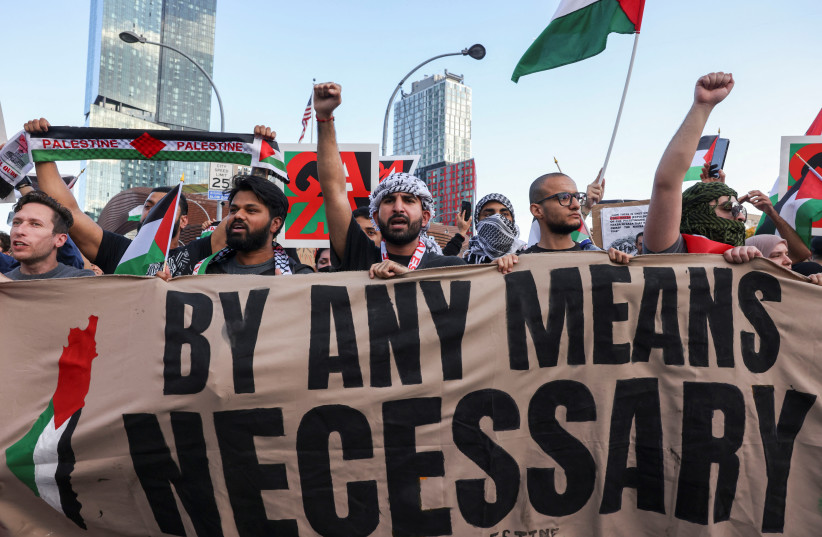
My friends’ awareness of antisemitism has been lowered bit by bit, and now it is virtually non-existent, and they have embraced the seemingly "nice and helpful" Mamdani. The antisemitic tropes Mamdani and those he supports use frequently, sometimes couched as anti-Zionism, sometimes not, don’t bother them. It didn’t upset them recently when Mamdani called American-Jewish lobbyists “monsters” who “move dark money,” nor were they worried when it was reported that before he was elected, he said, “When the boot of the NYPD is on your neck, it's been laced by the IDF.”
They weren’t put off by Mamdani’s October 8 tweet, which did not mention or criticize Hamas, but did call for “an end to occupation and dismantling apartheid.” That he spends much time calling for Israeli Prime Minister Benjamin Netanyahu’s arrest, and never criticizes any other world leader, does not even register with them.
I’ve tried to understand their point of view, and I think the bottom line for them is: If Mamdani is a passionate anti-Zionist, that’s part of his brand, his sincere concern for the underdog. OK, so he won’t condemn the phrase, “globalize the Intifada” – what does that even mean, anyway, and Mamdani is so young and charismatic, with his chic artist-influencer wife, and they looked great celebrating the Knicks’ championship victory. So, she liked a lot of posts that celebrated the rape and murder of thousands of Jews – nobody’s perfect, right?
But what is most upsetting to me is that they seem to have forgotten what I went through on October 7, wondering how my son Danny, who is on the autism spectrum, was coping with the missile attacks on the area where he lives, and worrying about how close the terrorists were getting to his village, which is a bit closer to the Gaza Envelope region than Jerusalem, where I live. They expressed sympathy for our predicament on that day as if it were a natural disaster like a tsunami, not due to deliberate acts of terrorism intended to start a war. To go back to the Broadcast News devil speech, the lowering of their standards “bit by little bit” was well on its way years before Mamdani came on the scene.
'The world around us was filled with Jews'
The people among whom I grew up on the Upper West Side in New York tend to be liberal and politically engaged, and we all had a very secular upbringing. I never attended a Jewish school, although at every school I went to, almost all the white kids were Jewish. New York City public schools were closed on big Jewish holidays. My parents were Zionists, but had never visited Israel, which was common among my friends’ families. Few of my schoolmates had a bar or a bat mitzvah. It never occurred to me that I would have one, and I didn’t learn Hebrew until I was in my 20s.
My parents weren’t rebelling against religion, and all four of my grandparents were not observant; on one side, even my great-grandparents were secularists. We did observe some holidays and saw ourselves as culturally Jewish. Several of my friends were the children of Holocaust survivors and refugees who had made narrow escapes from Nazi Germany. We were not self-hating Jews, but Judaism was just not an important part of our lives. We never experienced antisemitism. I was always told, “There used to be a lot of antisemitism in America, but it’s in the past.” I grew up believing that was true.
The world around us was filled with Jews. Abe Beame and Ed Koch were mayors of New York. Everybody went to Woody Allen and Mel Brooks movies, and Barbra Streisand, Elliott Gould, and Gene Wilder were big movie stars, and Judd Hirsch, Henry Winkler, Gilda Radner and, later, Jerry Seinfeld and Larry David were popular on the small screen.
We listened to Bob Dylan, Simon and Garfunkel, Carole King, Billy Joel, and so many other Jewish musicians. Philip Roth, Norman Mailer, Saul Bellow, and Joseph Heller were among the era’s most acclaimed writers. There were Judaica shops, synagogues, and kosher butchers all over the Upper West Side, although we didn’t frequent them. When we went off to college, between a quarter and a third of the other students were Jewish.
'The bubble' of American Jewry
We didn’t know we were living in a bubble. Maybe you can never see the bubble you’re in until it bursts.

I can see that now. But my friends in the 33% still feel they are living in that bubble. None of them are “visibly Jewish,” and no one they know has been threatened on the street or attacked in a hate crime. So far, professional organizations to which they belong have not asked them about their attitude toward Zionism. Their children went to good colleges and now have good jobs.
Their big issue is President Donald Trump and all he stands for. They go to one or two anti-Trump rallies every year and consider themselves very politically committed. I can’t help comparing this level of engagement to the hundreds of thousands of Israelis who turned out at weekly rallies during the war calling for a ceasefire and the release of the hostages, rallies where speakers often referenced the suffering of Gazans, with some participants holding pictures of children in Gaza who were killed. Not to mention the weekly rallies all around Israel prior to the war, calling for an end to the government’s program of judicial reform.
My friends have told me they know now what it’s like to live in a dictatorship - because of Trump - although when I asked them what they could no longer do because of this dictatorship, they couldn’t answer me.
Although they are well educated and voracious consumers of newspapers and other media, they are selectively ignorant about so many issues that are central to understanding Israel. They know that Israel has been branded as a white colonist enterprise, for example, but don’t know that 800,000 Jews were expelled from Middle Eastern and North African countries in the late 1940s and early 1950s and that most moved to Israel. Nor do they know that more than 30,000 missiles were fired at Israel from Gaza during the years between the time Israel withdrew from the Gaza Strip in 2005 and the present, or even that Israel withdrew from Gaza at all.
An old friend thought I was making a tasteless joke in 2025 when I said that I worried about missile strikes when I drove Danny home from the village in central Israel where he lives during the week. It took time, and I had to send him a few articles before he could believe me. After he understood, his response was simply that I should flee this terrible place immediately – he became hysterical -- and go back to a good place (New York).
That the supposedly terrible place offers a level of care for my son that only the richest Americans can afford seemed to confuse him, and then he dropped the subject. Saying that my son has a good life here is cringe-inducing, since it might put me on the side of uncool people who don’t hate Trump, and against charmers like Mamdani.
A lack of curiosity
The gaps in their knowledge and their lack of curiosity once they become aware of these gaps make it almost impossible for us to talk. I’m not sure they believed me when I told them that most Israelis I know are as eager as Mamdani to see Netanyahu in prison, but on the corruption charges for which he is on trial in Israel, not for the bogus and fashionable genocide allegation that New York’s mayor has repeated. As a quote widely attributed to Mark Twain puts it, “It’s easier to fool somebody than to convince them they’ve been fooled.”
When the wars with Iran started, a few reached out to make sure my family and I were OK, and that was comforting. But many assumed that my main emotion was not fear of Iranian missiles but rage at Trump. To show their concern, they sent me anti-Trump diatribes. They sounded disappointed and bewildered when I expressed anger at the Iranian government.
I understand that rational people can have a disagreement about the wisdom of the US engaging in the war against Iran. I was surprised, though I shouldn’t have been, that my friends would take the “America First” isolationist point of view, or rather a left-wing variant of that view, that the US should never get involved in any conflicts because America is so toxic that any action it takes is evil. That the earlier America First movement made it difficult for their families and millions of other Jews to escape the Nazis is not something they think about today, it seems.
It was also confusing that these friends never, literally never, mentioned that they had problems with the US joining and supporting the coalition to fight ISIS about a decade ago. They did not think that the US and the other countries in the coalition were guilty of genocide because of civilian casualties in Iraq and Syria. It’s hard to imagine them supporting a New York mayor who spent a significant portion of his time accusing the anti-ISIS coalition of genocide in Mosul and Raqqa rather than governing the city. Nor did I hear a peep out of any of them back when the US went to war in Afghanistan and Iraq in the wake of 9/11.
Of course, they were angry when it turned out there had been no weapons of mass destruction in Iraq. But at the time when the US launched those actions, they were fully behind them, thinking them justified because of the Al-Qaeda terror attack on New York. I never heard them, or anyone else, term the hundreds of thousands of civilian deaths in those countries a genocide.
That the Hamas massacre was the equivalent, in population terms, of about 40,000 dead in the US, not in four airplane attacks but one-on-one killings, with about 10,000 taken hostage, has never independently occurred to any of them. When I brought it up, they invariably changed the subject. Nor have they ever wondered why Hamas built hundreds of miles of tunnels beneath Gaza but won’t let civilians take shelter in them during a war.
Conversely, although most of my US friends are outspoken feminists, I have never heard them express outrage at the treatment of women by the Iranian government, during the “Woman. Life. Freedom” protests following the killing of Mahsa Amini in prison after her arrest for improperly wearing her government-mandated hijab in 2022, or at any other time. Nor did they express the slightest compassion for the tens of thousands of Iranian protesters killed in three days in early 2026.
I can understand that they may feel these killings are not a justification for going to war, but I would expect feminists especially to express sympathy for these protesters, most of them the age of our adult children, many of them young women who took off their hijabs. But they don’t.
My friends show little interest when I tell them my daily Israel experience
And while they admire the mayor who condemns Israel for “apartheid,” they show little interest when I tell them that my daily experience contradicts this accusation. The specialist doctor who treats a family member is a Muslim, and most of the doctors who took care of my mother during her many hospitalizations in the last years of her life here were Muslims, as were the police officers who came to her apartment after she died in home hospice care (the police are called whenever someone dies at home). My pharmacist is Muslim. When my son needed an aide to work with him daily in a program, I hired a Muslim graduate student in special education.
On October 7, I heard from Palestinian friends who wanted to know if I was safe and to see how Danny was handling the war. Some of them have been praying for Danny in their Friday prayers for many years, and they have expressed much more concern for my son in the recent wars than many of my old friends in the US. Go figure.
It is certainly true that Arabs in Israel face discrimination, and it is my sincere hope that a new government will soon be elected that will redress this wrong and will put a stop to the frequent and extreme violence against Palestinians in the West Bank at the hands of Israelis. Still, that does not mean that Israel is an apartheid state, and to characterize it incorrectly makes helping the Arabs who face discrimination here that much harder.
When I talk to my old friends lately, I feel like a combination of a Cassandra and a nudnik, constantly bringing up facts that contradict their worldview, which they have no genuine interest in. That I still keep my shoes right next to the door in the event of a flare-up of the war with Iran so I can run to our shelter quickly is a meaningless piece of information to them. Mamdani is the good guy, Trump is the bad guy, and I’m just someone who made a really bad choice about where to live, as if I had pitched a tent next to an active volcano.
But more than anything else, they just don’t want to hear about it anymore.