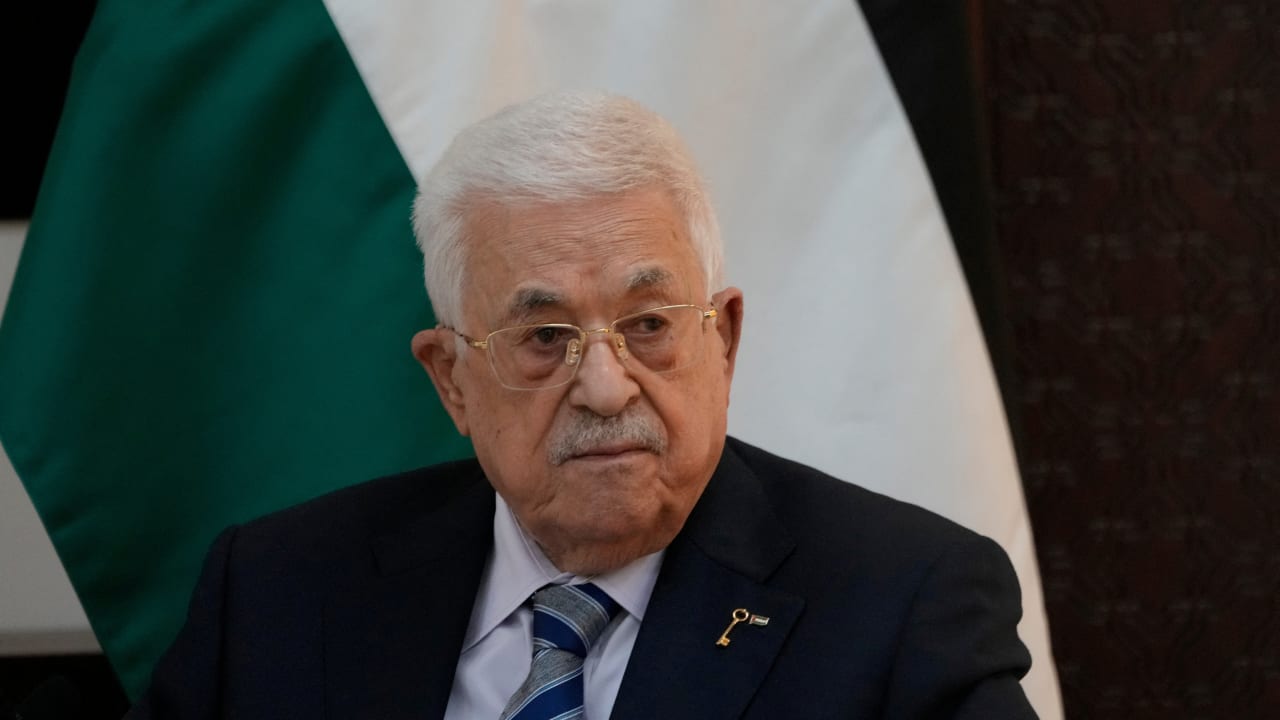
Mahmoud Abbas, president of the Palestinian Authority, has recently announced that legislative elections will take place on November 28.
While some have welcomed this as a promising opening for democracy in the Palestinian territories, its timing and motives invite scrutiny. Before celebrating the news, we should first ask if these elections represent democratization or merely political preservation. Ultimately, even if Palestinians do vote, ballots alone will not be enough to bring about democracy.
These elections are long overdue, with Hamas’s victory in the 2006 legislative elections marking the beginning of a fierce Hamas-Fatah power struggle and an end to general elections. Since then, Abbas has ruled the PA-administered parts of the West Bank largely by decree. The past two decades have seen various promises made of fresh elections, none of which have materialized.
Recent skepticism stems from the postponement of legislative and presidential elections initially scheduled for May 22, 2021, and July 31, 2021, respectively. The justification given by Abbas was a claim that Israel refused to allow east Jerusalem residents to participate in voting.
Critics, however, emphasize Fatah infighting as the true driver of Abbas’s actions. Marwan Barghouti and Mohammed Dahlan are both potential rivals to Abbas’s Fatah. Barghouti maintains considerable support while serving multiple life sentences in prison, and had planned to challenge Abbas’s presidency in 2021.
These Fatah factions and offshoots were seen to have posed a tangible threat to Abbas’s popularity, making elections a significant political risk.
The lesson from past cancellations is clear: current PA leadership views the will of the people as a threat to legitimacy, not the source of it.
The timing of this new announcement is equally questionable. Some argue that the move represents an attempt to demonstrate popular approval amid growing Hamas popularity in the West Bank since the October 7 terror attack.
Others point to the internal discontent within Fatah, suggesting that the elections serve as an opportunity to manage his rivals and entrench authority.
As domestic pressure intensifies, these renewed promises of elections emerge in a time of PA financial hardship. In fact, the announcement comes just days before the EU’s second meeting of the Palestine Donor Group, raising the likelihood that this apparent democratization may reflect an effort to improve their international standing among donors.
These elections also raise the issue of Hamas – Fatah is far from the sole political actor in the Palestinian territories.
Under the current electoral framework, candidates must accept the PLO’s commitments under the Oslo Accords, a condition that would effectively exclude Hamas from candidacy. Hamas’s participation poses a fundamental paradox.
Should it be prevented from contesting, many will perceive the elections as illegitimate. If it is allowed to run, however, any major electoral gains could be disastrous for the security and institutional integrity of the West Bank.
How Hamas influenced West Bank elections in the past
Regardless of its official absence from the April 2026 municipal election, Hamas was able to informally back a variety of independent lists to expand its influence. Whether or not it officially stands in the coming elections, Hamas will seek to extend and deepen its networks in the social and political fabric of the Palestinian territories.
This would threaten both peace and representative government, given Hamas’s past descent into authoritarianism.
Even more striking than the announcement of legislative elections is Abbas’s promise of a 2027 presidential election. At 90 years old, the subject of succession remains a lingering taboo for many Palestinians.
If we assume Abbas will run – which he himself has not confirmed – then it appears to be a last bid for legitimacy as PA sovereignty crumbles.
Alternatively, in the event he does not stand for reelection, it could provide the transitional moment for a new political dynasty in the Middle East.
Currently, the vice president (Hussein al-Sheikh) is designated to assume power should Abbas end his term unexpectedly. Nevertheless, Abbas’s eldest living son, Yasser Abbas, has emerged as a rumored successor, becoming increasingly involved in Palestinian politics.
A controversial multimillionaire facing allegations of corruption, Yasser was elected to Fatah’s Central Committee in May, making him part of Fatah’s highest decision-making body. Although the motivations behind his appointment remain unclear, Yasser’s succession would safeguard both the family’s political authority and their extensive business interests in the West Bank.
In recent decades, dynasties have frequently accompanied dictatorships in the region. If the 2027 elections are designed to facilitate this, then they would fail to represent democratic revival, but rather a managed inheritance of power within the existing regime.
Despite the growing uncertainties surrounding these general elections, some are optimistic that they may be a positive step towards representation and pluralism. Indeed, holding elections demonstrates both a level of organizational competence and institutional commitment.
Yet performative reform does little to build the future of Palestinian governance. We should not forget that elections are only one feature of democracy. If meaningful progress is to be made, there are many other conditions that have not been met.
Where elections are leveraged, exploited, and manipulated to reinforce the status quo, they cease to be a form of popular participation. To believe that highly imperfect elections are better than none is to ignore how, without a strong democratic foundation, they can reinforce the very deficits they should address.
There are many possible outcomes, perhaps the most likely being that the elections are canceled altogether. Should they proceed, however, we could see anything from Fatah stagnation, an Abbas dynasty, or Hamas expansion. Of all possibilities, none point toward true democratization.
The writer is a British-Egyptian history and politics student at the University of Oxford. She is a policy fellow at the Pinsker Centre, a UK-based foreign policy think tank, and a 2025 Laidlaw Scholar.