
It is no surprise that the Jewish people’s return to their ancient homeland in Israel has entailed the reintroduction of grape-growing and quality winemaking. And it is natural that the long-forgotten festival of Tu B’Av (Menachem Av 15), which was this week, be reintroduced in modern Israel.
No, I don’t mean the cheap celebration of Tu B’Av as Jewish Valentine’s Day, a festival of love where, according to the gods of modern marketing, one is supposed to buy flowers, chocolate, and other trinkets for spouses and partners (although that is not a bad thing).
I mean, rather, the religious celebration of Tu B’Av as the time of grape harvest, a time for recognition of God’s bounty. It is an occasion for renewed explorations of the connection between the Jewish people and their patron in heaven as expressed by abundance and rootedness in the Land of Israel.
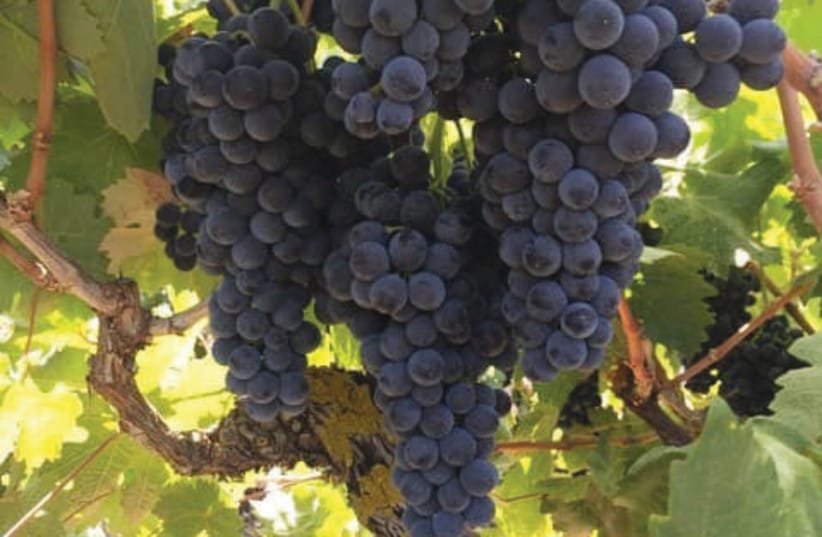
The background to this is biblical. There are four basic agricultural products in Israel repeatedly mentioned in Scripture, and each is associated with one of the four major holidays:
Olives, harvested in autumn primarily for olive oil, are related to the fall festival of Sukkot.
Barley, harvested in the early spring, is tied to Passover, and from which the meal offering was sacrificed on the first day of the holiday in the Temple in Jerusalem.
Wheat, a summer harvest product, is bound to the summer festival of Shavuot, and from which the shtei halechem (two loaves) bread offering was held aloft and then eaten in the Temple on the holiday.
Where do grapes come in? Grapes are for making wine, and wine has a biblical holiday too: Tu B’Av, which occurs at the beginning of the grape harvest in July-August.
This is meant to mean much more than young women going out to dance in the vineyards on Tu B’Av to find their shidduch (marriage match) – as described in the mishna (Tractate Taanit 4:8). That rabbinic teaching is the source of the ridiculous riff on Tu B’Av as Valentine’s Day.
The deeper meaning of the mishna is that the explosion of joy at grape harvest time is an opportunity for seeking closeness – with other Jews, with family, and with God.
Indeed, the Torah ties grapes to our two most basic relationships in this world: to the relationship between man and woman, and the relationship between man and God.
Between man and woman: “Your wife is like a fruitful vine in the innermost parts of your house, and your children are like flowering olive plants around your table” (Psalms 128:3).
The most basic familial relationships are symbolized by wine and olives in plenty around the dinner table.
Between man and God: “Look down from heaven and be mindful of Your vine, of Your stock which You Yourself planted” (Psalms 80:15-16).
That is the Jewish people. We are God’s stock; we are the vines that He planted and the branch that He has made strong for His own glory, for His own name in the world.
Grapes and wine in scripture
There are magnificent biblical descriptions of festivity at the grape harvest (for example, Judges 9 and Isaiah 16). The harvesters would enter the vineyards in gladness, and they would sing out and shout in joy, in exultation, with jubilant cries, hollering hooray, and with song and harp. (Harp is nevel in Hebrew, and it’s a play on words: it means both a harp and a flask of wine.)
In the modern Zionist era, there has also been sensational celebration around the harvesting of grapes to produce wine. Consider, for example, this passage from the journal of one of the men who worked for Baron Rothschild back in 1890 at his new winery in Rishon Lezion when the first harvest was received.
The worker, David Yudelevich, relates the eruption of ecstasy: “The bell rang at 4 a.m. to wake up the army of young men, women, and children armed with pruning shears. Their carts overflowing with grapes began streaming into the crushing vats, and they all sang, ‘Awaken, oh people of Israel, your youth has returned to the land, your redemption is near,’ followed by more song and dance.”
This is a biblical prophecy coming to fruition in our day. As Ezekiel (36:8) foretold in God’s name, in the time of redemption “You mountains of Israel shall shoot forth your branches and yield your fruit to My people Israel.” Two thousand years of desolation and devastation would come to an end.
Based on this verse, Rabbi Abba taught in the Talmud that “There is no greater revealed sign of redemption than the agricultural reblooming of the Land of Israel” (Tractate Sanhedrin 98a).
Jewish theology and law elevate wine one step further, giving it an important role in bringing the Divine Presence into this world. This is not possible, we are taught, when sadness and pain are the primary life experiences. Holiness in our lives and the divine presence in our world are only possible when we are happy.
Fortunately, “wine makes the heart of man glad, making the face even brighter than oil” (Psalms 104:15), and “wine cheers man and God” (Judges 9:12).
Drawing on these verses, the Talmud (Tractate Brachot 35a) rules that you cannot really give thanks to God unless you have a kos shel bracha, a glass of blessing or a goblet of wine, in hand.
This is where we get the use of wine for kiddush (sanctification) on Shabbat and holidays and at all Jewish life cycle events. This is also where we get the special formulations in Jewish law for benediction over wine, borei pri hagafen before drinking wine, and al pri gafna after drinking wine. No other beverage is distinctively designated in this way.
Mediterranean grapes
From recent tastings, at the Sommelier professional trade fair in February and the Israel Museum public wine festival this week (held in Modi’in), I came away convinced more than ever that wines made from Mediterranean varietals (grape types) are the wave of the future in this country.
This is opposed to the classic French Bordeaux and Burgundy varietals, such as Cabernet Sauvignon and Merlot. This means lighter wines similar to those made in other hot climates such as southern France and the Rhone Valley, as well as Spain and Italy.
Some of the outstanding Israeli red wines made in Mediterranean hand and style that I tasted and recommend are Bazak Syrah, Carmel Signature Guvrin (Petit Sirah), Flam Even Sapir (Syrah), Hayotzer Lyrica GSM (a Grenache-Syrah-Mourvèdre blend), Munitz Shaked (Marselan-Syrah-Argaman), Netofa Tel Qasser Red (Grenache-Syrah), Pinto Holot (Grenache-Petit Sirah-Syrah), Raziel (Syrah-Carignan), Recanati Atlier Syrah, Telem Rock and Stems (Syrah), Teperberg Legacy Petit Sirah, Tura Special Edition (Shiraz-Marselan-Merlot), and Vitkin Petit Sirah.
The writer is managing senior fellow at the Jerusalem-based Misgav Institute for National Security & Zionist Strategy. He is also a WSET Level 3-accredited wine enthusiast, and he conducts wine tours and tutored tastings with Zionist/Jewish flavors. His diplomatic, defense, political, and wine columns over the past 30 years are at davidmweinberg.com.