
Life is full of markers telling you that you are getting older.
The bar or bat mitzvah is one. High school graduation, another. Then college graduation, a full-time job, marriage, your first child, a mortgage. And on and on it goes.
Life is also full of signposts telling you that you are not getting older, but – rather – that you are now old. Full stop. Old.
I ran into one of those the other day.
“Here, sit here,” a man on a bus at the airport said as I got on with The Wife, kindly offering me his seat.
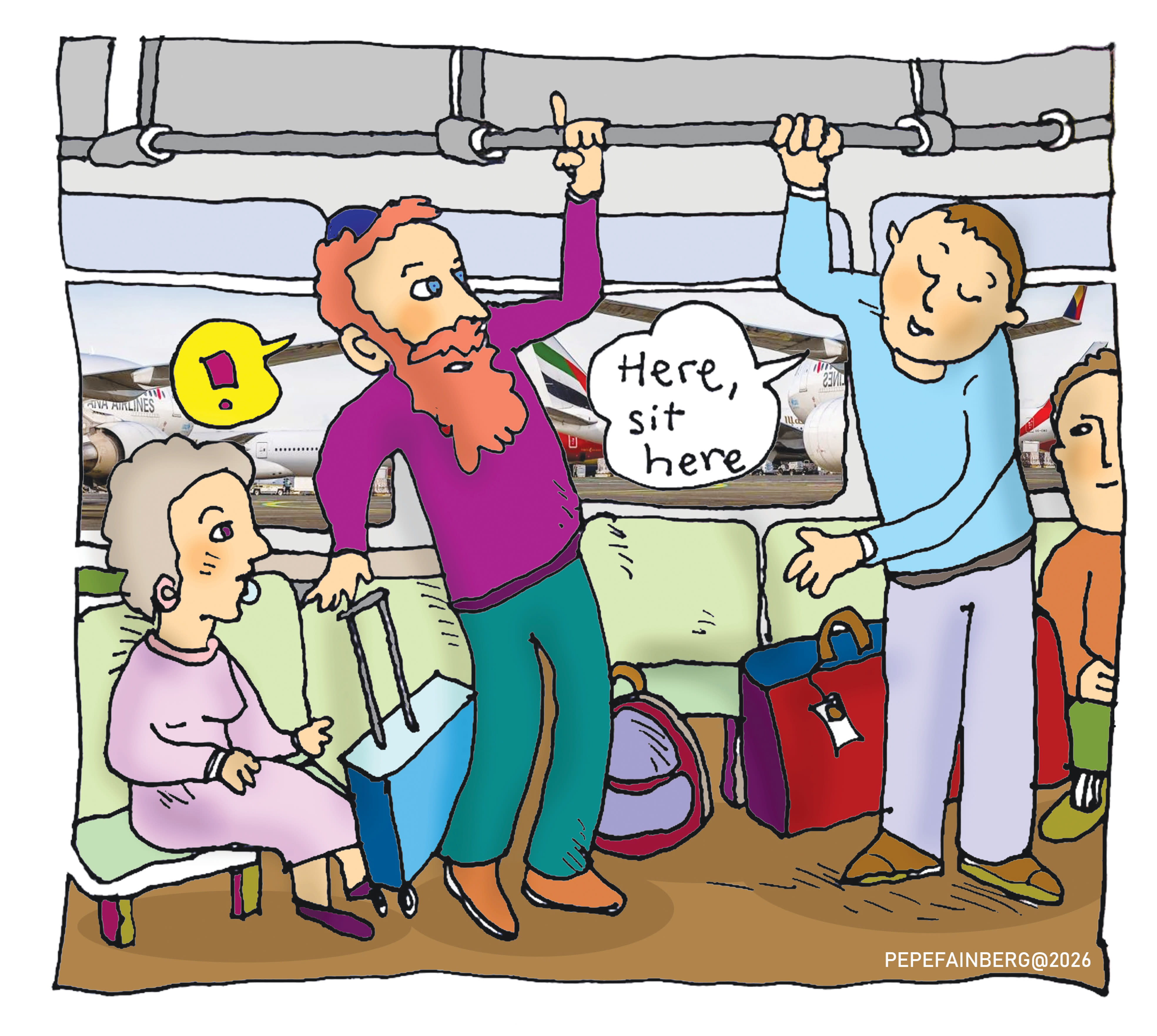
“Thanks, I’m okay,” I said, a bit humbled. “I’m not old, I just look old.”
The Wife chuckled in a self-satisfied kind of way, less at the joke and more at the fact that he offered his seat to me, not to her.
“Don’t get too smug,” I told her. “Remember who just got an official senior citizen card from the state.”
And indeed she had. In the eyes of the state, a woman is a senior citizen at 63 and three months, while a man has to wait until he’s 67. In other words, I’m now living with an old lady – literally and officially – while her man is, at least in the eyes of the authorities, full of vim and vigor.
Except, of course, not in the eyes of that fellow who offered me his seat.
What I should have done in that instance is not only thank him and decline the offer, but then proceed to stand on one foot and take off my shoe.
Why do that? Because, as I came across recently in the Talmud, “Until when is someone considered a young man?… As long as he can stand on one leg and remove or put on his shoe.”
Ever since I learned that, I’ve been practicing that maneuver daily.
HAD THIS been just one isolated instance, I would have let it go without a thought. But it wasn’t. It was one of several signposts lately indicating that old age isn’t about to arrive; it’s already knocking on the door.
Here’s one: “How old are you?” my five-year-old granddaughter asked as I fell asleep reading her a book.
“How old do you think?” I replied.
“Ninety,” she said.
Here’s another: I’m in the market for a shower mat to keep me from falling and breaking a hip getting in or getting out.
And here’s the third, the most telling: I recently spent three hours with a retirement consultant advising me about what to do with my various retirement and pension plans.
If I didn’t necessarily feel old before that, I definitely did after that meeting. When you first start work and sock away all that money for retirement someday, that day seems impossibly far off, like the end of a journey so long you can’t even imagine ever reaching it.
But then you meet with a retirement consultant, and it’s like rounding a bend and suddenly finding that once-remote destination just up ahead.
WHEN MY father, who passed away five years ago this month at the age of 90, retired from teaching after nearly four decades in the classroom, he was constantly asked what he was going to do.
The question annoyed him, because he thought the expectation was that he had to say he was going to do something of great significance, like study to become a veterinarian, volunteer at the local soup kitchen, or finally get around to reading Edward Gibbon’s The Decline and Fall of the Roman Empire.
And he was right: no one wants to hear “straighten up my desk,” “watch television,” or “go to Costco.”
And here is where there is a peculiar parallelism between when you are about to start the workforce and when you are about to leave it.
Before you start – just after college, when perhaps you haven’t made up your mind exactly what you want to do or be, or perhaps you’re actually clueless while other friends are already in law or medical school – the most grating and dreaded question is, “What are you going to do?”
“Plastics,” was always my wise-guy response, culled from the movie The Graduate. “I’m going into plastics; I heard there’s a great future in plastics.”
Fast forward some 40 years to the other end of one’s career, and the question – like the plastics – is recycled: “What are you going to do?”
My father had two pat responses.
The first, drawing on his career as a Shakespeare teacher, was, “I’m going to put the Bard’s entire works on the pin of a needle.”
The second: “I have a collection of seashells scattered on beaches across the world, and I’m going to visit them.”
Remarkably, people would often take him seriously – perhaps because of his straight-faced delivery, perhaps they were just being polite – and they would say, “Really, that sounds very interesting.”
Nothing, but nothing, gave my father a bigger hoot.
On my last visit to him just days before he died, he didn’t complain about any aches and pains. But he did complain about this: “I look into the mirror and see an old man.”
“Well, Dad,” I laughed, “I got news for you.”
He knew it, of course he knew it; he saw the signposts everywhere. But he didn’t let them bring him down. At least not most of the time. And of all the lessons he taught me, that’s the one – at this stage of life – I most need to learn.