The recent crisis in Ceuta cannot be understood merely as a migration episode. It is the visible expression of a much deeper transformation: the shifting strategic balance in the Western Mediterranean, where Spain, Morocco, Algeria, Israel, and the United States have become key players on the same geopolitical chessboard.
Spain and Morocco are far more than neighboring countries; they are two states compelled to cooperate while simultaneously managing interests that frequently diverge. Ceuta, Melilla, Western Sahara, the Canary Islands, migration flows, energy routes, and control of the Strait of Gibraltar are all part of the same strategic equation. In this environment, international relations are sustained not only by friendship but by the balance of power.
From Spain’s legal and historical perspective, Ceuta has been part of Spain since long before the establishment of the modern Moroccan state. Morocco, however, maintains a historical claim to the city. These competing narratives explain why the issue remains one of the most sensitive disputes in the Western Mediterranean.
Yet the true center of gravity lies in Western Sahara. Since 1975, Morocco has administered most of the territory, while the Polisario Front, backed by Algeria, continues to pursue independence.
The issue of Ceuta
Much of Morocco’s regional strategy revolves around this territory: projecting influence across Africa, securing access to strategic resources such as phosphates, developing renewable energy and green hydrogen, and consolidating its position against Algeria, its principal competitor for regional leadership in the Maghreb.

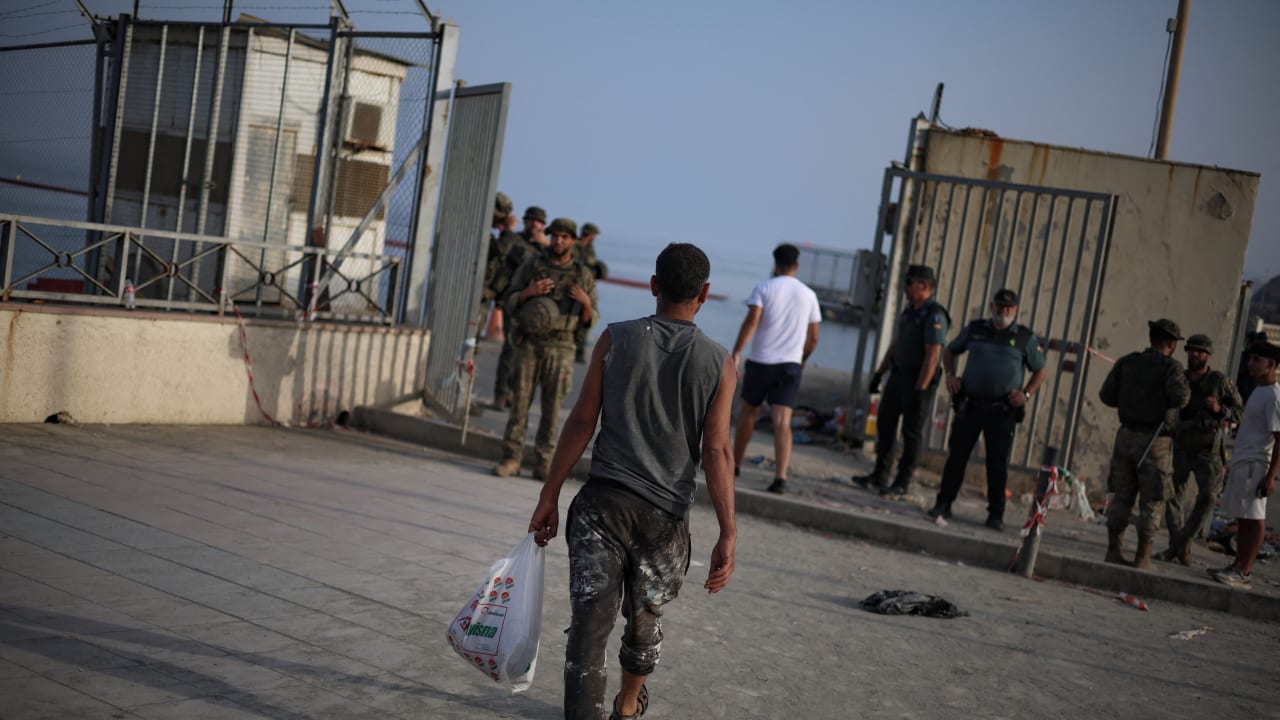
On July 20, Spanish Prime Minister Pedro Sánchez paid an official visit to Algiers, where he met with Algerian President Abdelmadjid Tebboune. Ten days later, on July 30, Ceuta experienced a massive influx of Moroccan migrants, placing unprecedented pressure on the border.
Whether or not these events are directly connected, they illustrate a broader geopolitical reality: When a state perceives shifts in the regional balance of power, borders often become the first arena through which strategic messages are conveyed.
Many analysts place these developments within the broader concept of “Greater Morocco,” a geopolitical vision that places Western Sahara at its core while preserving historical claims over Ceuta and Melilla.
At the same time, Rabat has strengthened its influence across Africa through investment, diplomatic engagement, and economic partnerships while expanding its maritime and energy ambitions in the Atlantic. Together, these elements form a long-term strategy combining infrastructure, diplomacy, economic development, and security.
One of the clearest symbols of that strategy is Tanger Med, now one of the Mediterranean’s leading container ports and a cornerstone of Morocco’s ambition to become a major logistics and energy hub linking Europe and Africa. Morocco has gradually reduced its economic dependence on Europe, strengthened ties with China, and simultaneously deepened its strategic partnership with the US, a relationship further reinforced following the Abraham Accords.
Shifts in regional geopolitics
The normalization of relations between Morocco and Israel marked a turning point in regional geopolitics. In exchange for US recognition of Moroccan sovereignty over Western Sahara during the Trump administration, Rabat secured a privileged position within Washington’s strategic architecture in the Middle East and North Africa.
More recent gestures such as naming a strategically important highway stretching more than 1,000 kilometers from southern Morocco into Western Sahara after President Donald Trump reflect Morocco’s determination to preserve that close relationship with Washington.
Within this broader context, the role of André Azoulay deserves particular attention. Appointed adviser to King Hassan II in 1991 and later retained by King Mohammed VI, the Moroccan Jewish statesman became one of the principal architects of the kingdom’s quiet diplomacy. Azoulay represents a unique tradition of dialogue that helped project an image of stability and moderation to the West while fostering channels of understanding between the Arab world and Israel.
For Spain, the challenge lies in responding to an increasingly influential neighbor without undermining an indispensable bilateral relationship. Since Hamas’s October 7, 2023, attack against Israel, Sánchez’s government has publicly clashed with the government of Prime Minister Benjamin Netanyahu, while several foreign policy decisions have also generated periods of tension with Washington.
On May 28, 2024, Spain formally recognized the State of Palestine, a decision that many international analysts viewed as politically benefiting Hamas. At a time when Morocco continues to strengthen its strategic ties with both the US and Israel, Spain faces the challenge of preserving its traditional alliances while maintaining regional stability.
Beyond Spain’s domestic political debate, the central question is whether Madrid possesses a sufficiently coherent long-term strategy to navigate an increasingly competitive geopolitical environment.
Ceuta is home to nearly 80,000 residents, including a historic Sephardi Jewish community of approximately 280 people, many of whom trace their origins to Tetouan.
The recent arrival of tens of thousands of migrants – reports speak of more than 40,000 Moroccan nationals – highlighted the extraordinary sensitivity of this frontier and underscored that Ceuta’s future depends not only on migration management but also on Spain’s ability to combine constructive relations with Morocco with strong international alliances.
History demonstrates that borders are rarely defended by military strength alone. They are equally safeguarded through diplomacy, credibility, and strategic partnerships. Today, Ceuta represents far more than a border city; it is one of the places where the future balance of power between Europe, North Africa, and the Middle East is beginning to take shape.
The writer is an Israeli-Hispanic journalist.