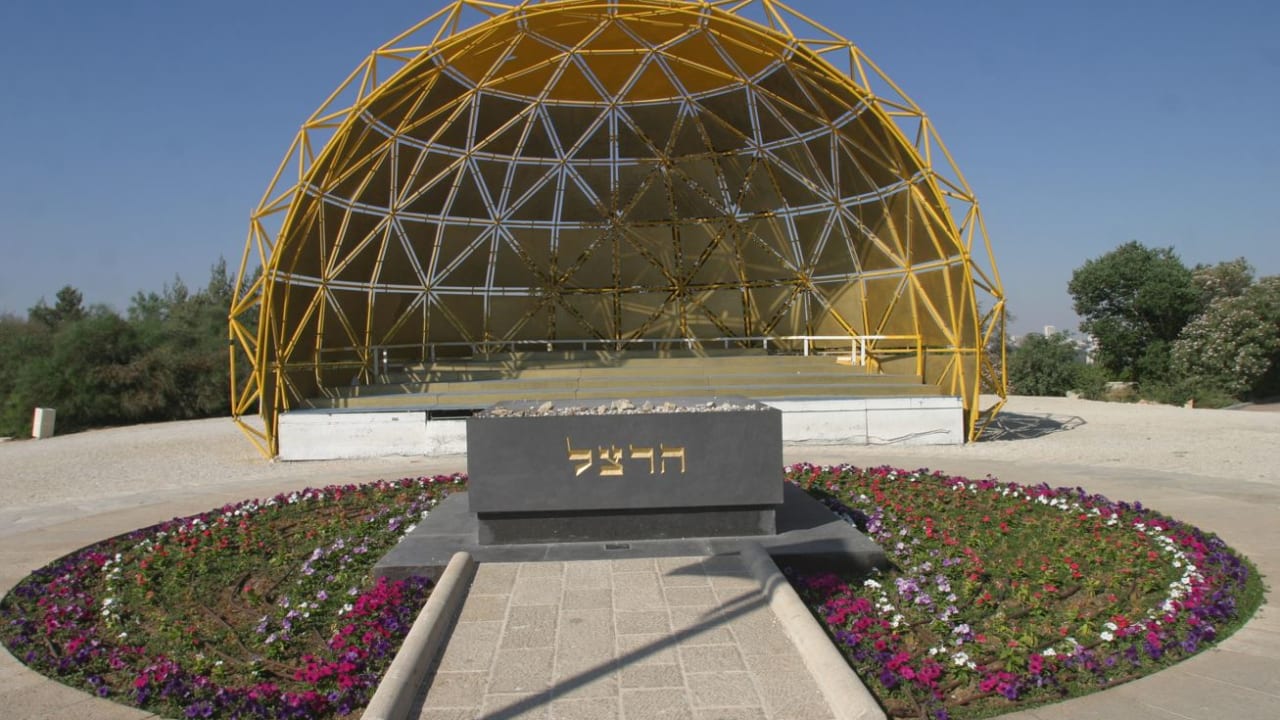
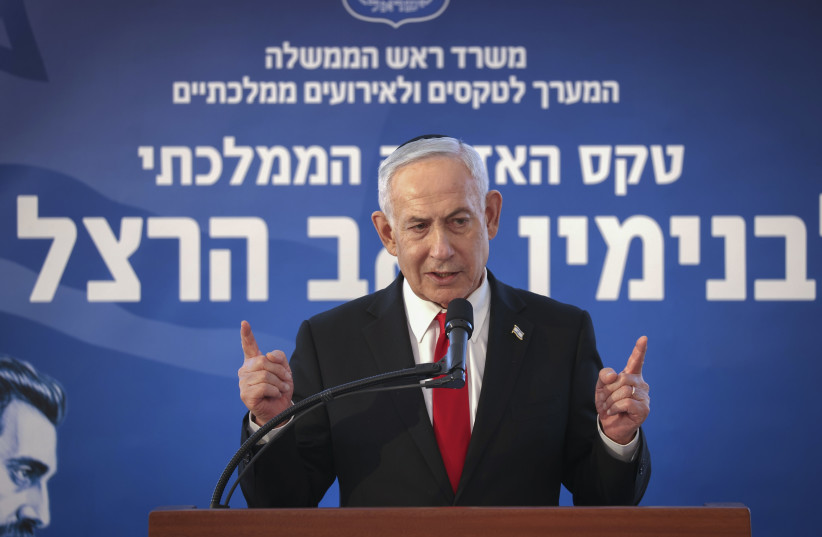
As the remains of Theodor Herzl’s grandparents are to be reburied in Jerusalem on Wednesday, it is easy to predict what the speakers at the ceremony will say. I would venture to suggest a few things that should be said, though I doubt they will be.
The founder of political Zionism grew up in an assimilated Jewish family in Budapest. His grandfather, Shimon Leib Herzl, lived and died in Zemun, today part of Belgrade, Serbia, and was close to Rabbi Judah Alkalai, one of the earliest advocates of Jewish national revival.
It is only natural that the speakers, including Israel’s president and prime minister, will argue that Herzl’s Jewish identity endured thanks to his grandfather, who also planted the first Zionist seed in his mind. They will rightly celebrate the establishment of the State of Israel and pledge to defend it.
But will anyone mention how far Israel has drifted from Herzl’s vision?
It was laid out in two works. Der Judenstaat (The Jewish State), published in 1896, two years before the First Zionist Congress, provided the intellectual foundation for the Zionist movement.
In 1902, two years before his death at 44, Herzl published Altneuland (Old-New Land), a novel depicting the future Jewish state. Together, the two books offer not only a political program but also a moral compass.
Given his principles, how would Herzl respond to the widening inequality in Israel today? How would the man who founded a movement on behalf of a persecuted minority react to the overwhelming rejection of political partnership with Arab citizens in Israel, simply because of their national identity?
Writing in a Europe marked by stark class divisions, Herzl nevertheless imagined an almost egalitarian society. Health care, education, and housing would be guaranteed to all, and so would human dignity.
One episode in Altneuland is particularly revealing. Two candidates compete for a leadership position in the Jewish commonwealth: an Arab engineer from Haifa and a Jewish politician of German origin who seeks to deny equal rights to non-Jews. Herzl, a successful playwright and journalist, before turning to politics, causes the racist to lose.
A separation of church and state
Herzl also addressed the relationship between religion and the state. He respected every faith and its leaders, but believed their primary role belonged in religion and culture, not government. Rabbis, he argued, should not intervene in affairs of state.
At the same time, he championed education, science, and knowledge as the engines of progress and prosperity. Will any of the speakers acknowledge the growing influence of religion in Israel’s public sphere, or the long-term consequences of an expanding population that is not receiving a core secular education?
A doctor of law, Herzl envisioned an independent, professional judiciary worthy of a liberal state. The country he imagined would be administered by experts, with clear institutional separation between political authority and economic management, thereby avoiding conflicts of interest and preserving public trust.
Although Herzl tirelessly sought financial backing from wealthy supporters, he refused personal compensation. He invested his own money, and that of his wealthy wife, in the Zionist cause. When he died, his family was essentially left destitute.
It is not difficult to imagine what Herzl would think of the polarization that characterizes Israeli politics today. Throughout his career, he sought the broadest possible coalition. He spoke to religious Jews in their language and to intellectuals in theirs, while searching for common ground that would allow the movement to advance with a united purpose.
The same instinct guided his diplomacy. Herzl understood that Zionism could not succeed without international support, and he carefully identified where the interests of foreign leaders whom he met overlapped with the Zionist project.
To the Ottoman sultan, he offered a plan to help eliminate the empire’s crushing debt. To Britain, he proposed ideas that would strengthen its position in some colonies.
One wonders what he would say today, when public confrontations with leaders, including friends, increasingly replace quiet diplomacy, and even as domestic political messaging often takes precedence over careful statecraft.
Seventy-seven years ago, Herzl’s final wish was fulfilled when his remains were reburied in the nascent country he had envisioned. My late father, a Holocaust survivor, served in the Israel Defense Forces honor guard at that ceremony.
It seems to me that if those two men sharing a name – the visionary who imagined the state and the ordinary soldier who fought for it – could look upon Israel today, they would not be satisfied merely to celebrate its existence. They would ask what kind of country it has become, whether this is what they had hoped for, and what must be done to bring it closer to the vision that inspired its creation.
The writer was Israel’s first ambassador to the Baltic states after the disintegration of the Soviet Union, ambassador to South Africa, and congressional liaison officer at the embassy in Washington. She is a graduate of Israel’s National Defense College.