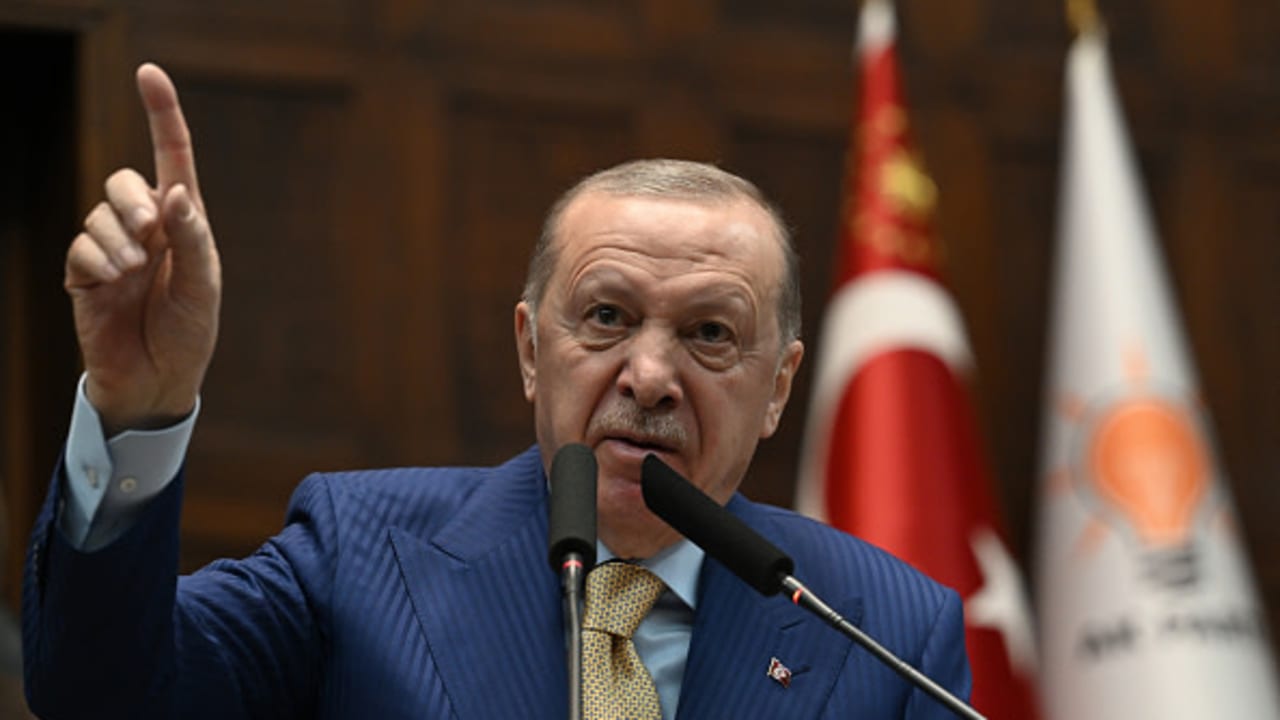
Several weeks have passed since Turkish President Recep Tayyip Erdogan declared that Turkish history contains “no genocide, no massacres, no oppression, and no colonialism,” but only “justice and compassion.”
The statement amounted not merely to a denial of the Armenian Genocide, but to a denial that centuries of conquest, slavery, ethnic violence, forced displacement, and imperial rule produced anything requiring apology or repentance.
What happened next was even more revealing than the statement itself: almost nothing.
Erdogan hosted world leaders at NATO’s summit in Ankara. Strategic discussions advanced. Conversations about military cooperation continued. The controversy, to the extent there was any, quickly faded from public view.
A major NATO leader had effectively declared his nation innocent of every crime commonly associated with the empire, and the world moved on with remarkable ease.

That response reveals a broader reality. Historical accountability is not applied evenly. Some countries become the subjects of endless scrutiny, investigations, resolutions, academic conferences, and activist campaigns. Others enjoy a degree of immunity tied less to their conduct than to the framework through which they are viewed.
In much of academia and activist culture, Western societies and those viewed as Western-aligned are often cast as the primary bearers of colonial and historical guilt, while non-Western societies are more frequently understood through the lens of victimhood, anti-imperialism, or post-colonial grievance.
Turkey’s long history of conquest, empire, demographic engineering, and ethnic violence sits within that framework. The result is not ignorance of the facts, but a reluctance to examine those facts through the same moral lens applied elsewhere.
But activist and academic culture is only part of the story. For decades, policymakers in Washington and Europe have operated on the assumption that Turkey is simply too important to alienate.
Whether that assumption remains justified is increasingly debatable. What is beyond debate is the extent to which it has insulated Ankara from forms of scrutiny that similar behavior would attract from many other states.
The record Erdogan denies
If Erdogan’s claim is to be taken seriously, it must be measured against history rather than mythology.
He did not limit his assertion to the modern Turkish Republic. He claimed that throughout Turkey’s “thousands of years of glorious history,” there had been only “justice and compassion.”
For centuries, the Ottoman Empire operated the devshirme system, forcibly removing Christian boys from conquered Balkan populations and converting them into state servants and soldiers. Historians have described the practice as a form of institutionalized slavery.
Ottoman vassal states along the Barbary Coast enslaved vast numbers of Europeans. The Hamidian massacres of the 1890s killed as many as 300,000 Armenians decades before 1915. None of this required overseas colonies. It required an empire.
Then came the period Erdogan almost certainly hoped to obscure.
Between 1914 and the mid-1920s, the Christian population of Anatolia collapsed from roughly one-quarter of the population to well under 1%. The Armenian Genocide, the Assyrian Sayfo, the destruction of Pontic Greek communities, and subsequent forced population transfers (ethnic cleansing) transformed one of the world’s most diverse regions into one of its most homogeneous.
Turkey is approximately 99.8% Muslim today. Whatever one wishes to call what happened to that missing quarter of Anatolia’s population, “justice and compassion” is certainly not it.
A half-century later came Cyprus.
Turkey’s 1974 invasion displaced between 160,000 and 180,000 Greek Cypriots. What followed was not a temporary military presence but a lasting political and demographic transformation. Successive Turkish governments encouraged settlement from mainland Turkey into occupied Cyprus.
Today, Northern Cyprus is recognized by exactly one country in the world: Turkey itself. More than five decades later, Turkish troops remain.
And, more recently, there is Afrin.
Turkey’s 2018 operation, ironically named Olive Branch, displaced more than 150,000 residents from what had been a predominantly Kurdish region of northwestern Syria. Human rights organizations documented allegations of demographic engineering as Kurdish residents were ethnically cleansed and replaced by populations resettled in territory under Turkish control.
Despite fitting many of the criteria commonly associated with settler-colonialism, population transfer, and ethnic displacement, Afrin never attracted the sustained academic, political, or activist scrutiny that comparable allegations elsewhere routinely generate.
The politics of selective accountability
None of these events are obscure. The Armenian Genocide is among the most extensively documented atrocities of the 20th century. Cyprus has been the subject of international diplomacy for decades. Afrin has been covered by journalists, human rights organizations, and international bodies. The issue is not a lack of information.
The issue is attention.
Concepts such as colonialism, indigenous rights, occupation, demographic engineering, and historical justice have become central moral languages of contemporary politics and academia. Yet their application often appears strikingly selective. A neighboring state sends its army across an international border into territory from which it faces no existential threat.
Indigenous inhabitants are displaced. Demographic changes follow under the authority of the occupying power. Such circumstances routinely generate international outrage, academic inquiry, NGO campaigns, and diplomatic pressure.
In Turkey’s case, they rarely do.
That discrepancy cannot be dismissed as a matter of missing facts or insufficient documentation. The record is extensive and readily available. What is often absent is the willingness to apply the same standards, language, and moral urgency that have become commonplace in other conflicts.
The actual scandal
Political leaders distort history all the time. Historical denial is hardly unique to Turkey. The real scandal is not that Erdogan told an outrageous lie. It is that so few influential voices seemed to care.
The conventional wisdom in Washington and many European capitals has long held that Turkey is too important to confront directly. Policymakers cite geography, NATO, migration routes, and regional influence. The result has been a persistent tendency to grant Ankara a degree of accommodation unavailable to most allies.
Yet after years of democratic backsliding, growing Islamization of public life, hostility toward fellow NATO members, military interventions across the region, and increasingly anti-Western rhetoric, one must ask whether the West has confused leverage with dependence.
Turkey has become remarkably adept at presenting itself as indispensable while using that perceived status to extract concessions from allies. Whether that reputation ultimately proves justified or merely geopolitical fool’s gold is a question for future historians. What is already clear is that the perception itself has functioned as a powerful shield against accountability.
Erdogan’s declaration that Turkish history contains no genocide, no massacres, no oppression, and no colonialism should have been treated as a diplomatic disgrace. Instead, it was met largely with a shrug. That reaction tells us something profoundly troubling.
The guardians of historical accountability appear less interested in universal principles than in selecting appropriate defendants.
Turkey’s denials, occupations, demographic interventions, and crimes against humanity are neither secret nor newly discovered. The evidence has existed for years, often decades. What has been missing is not proof but prosecutorial interest.
Erdogan’s statement was not the scandal. The refusal to meaningfully challenge it was.
The lie exposed the bankruptcy of a strongman’s version of Turkish history. The silence exposed the double standards that allowed it to flourish.
The writer is an attorney, former IDF soldier, and former NYPD officer. He writes widely on Israel, Zionism, antisemitism, and Jewish history. He serves on the board of Herut North America.