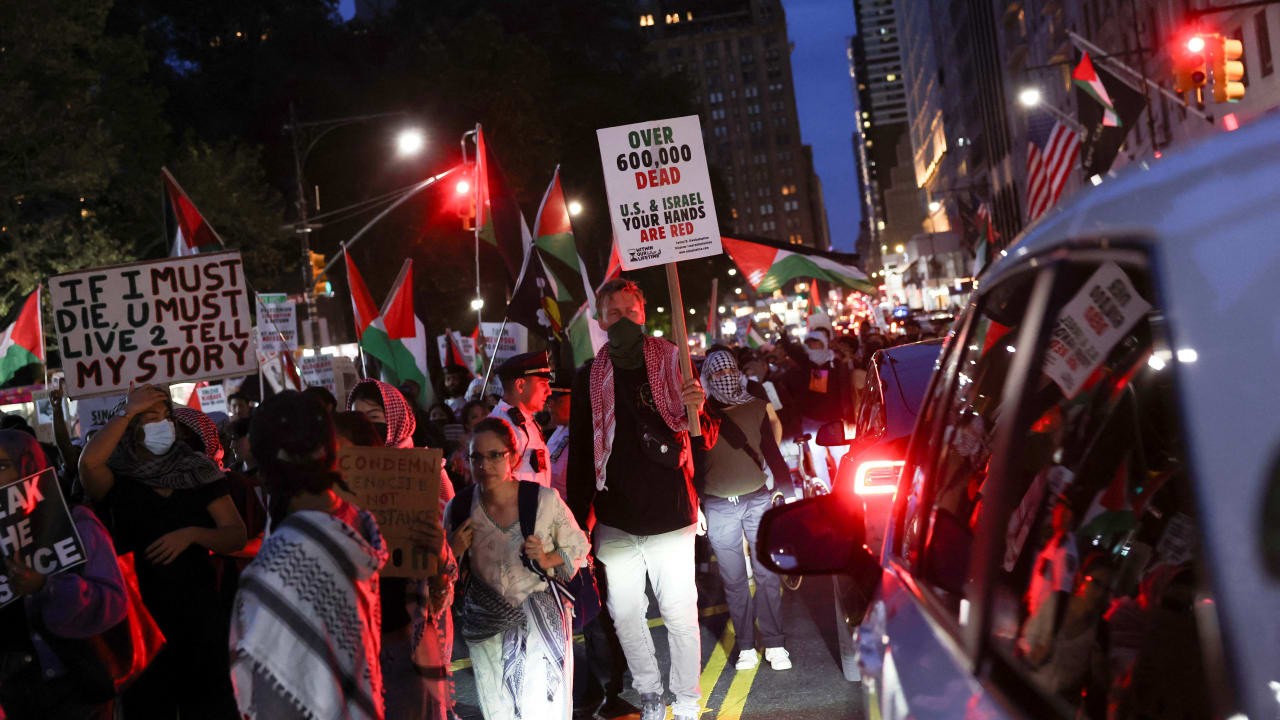
The current wave of antisemitism will – and already is – fundamentally altering Jewish life in the countries with the largest communities outside of Israel: the United States, France, the United Kingdom, Canada, Australia, and Germany.
Almost three years since October 7, and the wave of antisemitism is not receding; it is becoming more pervasive and more commonplace. In the US, for example, one in three individuals said they were targets of antisemitism, and over half of Jews have changed their behavior out of fear of antisemitism, according to a recent survey.
The antisemitism genie will not go back into the bottle on its own. Political and social polarization, the convergence of left-wing and right-wing hatred, hostility toward Jews in academia, greater proclivity towards antisemitism among younger adults, well-funded Israel-defamation campaigns by state actors, and growing immigration from Arab countries with high rates of religious extremism – all signal that we have likely crossed a point of no return.
This doesn’t bode ill only for Jews in the West; there are major repercussions for Israel as well. Foremost, its strategic alliance with the United States is in jeopardy, as public sentiment turns increasingly anti-Israel and somewhat anti-Jewish. Israel will need to reassess its strategic situation and act.

First, Israel must continue to pursue military self-sufficiency. It must have the capacity to fight an extended war without dependency on the US (or any other country) for arms, munitions, and spare parts. After all, a future American president may simply refuse to provide them.
Prime Minister Benjamin Netanyahu compared Israel’s new situation to the ancient isolationist Greek city-state of Sparta, which successfully fought its wars alone. The analogy was useful but flawed: in a global world, Israel should not aspire to Spartan isolation.
Rather, Israel should redouble efforts to build robust alliances with non-Western countries that don’t fall along the trend-lines of rising antisemitism – including India, former Soviet Republics, countries in South America, the Far East, and Africa, including moderate Muslim nations.
Among Western allies, Israel should foster mechanisms of co-dependence, so that there will be a real cost for such countries should they choose to abandon their partnerships with Israel.
Counterweight to hate
In parallel, both Israel and the global Jewish community need to acknowledge the real danger of both state and non-state actors who promote delegitimization of Israel – which invariably leads to increased antisemitism.
Countries like Qatar, Iran, and Turkey, and offshoots of various Muslim Brotherhood organizations and the Boycott Divestment and Sanctions (BDS) movement, are increasingly motivated to undermine public support for Israel in the West, especially after Israel’s military coup-de-force following October 7.
An effective Israeli strategy does not necessarily mean confronting these perpetrators directly, but rather building alternative centers of power that will increasingly serve as a counterweight to the spreaders of hate.
Israel should also ensure that its relations with global Jewish communities are stronger than ever and based on as broad a “Zionist tent” as possible. The focus should be on maintaining national responsibility rather than narrow partisan or ideological considerations.
Representatives from all corners of Zionism and swaths of Israeli society must be involved. Each can then more effectively engage their ideological counterparts in the West and the Jewish world.
Finally, Israel must come to terms with the fact that some of the harm is self-inflicted. Israeli officials and representatives should refrain from automatically or reflexively blaming all criticism on antisemitism, and should instead leave room for introspection and improvement. Failing to do so harms Israel from within, as much as it does from without.
This includes the recent increase in Israeli Jewish extremist violence against Palestinians; Israel cannot expect that turning a blind eye or taking half-measures against the perpetrators will be sufficient at home or abroad. Israel’s image is also exacerbated by problematic statements from opponents of Israel’s policies on the Israeli far Left and Right.
These are leveraged by Israel’s opponents and antisemitic elements in the West.
The post-October 7 world is still taking shape. Yet it already appears that the long “golden age” of Jewish status and prosperity in the West, especially in the US (and Canada), is steadily eroding, and a different reality is emerging.
History teaches that the Jewish people have an extraordinary ability to adapt, survive, and even thrive in changing conditions. The question is not whether such adaptation will occur this time as well, but rather what it will look like – and what the accompanying costs and opportunities will be.
The more Israel accelerates the process of recognizing this new reality and developing responses to the challenges it poses, the more effective the adaptation process and optimal the new reality will be.
The writer is a research fellow at the Jerusalem Institute for Strategy and Security, an independent research institute focused on foreign and security policy, and managing director of the Comper Center for the Study of Antisemitism and Racism at the University of Haifa. He is a major (reserve) in the Israel Defense Forces Spokesperson’s Unit.