
Today, six years ago, on August 13, 2020, the Middle East changed. US President Donald Trump, Prime Minister Benjamin Netanyahu, and the Crown Prince of Abu Dhabi, Mohamed bin Zayed, announced an agreement for full normalization between Israel and the United Arab Emirates.
For the first time in more than a quarter-century, another Arab country chose to establish full relations with the State of Israel. A month later, the Abraham Accords were signed at the White House.
At the time, most of the attention was focused on the political breakthrough – and rightly so. The agreement broke a concept that had dominated Middle Eastern diplomacy for decades: the claim that Israel could not reach true peace with the Arab world before resolving the Palestinian conflict.
But six years later, after the Middle East has gone through one of the most turbulent periods in its history, a deeper lesson can be identified. The UAE’s lesson is that true peace does not begin at a signing ceremony. It begins in the classroom.
Since August 2020, relations between Israel and the Emirates have faced intense tests that none of the signatories to the agreement could have predicted. The October 7 massacre, the war in Gaza, and the regional turmoil created immense pressure on Israel’s relations with the Arab world.
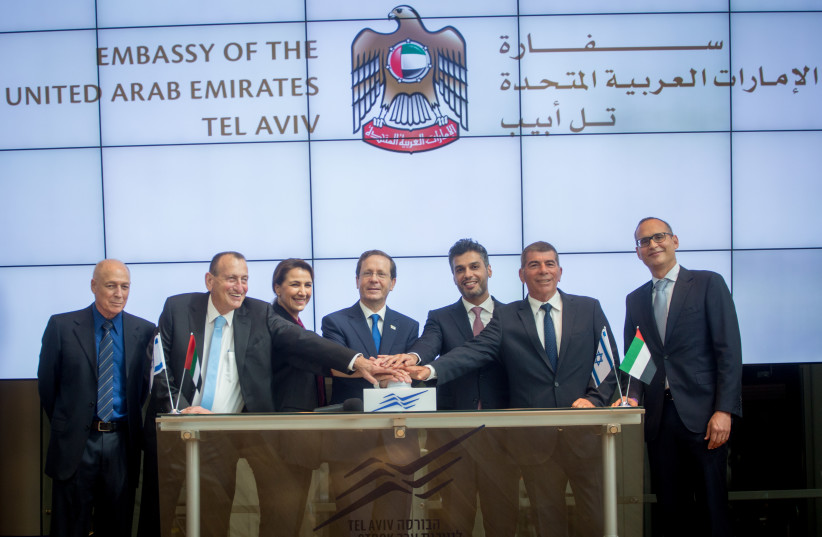
The UAE sharply criticized Israeli policy on various issues. There were disagreements, tensions, and periods in which the warmth that characterized the beginning of the relations was replaced by caution.
But relations were not severed.
The embassies remained open, channels of dialogue were maintained, and economic and institutional ties continued to exist. It is precisely the disagreements that illustrate the importance of the achievement.
Peace is not measured when everything is quiet. It is measured at the moment when the sides disagree, the public is agitated, and the political cost of maintaining relations rises.
Here lies the first lesson of August 13: an agreement that holds up only during periods of quiet is a temporary arrangement. True peace is tested by its ability to survive a crisis.
Peace cannot be built on decades of education toward hatred.
For decades, the international community in the Middle East focused almost entirely on leaders and agreements. Presidents met. Diplomats drafted. Governments signed. International money flowed. Institutions were established.
But the most important question was asked too rarely: What does the Muslim child learn in the classroom the morning after the agreement is signed?
You can bring a leader to the negotiation table through interests and pressure. You can establish an embassy by a government decision. You can even create security and economic coordination mechanisms.
But if the education system continues to teach the next generation that the Zionist entity is an eternal enemy, that its history is forged, that its religion is inferior, and that its very existence is illegitimate, an agreement has been signed between governments, but peace has not been built between peoples.
The UAE offers a different model.
On my visits to the UAE, I found an extensive emphasis on tolerance, coexistence, and acceptance of other cultures and religions – including a magnificent synagogue in the Abrahamic Family House complex in Abu Dhabi.
Studies by the IMPACT-se research institute that examined the Emirati education system also found positive changes regarding Judaism and Israel, and the Abraham Accords themselves were integrated into the learning materials.
This does not mean that all disagreements have disappeared, but it teaches that a country seeking to create long-term peace cannot settle for changing its foreign policy. It must gradually create a cultural infrastructure that allows the next generation to accept peace itself as legitimate. This is a strategic lesson, not just an educational one.
The Palestinian comparison that cannot be ignored
And here lies the difference that the State of Israel and the West must learn from.
Since the Oslo Accords, vast sums have been invested in building Palestinian institutions. Governance and security mechanisms were established, agreements were signed, and international aid was transferred on a massive scale. The assumption was that building institutions, improving the economy, and political progress would gradually create an incentive for peace.
But for years, research and reviews pointed to inciting content in the Palestinian education system, including the glorification of “martyrs,” content hostile toward Israel, and a consistent absence of education that recognizes the State of Israel and the Jewish people as legitimate neighbors with a historical connection to the land.
The West sometimes sought to build peace from the top down, while beneath it, mechanisms continued to exist that passed the conflict on to the next generation.
You cannot expect a child who is educated for years to view Israel as an illegitimate entity to become a natural partner for reconciliation at age eighteen just because leaders signed a document.
The Emirates teaches the other side of that same equation.
When leadership changes the public discourse, encourages religious tolerance, recognizes Judaism, and presents cooperation with Israel as part of a possible future, it creates an additional protective layer for relations even when severe political disagreements arise.
Peace through strength, interests, and awareness
The Abraham Accords also proved another principle: Peace does not have to be born out of weakness or out of giving up national interests. On the contrary.
The agreements were born out of a recognition of shared interests. Israel and the Emirates identified shared regional threats and understood the benefits inherent in cooperation in the fields of security, technology, trade, energy, innovation, and tourism.
Instead of the old concept according to which the parties must first resolve all disagreements and only then start cooperating, the Abraham Accords offered the opposite logic: cooperation itself can become an engine of stability.
But the past six years add a third layer to the equation.
Strength creates deterrence.
Interests create profitability.
Education creates resilience.
All three components are necessary.
Peace that is not backed by strength is liable to invite aggression. Peace that lacks shared interests is liable to become an empty document. And peace that is not supported by an educational and cultural infrastructure is liable to collapse when the first crisis arrives.
The lesson for the day after
This lesson has special meaning right now.
In any future discussion on regional arrangements, on expanding the Abraham Accords, on relations with the Palestinians, and on the future of Gaza, the State of Israel and its partners must not repeat the mistake of measuring peace through signatures alone.
Textbooks must also be measured.
When the international community invests billions in reconstruction, it must ask not only how many schools were built, but also what is taught inside them.
When new institutions are established, one must examine not only who runs them, but what worldview they convey to the next generation.
Does Israel appear on the map?
Is the Jewish people presented as a people with a history and a right to self-determination?
Is terrorism presented as heroism or as a disaster?
These are not marginal questions. These are questions of national security.
You can defeat an army on the battlefield. You can dismantle a terrorist organization. You can eliminate commanders and destroy infrastructure. All of these are necessary for the defense of the state. But long-term victory also requires preventing the ideology that birthed the war from passing intact to the next generation.
This is the greatest lesson of August 13, 2020.
The achievement of the Abraham Accords is not only that Israelis fly to Dubai, that Israeli and Emirati companies do business, and that an Israeli flag flies over an embassy in an Arab country.
The more important achievement is proving the possibility of creating a different model in the Middle East.
A model in which countries do not have to agree on everything to live in peace. A model in which shared interests replace the politics of boycott. A model in which tolerance is not just a diplomatic slogan, but a value that a country seeks to pass on to the next generation as well.
Leaders can sign a peace agreement in one day.
Strength and interests can preserve it in times of crisis.
But for peace to last for generations, it must be taught in the classroom.
This is the lesson of the United Arab Emirates, and it should also be the lesson for any future arrangement in the Middle East.
The writer is the deputy head of the Security Policy Institute of the Israel Defense and Security Forum (IDSF/Habithonistim), and former policy adviser to strategic affairs minister Ron Dermer.