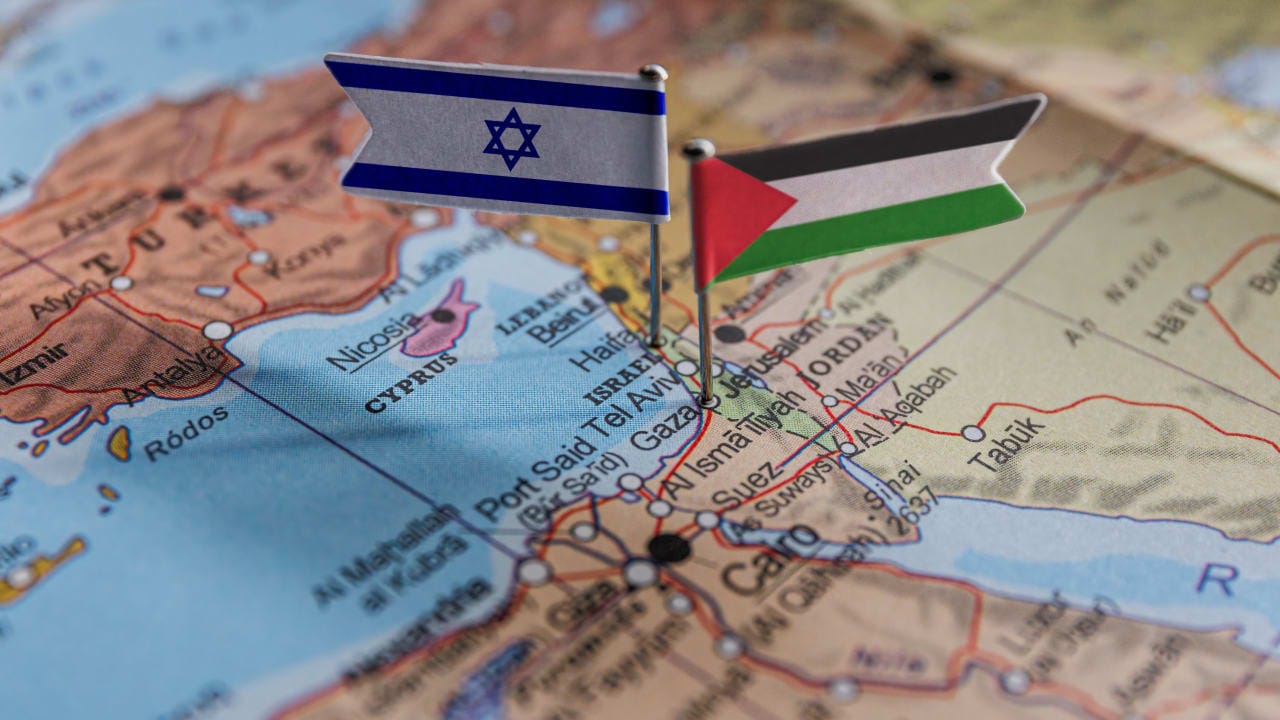
For decades, a simple explanation of the Israeli-Palestinian conflict took hold across broad segments of Israel’s Left and Center: at its core, the conflict was territorial. Israel would give up land, the Palestinians would establish a state, and the conflict would gradually come to an end.
The Oslo Accords were built on this premise. Negotiations were conducted on its basis, and far-reaching proposals were offered to the Palestinians. But the events of recent years, above all the October 7 massacre, have shaken the assumption on which this entire approach rested for many Israelis.
The question they are asking today is far more difficult: What if the conflict is not only about where the border will be drawn, but also, and perhaps primarily, about the very legitimacy of a Jewish state existing in this region?
This does not mean that every Palestinian seeks Israel’s destruction, and a complex national conflict should certainly not be reduced to a sweeping generalization about an entire population. But it is no longer possible to ignore the enormous influence that Islamist religious ideology has gained in Palestinian society over recent decades.

Hamas makes no secret of its worldview. For Hamas, the struggle does not end at the 1967 lines, and the land is not merely territory subject to political negotiation. It is part of a much broader religious and historical vision.
This is something the West has struggled to understand. For years, it has tried to interpret the conflict through concepts familiar to it: borders, settlements, sovereignty, national rights, and self-determination.
All of these are indeed important components of the conflict. But they do not explain the intensity of the hatred, the glorification of martyrs, the celebration of armed struggle, or the fact that after Israel withdrew from the Gaza Strip in 2005, Gaza did not become a laboratory for building a prosperous state. Instead, it gradually became a military stronghold for Hamas.
In this sense, Oct. 7 was a defining moment.
Israelis who believed that economic improvements, jobs in Israel, and eased civilian restrictions would reduce the motivation for confrontation discovered how dangerous it can be to assume that the other side operates according to the same logic.
The massacre was not directed at settlements in the heart of the West Bank. Be’eri, Kfar Aza, and Nir Oz are inside sovereign Israel. For the terrorists who entered those communities, that, too, was considered “occupation.”
This is the source of the awakening now taking place among parts of Israel’s Left and Center. It may be that the debate over dividing the land concealed a deeper question for years: Is the Palestinian national movement truly capable of accepting, and not merely as a tactical matter, the existence of a Jewish nation state?
Alongside the military campaign, another battle is being fought, one no less sophisticated: the war for global public opinion.
This is where Qatar enters the picture
For years, Doha has managed to build an extraordinary position for itself. It is an ally of the United States and hosts an important American military base, while having hosted Hamas leaders and provided enormous sums of money to the Gaza Strip at the same time. It also controls one of the most influential media organizations in the Arab world, Al Jazeera.
Al Jazeera is not simply a television station. It is an international network with the ability to shape the global agenda and distribute images and narratives at extraordinary speed. In a world where a video lasting 30 seconds on TikTok or Instagram can have greater influence than a 1,000-word article, the first image people see and the first headline they read carry enormous weight.
This campaign is being conducted professionally. Images of destruction in Gaza are shown repeatedly, often separated from the context of fighting an armed organization operating from within a densely populated civilian environment.
The message is simple, emotional, and easy to absorb: Israel is the stronger side and therefore the aggressor. The Palestinians are the weaker side and therefore the victims.
Within such a framework, there is almost no room for more difficult questions. Who started the war? How did Hamas act with horrifying brutality, murdering, raping, and dismembering women and children? What responsibility rests with an evil regime that spent years investing vast resources in building its military capabilities?
This has been one of the greatest achievements of the Palestinian and Islamist campaign in the battle for public opinion: reducing history to a single image and transforming a complex conflict into a simple morality tale.
Israel, by contrast, often continues to conduct public diplomacy as though it were holding a news conference in the 1990s. By the time Israel releases an investigation, a map or evidence, the narrative has already reached millions of people.
In the age of social media, whoever reaches the public consciousness first gains an advantage that is extremely difficult to erase.
The struggle is not against Islam, nor is it against every Palestinian. It is against an ideology that denies Israel’s right to exist and sanctifies violence as a means of achieving that goal. Making this distinction is essential if Israel wants to persuade the world.
This awakening must lead to the abandonment of illusions.
A political settlement can exist only when both sides genuinely want to live alongside one another, not when one side views an agreement merely as another stage on the way to a different objective.
Before asking where the border should be drawn, a much more fundamental question must be asked: Is there a genuine willingness among Palestinians to accept the State of Israel as a permanent and legitimate reality?
The Oct. 7 massacre unfortunately provides a negative answer.
Therefore, the argument is not about territory. It is about the very existence of the State of Israel.
The author is CEO of Radios 100FM, an honorary consul and deputy dean of the consular diplomatic corps, president of the Israeli Radio Communications Association, and a former Israel Army Radio monitor and NBC television correspondent.