
I’m standing with my husband at the port in Thessaloniki, a vital commercial hub on the Aegean Sea connecting Southern Europe with the Balkans.
I’m thinking of the Jewish stevedores who once worked these docks, and of those who later made aliyah and helped haul cargo on the waterfronts of pre-state Israel. Men from this community were also among the Sonderkommando prisoners who revolted at Auschwitz-Birkenau and destroyed crematorium IV.
When a proposed flight of two hours and 20 minutes appeared on my computer screen from Sun d’Or, El Al’s subsidiary, I booked tickets for my husband and me.
I had long wanted to visit the city where the port once closed on Shabbat, and where Jews were both longshoremen and leaders in commercial development. I didn’t know much more than that.
I was about to learn a great deal.
First, the name.
The Jewish community used a shortened form, spelled either Salonika or Salonica, and referred to this pretty city on the sea as “La Madre de Israel,” the Mother of Israel, and the “Jerusalem of the Balkans.”
Thessaloniki is the older name, and it commemorates a woman. Thessalonike was the half-sister of Alexander the Great and the wife of Cassander, who founded the city in 315 BCE. According to Greek legend, after Thessalonike’s death she became a mermaid who appeared before passing ships and inquired if her brother Alexander was still alive. The sailors had to answer, “He lives and reigns and conquers the world.” If they answered incorrectly, she would metamorphose into a monster and sink their ships.
There are legends, too, that Jews arrived with King Cassander, but no one knows exactly when Jews first settled in Thessaloniki. The city’s Jewish Museum describes an ancient Romaniote community, traditionally dated to around 140 BCE. They spoke a Jewish form of Greek known as Yevanic. They were joined many centuries later by the more than 20,000 Jews expelled from Spain in 1492, and from Portugal several years later.
Spain’s loss was Thessaloniki’s gain. The intellectual and commercial talents of the Golden Age of Spanish Jewry enhanced the seaside city. The newcomers prospered in business, printing, scholarship, and the arts.
Eventually, Jews made up half the population, and Ladino became one of the city’s principal languages. The port, which the Jews expanded and where they served as merchants, brokers, and longshoremen, naturally closed on Shabbat.
As a capellophile, I shopped in a hat shop called Stamion, “established 1914.” I learned that the proprietors weren’t Jewish, but that previous generations of the family had spoken fluent Ladino because so many of their hat-wearing customers were Jews.
In 1917, a cooking fire spread and ravaged Thessaloniki. More than 70,000 people were left homeless, approximately 52,000 of them Sephardi Jews. Many Jews left for Paris, New York, and pre-state Israel. Experienced Jewish longshoremen from Salonika played an important role in developing the ports of Haifa and Tel Aviv.
The day of rest was changed to Sunday. The Jewish Museum documents the rise and fall of one of the world’s outstanding Jewish communities, as well as today’s Jewish community.
The museum’s ground floor is surprisingly dominated by recovered tombstones.
Until December 1942, an enormous Jewish cemetery containing hundreds of thousands of graves occupied the land on which the city’s Aristotle University now stands. Some graves dated back to the 15th century. Empowered by the Nazis who conquered Greece, municipal workers arrived with pickaxes to topple the graves and take the land. Marble was used for a swimming pool for German soldiers, for church renovations, for pavements, and for private courtyards. The Hebrew lettering was scratched away, or the stones were turned over.
Recovering the gravestones remains an ongoing process.
This reminded me, of course, of the devastation of the Jewish cemetery on the Mount of Olives between 1948 and 1967. I have often visited the grave of Hadassah founder Henrietta Szold, who died in 1945. Her headstone was used as road pavement. After the Six Day War, the cemetery caretaker found it and returned it to her grave.
Thessaloniki's Jews were forced to remove bodies from gas chambers at Auschwitz
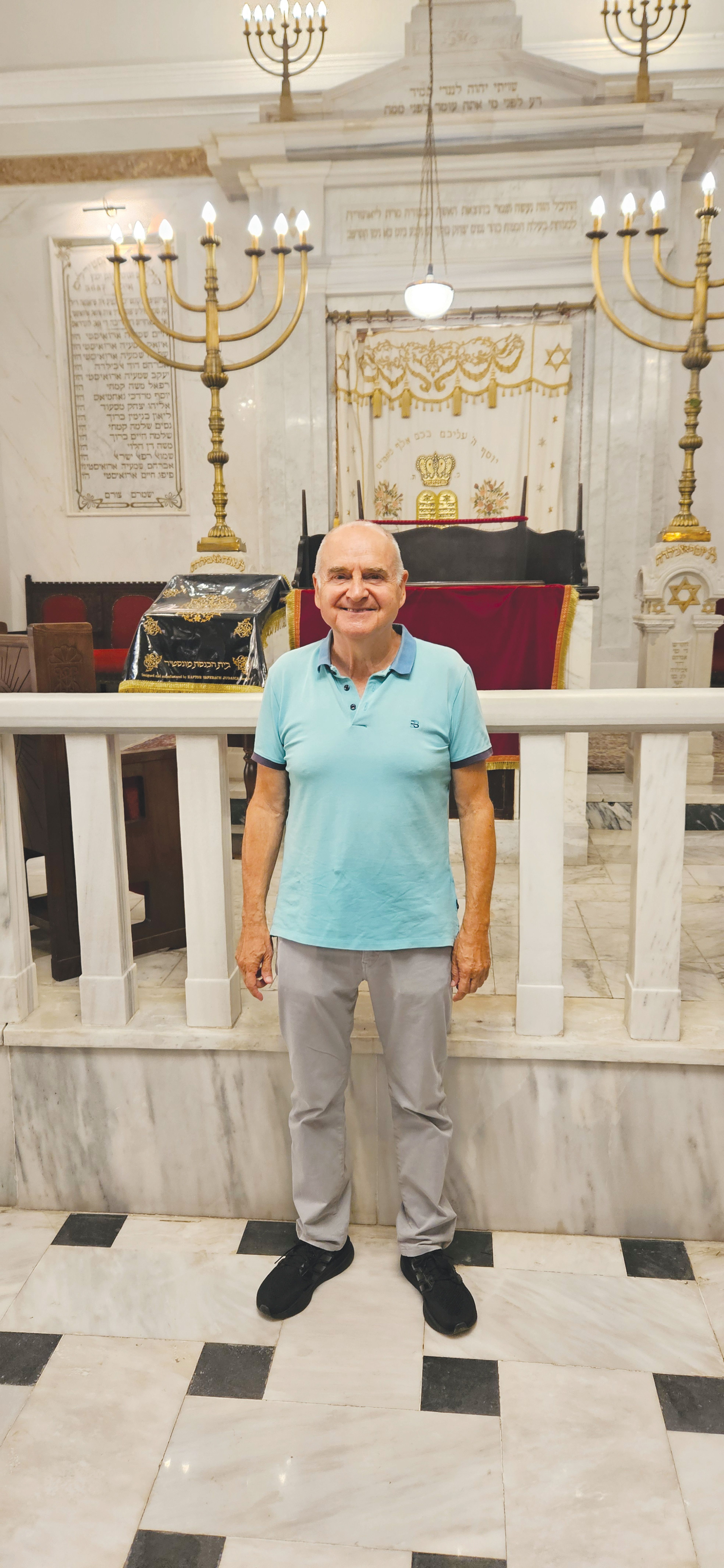
AT THE Monastirioton Synagogue, which survived because it was used by the Red Cross during the German occupation, we were privileged to hear Elia Matalon, a retired surveyor and civil engineer, recount the history of the community through both public events and the experiences of his family and those of his wife, fellow guide Hella Kunio Matalon.
Long ago, on a tour of Auschwitz-Birkenau, I heard that Jews from Thessaloniki, known for their physical strength as longshoremen, were forced into the Sonderkommando units. These prisoners had the horrifying task of removing bodies from the gas chambers and bringing them to the crematoria.
I knew about the mighty Jewish boxer Salamo Arouch, a longshoreman about whom a movie was made. I had never understood how an entire community of more than 50,000 people, including so many tough, experienced port workers, could have been transported to Auschwitz with so little organized resistance.
Matalon explained how thoroughly the community had been deceived.
Hard as it is to imagine in today’s world of instant communication, the Jews of Thessaloniki didn’t know about the concentration camps and death camps of Poland. Using a modified strategy, the Germans initially avoided sealing them inside the kind of starvation ghettos found in Eastern Europe. The boundaries of the ghettos were porous. Matalon’s mother-in-law, then a schoolgirl, would leave in the afternoon to meet her non-Jewish Greek friends and return at night.
The Germans promoted the fiction of a “New Europe” in which unemployed and hungry Jews would supposedly find jobs, education, and abundant food in Poland.
Rabbi Zvi Koretz, the city’s chief rabbi, remains a contentious figure. He had been arrested by the Germans and imprisoned near Vienna before being returned to Thessaloniki. Matalon believes that Koretz came back a manipulated and manipulative man.
Koretz preached at the many city synagogues that the Jews should embrace relocation. The community was led to believe that families would travel together by train and be resettled together. Instead, they were forced into cattle cars, and it was too late to turn around.
More than 53,000 members of the Jewish community, out of a population of 56,000, were murdered.
Matalon’s mother-in-law came from a large family that had experienced an earlier confrontation with the Nazis. That experience led some family members to suspect that the promises of resettlement were a ruse. Even so, of the 23 members of the extended family, only his future in-laws and the daughter who would become his wife went into hiding. The others were murdered at Auschwitz.
“They felt it inconceivable that their entire community could be destroyed,” Matalon told us.
His own family survived because Righteous Gentiles hid them in Albania.
Thessaloniki has begun acknowledging the Jews who contributed to its history
Later, walking through the port, my husband mused that perhaps we should not have come. Too many residents of Thessaloniki had been complicit. Too many had taken possession of Jewish apartments, shops, furnishings, and property. We had not understood the full scope of the tragedy that had befallen this magnificent Jewish community.
Last year, we visited Chalkida, another Greek city, where non-Jewish residents helped save their Jews.
But then, we thought, staying away would leave its Jewish history even more invisible. How will we know if we don’t come and see?
In more recent years, Thessaloniki has begun acknowledging the Jews who contributed so much. Holocaust memorials have been erected, and signs identify Jewish contributions to the city’s commercial and architectural life.
Greece is making a huge investment in Israeli defensive technology. Our Uber driver praised Israel for objecting to the sale of advanced fighter planes to Turkey.
At the Monastirioton Synagogue, we heard Elia Matalon sing the popular Ladino song “Adio Kerida,” Goodbye, Beloved. It’s a haunting song of wounded love and departure. Matalon told us that Jews sang it to their city as they stood beside the railway tracks.
The beloved had betrayed them.
“I’ll go find another love. I hope there is a real love there,” the song proposes.
An estimated 55,000 descendants of Greek Jews live in Israel today, many of them with roots in Thessaloniki.■
The writer is the Israel director of public relations at Hadassah, the Women’s Zionist Organization of America. Her latest book is A Daughter of Many Mothers, cowritten with Holocaust survivor and premier English-language witness Rena Quint.