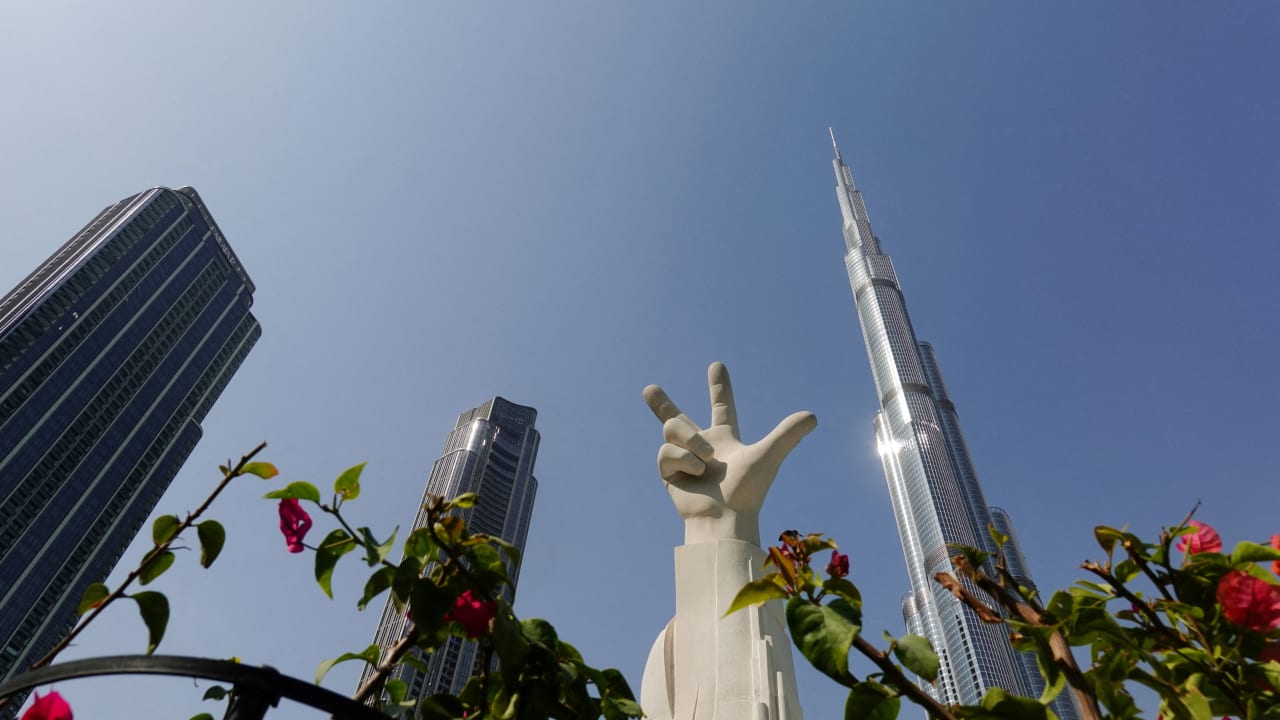
Recently, an argument has emerged which maintains that the rise of Dubai and the Gulf states was closely tied to Iran’s withdrawal from its regional position after the 1979 Iranian revolution. A stable Iran open to the world, the argument goes, would return the economic center to Tehran and cause Dubai to lose much of its appeal as a temporary substitute.
Initially, the idea seems open to debate, especially when we consider Iran’s size, resources, location, population base, and civilizational heritage. However, the argument weakens when Iran’s presumed rise becomes a condition for Dubai’s decline, and what the United Arab Emirates has achieved in half a century is reduced to a vacuum left by another state.
Undeniably, Iran has the foundations of enormous economic power. If it becomes a stable state, economically open, and reconciled with its region and the world, it will likely recover some of the capital, skilled people, and businesses that sanctions, restrictions, and instability pushed abroad. But this is where the basic assumption needs scrutiny.
The movement of capital and businesses to Dubai hardly proves that Iran’s isolation made Dubai successful. The faltering of one country’s economic environment rarely creates a successful economic center in another. Between the two lies a more important factor: the ability of the alternative environment to compete and attract.
Dubai’s rise rests on its own model rather than the withdrawal of others. It built an environment that targets capital, companies, and talent, accumulated infrastructure, global connectivity, legal and regulatory frameworks, and stable rules.
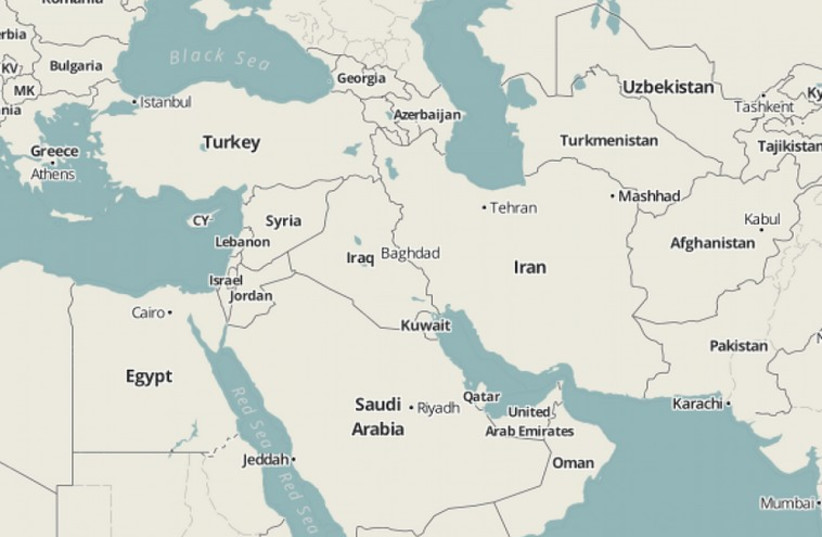
By contrast, other regional economies suffered, to varying degrees, from sanctions, regulatory restrictions, state intervention, bureaucracy, and political and economic uncertainty.
To be sure, the difference here is that no vacuum is left by one side and filled by another. It is the ability of one model to attract what other environments failed to attract or retain.
If Iran’s crises and isolation were enough to explain Dubai’s rise, then the region’s crises would likely have produced similar economic centers nearby. None emerged.
The absence or faltering of a competitor may create an opportunity, but it alone fails to build a global center. Otherwise, replicating the Dubai experience would be far easier than reality has shown.
This exposes another flaw in the notion of a temporary substitute. It assumes that Iran once occupied a natural economic position, that this position moved to the Gulf after the Iranian revolution in 1979, and that Tehran can reclaim it whenever circumstances change. Financial and commercial centers never move between countries the way spheres of influence move on maps, and no historical right reserves an economic center for its former owner.
Undoubtedly, the capital that reached Dubai was seeking the environment most able to serve it, rather than an heir to Tehran. Had it failed to find that environment there, it would have considered centers such as Singapore, London, Hong Kong, and other cities that compete globally for money, companies, and talent.
This point is key. From the outset, Dubai’s competition involved a network of global cities seeking to perform the same functions or parts of them, rather than Iran alone.
What Dubai has accumulated in this competition is now more than a circumstantial advantage. It has become a network of measurable scale. In 2025, 95.2 million passengers passed through Dubai International Airport, the highest annual figure in the airport’s history, according to Dubai Airports data.
The number of active companies registered in the Dubai International Financial Center exceeded 10,000 by the end of the first half of 2026, while Jebel Ali Port is connected to more than 150 ports around the world.
These figures measure more than assets – they measure a network in which the flows of people, capital, trade, and services overlap, and one that resists replication.
Investors assess opportunity, risk, the stability of rules, contract protection, the ability to move capital, and access to suppliers, customers, and talent. Companies rarely relocate their business centers simply because a promising market appears, since they operate within systems of relationships, services, and trust accumulated over years. History does matter, but civilizational age alone confers no future economic role.
In Iran’s case specifically, even if political conditions change radically, Tehran will hardly awaken the next morning as a global financial center. Reintegrating a large economy that has been subjected to prolonged sanctions and restrictions will require reforming the banking sector, stabilizing the currency, protecting investment, and rebuilding international confidence.
Iran’s potential is indeed enormous, but turning it into a stable economic power requires time, policies, and institutions.
A prosperous Iran could benefit Dubai
The Iran-or-Dubai equation misses the point. A future Iran, open and prosperous, may be one of the greatest economic opportunities for Dubai itself.
In fact, the reentry of a large Iranian economy into global markets will create broad demand for finance, insurance, aviation, ports, consulting, technology, and logistics. International companies that want to enter the Iranian market will need nearby regional centers that already possess these networks. Dubai, because of its location and accumulated commercial and financial relationships, can serve as one of the most important gateways.
But the issue involves more than Dubai’s relationship with Iran. It concerns the region as a whole.
If the Middle East succeeds in resolving its conflicts, it is more likely to produce multiple economic centers than to fall under a single center. Riyadh is expanding its economic weight; Abu Dhabi is building advanced positions in investment and technology; Dubai has entrenched global functions; and Iran is capable, under different conditions, of adding a massive economic center to this map.
Competition will be intense. That is natural, and Iran’s return may indeed redistribute some investments and roles. Dismissing that weakens any serious analysis. But competition is one thing, while the belief that Iran will reclaim from Dubai an economic position it supposedly once owned is another.
A future Iran will be more successful when it makes investors, talent, and companies choose it because of the opportunity, confidence, and efficiency it offers, rather than because of a notion that its neighbors’ prosperity resulted from its absence.
The United Arab Emirates, for its part, needs no weak Iran to succeed. Countries confident in their models never make a neighbor’s failure a condition for their continued success.
The Dubai experience proves this. Dubai never waited for history to assign it a place. It spent decades building the place that the world wanted to come to. Dubai’s success and economic standing are not based on an Iranian legacy that moved to the UAE after the 1979 Iranian revolution, such that Iran’s return would mean taking them back.
Dubai built its own center over decades of decisions, policies, and institution building, and tied it to global networks of trade, finance, and business. Iran can build its center anew, and it has enough potential to make its success an interest for the entire region. But that requires no dismantling of what others have built.
The writer is a UAE political analyst and former Federal National Council candidate.