
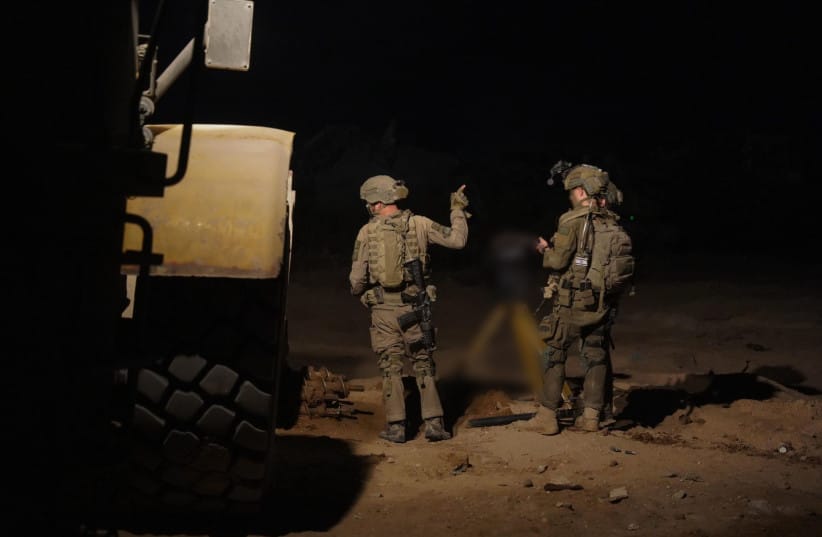
Last week, 16 religious soldiers refused an order to participate in an operational mission in Gaza, and the mission was canceled because a female paramedic was supposed to travel with them in their Namer armored personnel carrier. There is no halachic justification for their refusal; on the contrary, their refusal goes against Jewish law.
Negiah (physical contact): Perhaps they were concerned about touching the female soldier, but I have already demonstrated (Responsa in a Moment, Vol. V, Jerusalem, 2021, pp. 319-339) that this “prohibition” appears neither in the Talmud nor in the writings of the leading halachic authorities.
Rather, it is a custom that developed on the basis of late midrashim and medieval ethical literature, and there is no obligation to observe it.
Yihud (seclusion with women in a closed space): According to the Talmud (Sanhedrin 21b), a decree was enacted in the days of King David prohibiting a man from being secluded with an unmarried woman, as a reaction to the rape of Tamar by Amnon.
However, according to the Mishnah (Kiddushin 4:12) and in the view of the majority of leading halachic authorities (Rif, Rosh, Tur, Rema, and many others), it is permissible for one woman to be secluded with two men.
Mara d’atra (the local halachic authority): The brigade rabbi ruled that the soldiers were permitted to take part in the mission. They then consulted a rabbi from their yeshiva, who prohibited it. This runs contrary to the widely accepted halachic principle of mara d’atra.
Trust a ruling by a rabbi familiar with the ins and outs of military norms
If there is a local rabbi who is an expert in Jewish law related to the army and deals with these issues on a daily basis, his ruling should be followed, rather than that of an outside rabbi who is unfamiliar with the operational realities on the ground in Gaza.
Pikuah nefesh (saving a life): The principle of pikuah nefesh overrides all the commandments of the Torah except for idolatry, prohibited sexual relations, and murder (Sanhedrin 74a and elsewhere), and this was the ruling of the major halachic authorities, including Maimonides (Yesodei Hatorah 5:1-3), the Tur, and the Shulhan Aruch (Yoreh De’ah 157:1).
In the present case, there is a double concern regarding pikuah nefesh: the need to protect the people of Israel from a murderous enemy, and the need to safeguard the lives of the soldiers themselves through the presence of a female paramedic who underwent 13 and a half months of training to save their lives.
A soldier who refuses to engage in life-saving activity because of concerns about “physical contact” (negi’ah) or “seclusion” (yihud) resembles the “pious fool” (hasid shoteh) described in the Talmud, who sees a woman drowning in a river and refrains from rescuing her to avoid looking at her (Sotah 21b).
Kiddush Hashem and hilul Hashem (sanctifying and desecrating God’s name): Both of these commandments are derived from the same verse (Leviticus 22:32): “You shall not profane My holy name, and I shall be sanctified among the children of Israel; I am the Lord who sanctifies you.” Every good deed performed by a Jew publicly sanctifies God’s name; every bad deed performed by a Jew publicly desecrates God’s name.
Unfortunately, these young soldiers publicly desecrated God’s name, as can be seen from the 670 responses to the Ynet article about this incident.
I do not blame the soldiers; I blame their rabbi. He is the one who caused this desecration of God’s name. May it be God’s will that their rabbis learn to distinguish between what is essential and what is secondary in Jewish law.
The writer, a rabbi who serves as a professor of Talmud and Halacha at the Schechter Institute in Jerusalem, has published 40 volumes of responsa and other books related to Jewish law.