
Judaism tantalizes the senses with the sights, sounds, and fragrant smells that characterize its observance.
Rosh Hashanah is certainly one of those times when we are overwhelmed by the richness of Jewish symbolism. At the heart of our new year observances lies the piercing cry of the shofar. What is the meaning of the shofar?
Various explanations describe why we blow the shofar during the month of Elul – on Rosh Hashanah and at the close of Yom Kippur.
These interpretations include: it signifies creation, specifically the beginning of God’s kingship; it is meant to remind us to hearken to the blasts echoing from God’s revelation at Sinai; it links us to the binding of Isaac since the shofar is a symbol for the ram caught in the thicket by its horns that ultimately is offered to God in place of Isaac; and the sharp sound of the shofar is to be understood to be a call to teshuvah, repentance.
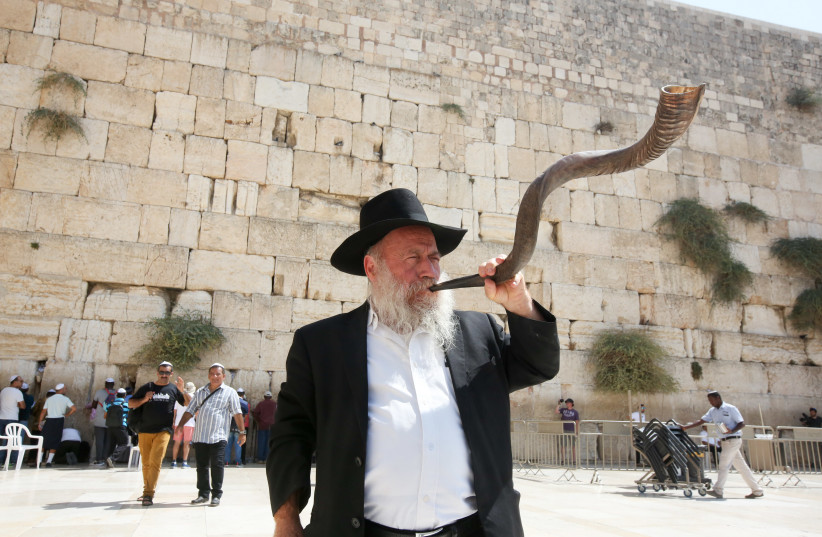
The latter interpretation connects the shofar with a wake-up call to each and every one of us. In reading Rabbi Marc-Alain Ouaknin’s magnificent book Symbols of Judaism, I find myself further inspired by his philosophical explanation of the call of the shofar when he writes, “The prohibition of representation or definition is sounded by the notes of the shofar” (page 64). What does he mean by this?
At Deuteronomy’s core are the dramatic curses and blessings. Most notable, in this respect, is the phraseology of the opening curse, which reads: “Cursed be anyone who makes a sculptured or molten image, abhorred by the Lord, a craftsman’s handiwork, and sets it up in secret” (Deuteronomy 27:15).
Not surprisingly, this curse reminds us of the Torah’s fervor in its condemnation of idolatry – which is found in particular at the beginning of the “10 Utterances (10 Commandments).” As Ouaknin points out, “there are no idols, only idolaters.” More than the fear of immutable idols is the Torah’s fear of immutable people.
Elul and Rosh Hashanah give us the annual opportunity to shatter the idolatrous images we have adopted over the course of the past year. We have become hardened, and the challenge is to break the mold – to become more human and more ourselves.
It is for this reason that we are granted the gift of multiple calls of the shofar. Tekiah means that which is rooted; shevarim means that which is broken; and teruah refers to an image of shaking.
Striving for renewal
As we enter the High Holy Days, we are like the tekiah call of the shofar – fixed and rooted, hardened by our routines.
Elul presents us with the challenge of becoming shevarim, of examining and critiquing ourselves so that we can break ourselves, indeed, be able to shake ourselves out of a spiritual malaise. And we close with a tekiah gedolah, a great, long sound representing the rebirth of the self.
By the end of Yom Kippur, with the help of God, we have managed to build ourselves up again to a new and passionate whole.
Perhaps this is the meaning of Rashi’s commentary on Deuteronomy 26:16. The verse states, “The Lord your God commands you this day to observe these laws and rules; observe them faithfully with all your heart and soul.”
Rashi, the prolific medieval commentator, writes, “The meaning of this verse is that every day should be fresh in your eyes as if the Torah were commanded to you on this day.”
To approach Judaism with a fresh set of eyes and renewed sense of purpose is ultimately the goal of this period of repentance. May we each strive for such renewal and emerge from the heightened sanctity of Rosh Hashanah and Yom Kippur – each of us as a tekiah gedolah.
The writer, an artist and illustrator, is president of the Schechter Institutes, Inc.