
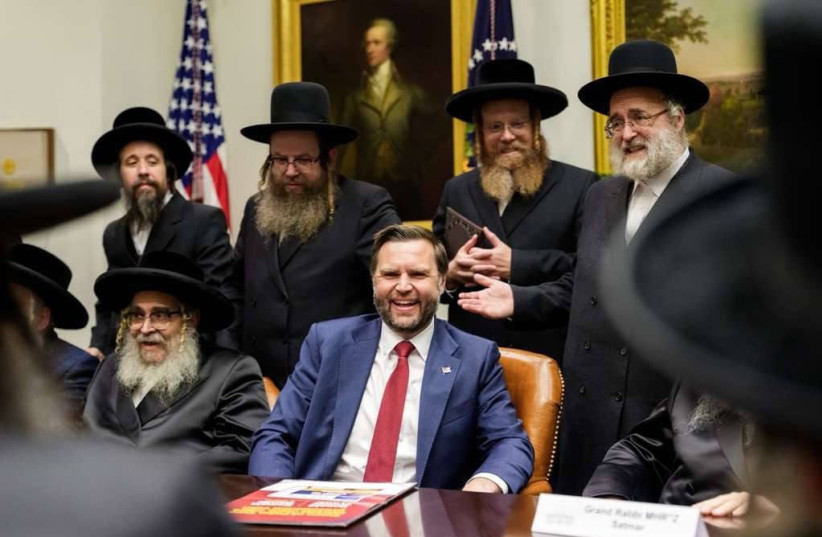
Last Thursday, for the first time since 1979, a delegation of hassidic leaders came to the White House to meet the president of the United States.
They spent an hour with senior officials on the needs of their communities, then half an hour with US President Donald Trump himself. Vice President JD Vance and Secretary of State Marco Rubio dropped in unannounced.
The grand rabbis of Satmar, Bobov, and Vizhnitz came, along with a representative of Skver and the head of Beth Midrash Govoha, the great yeshiva of Lakewood, New Jersey. The community had come to Washington to talk about conditions of federal prisons, the future of Maimonides Medical Center in Brooklyn, and housing assistance for large families.
On that last point the vice president, who walked over after his press briefing, had some standing. Hassidim, he joked, are the only people with bigger families than his. Rabbi Teitelbaum led the delegation in the blessing for kings - the prayer Jews have said over emperors and presidents for centuries - and left the president a leather-bound copy.
Before the rabbis had even arrived, the meeting was being argued over online. Satmar teaches that a Jewish state must wait for the Messiah. Some of the president's own supporters said men who believe that had no business standing next to him.
As antisemitism abounds, White House opens its door to Jews
The argument, however loud, missed the point. Most Americans cannot tell a Satmar hasid from a Bobov one. What they saw was simpler and far more important. A week before Rosh Hashanah, the most powerful man in the world sat with a room full of bearded men in long coats and black hats - visibly and unmistakably Jewish - and gave them his attention.
We live in a moment when a young couple leaving a Jewish museum in Washington can be shot dead on the sidewalk and marchers for the hostages can be set on fire in Colorado. When the regime in Tehran chants death to America and death to Israel in the same breath, and antisemitism rises here and abroad. When synagogues have a budget for armed guards. When a man in a fur hat and long black coat thinks twice before walking home alone. Against all that, the door to the Oval Office opened. America and the world saw it open, and saw a president who cares.
At a briefing just before he joined the rabbis, the vice president said you can disagree with someone and still be friends, because the republic depends on people of different views being able to talk to one another. A plain idea, and an American one.
Trump knows he must serve all Jewish communities
The fight over who belonged in that room is a family fight, and it is ours to have. No single White House meeting will settle it. A president who grasps that he serves the whole family, including the branch that argues with the rest, has understood something about this country.
Consider what the delegation came to discuss: prisons, housing, a hospital. Ordinary matters, brought by citizens to their government. For decades, Washington treated hassidic communities as a curiosity when it noticed them at all. On Thursday they were treated as constituents. That is the whole purpose of the White House Faith Office, and of the decision to seat the administration's liaison to the Jewish community inside it for the first time. That liaison spent months arranging Thursday’s visit.
The record behind the picture is real. This president has treated antisemitism on college campuses as something to confront rather than manage. He has defended religious schools and the parents who choose them. He has made the safety of Jews a matter of federal policy. He won a larger share of the Jewish vote than any Republican since 1988, and hassidic precincts voted for him nearly as one. The rabbis in the Oval Office thanked him for all of it. So do I. And the vice president deserves his own thanks for walking in when he could have walked past.
One more thing happened on Thursday. The two Satmar rebbes are brothers who lead rival factions and have been estranged for two decades, since their father’s death in 2006. They shook hands and spoke face to face. One congratulated the other on a grandson’s engagement. The visit took more than a year to arrange, and it landed in the days before Rosh Hashanah, when Jews wish one another a happy, healthy and sweet new year and set about repairing what is broken between people. That two brothers reconciled in the room where world leaders meet and make their hardest decisions fits the season’s spirit.
It also suggests a wish for the year ahead. Wherever we live, in Israel or America, however we vote, however we pray, we are one people. We can disagree, and we will, but we will still be able to wish each other a Shana tova.
The writer is the former chairman of the United States Commission for the Preservation of America’s Heritage Abroad.