
Before Britain lectures Israel about morality, human rights, and the treatment of refugees, it should remember its own record when European Jews desperately needed a place of refuge.
This is not an accusation based on hindsight. It is a matter of documented history.
In May 1939, only months before the outbreak of World War II, Britain issued the White Paper that drastically restricted Jewish immigration to Mandatory Palestine. It allowed approximately 75,000 Jewish immigrants over five years. After that, further Jewish immigration would depend on Arab consent. Britain also declared its determination to prevent “illegal immigration.”
The timing cannot be ignored.
By 1939, Nazi persecution of German Jews was already notorious. The Nuremberg Laws had stripped Jews of their rights. Kristallnacht had demonstrated what Nazi antisemitism meant in practice. Jewish families were desperate to escape Europe.
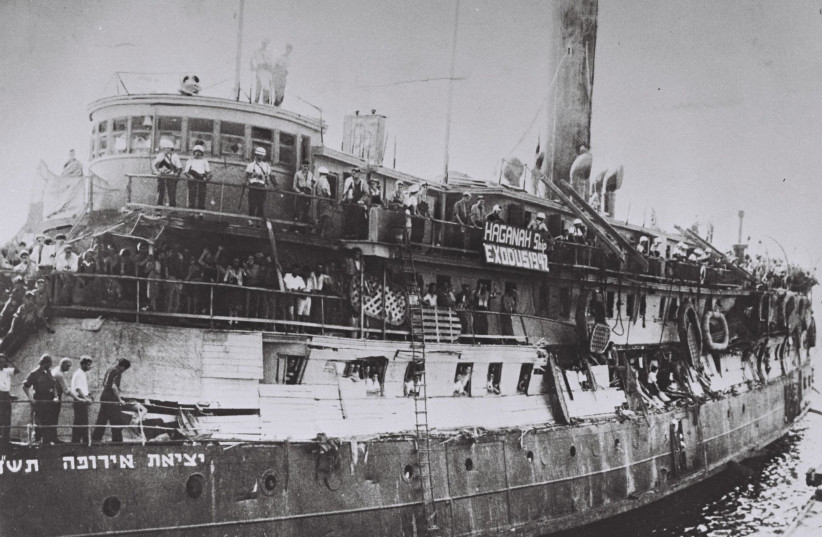
Jewish refugees prevented from entering Mandatory Palestine
Britain knew this. And yet it strengthened its efforts to prevent Jewish refugees from reaching Palestine. British authorities stopped ships carrying hundreds of Jews and, in documented cases, ordered them back toward the countries from which they had fled. In April 1939 alone, 1,229 Jewish refugees were prevented from landing in Palestine; among them were hundreds of German Jews.
For me, this is not merely history.
My father was one of those Jews fleeing Nazi persecution in 1939. He reached Palestine aboard an illegal immigration ship. I grew up knowing that his survival was not guaranteed.
According to the family story, members of the Hagana who helped organize the escape instructed the passengers to throw their passports into the sea. The idea was brutally simple: without documents identifying their country of origin, they could not simply be treated as ordinary immigrants and sent back to where they had come from.
That act of desperation meant that my father and the other passengers became, in effect, stateless refugees.
Had they been returned, they would have been sent back toward a Europe in which the Nazi machinery of persecution was rapidly becoming a machinery of extermination.
My father’s survival therefore carries for me a personal meaning that statistics never can.
This is why I find it difficult to accept moral lectures from Britain about refugees and human rights without remembering this history.
Britain did not create the Holocaust. Nor is it historically accurate to claim that Britain deliberately sent Jews to the Nazi death camps.
But Britain controlled the gates of Palestine.
And while Jews were desperately searching for a way out of Europe, Britain chose to restrict one of the few places where they might find refuge.
So before Britain lectures Israel, perhaps it should look into the mirror of its own history.
A country whose government restricted the escape of persecuted Jews while the Nazi killing machine was gathering momentum should be extremely cautious before preaching morality to the Jewish state.
Britain fought Nazi Germany bravely, and that sacrifice deserves recognition.
But military courage does not erase political responsibility.
Britain should remember both.
And before it lectures Israel, it should remember the Jews it once refused to let in.
The writer served as strategic adviser to Shimon Peres, 1990-2016.