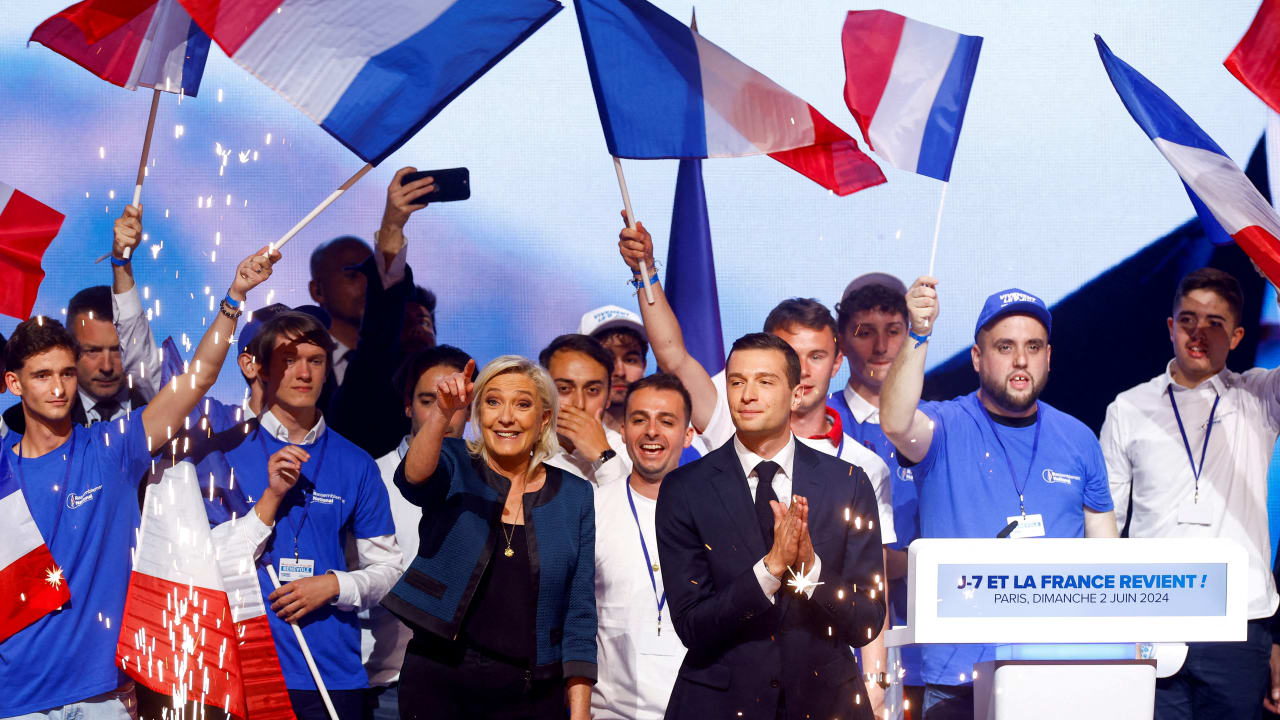
As the head of the far-right party National Rally, Jordan Bardella, expected to become prime minister if Marine Le Pen becomes president in May 2027, faces accusations of antisemitism, he has found an unlikely ally in Diaspora Affairs and Combating Antisemitism Minister Amichai Chikli, whose support reflects a profound shift in his country’s relationship with Europe’s far-right.
In February 2025, newly appointed Foreign Minister Gideon Sa’ar decided to establish closer ties with three far-right parties: Spain’s Vox, the Sweden Democrats, and France’s National Rally (RN).
A month later, Chikli organized a conference on antisemitism attended by far-right parties, including the National Rally, with Bardella in attendance.
For Marine Le Pen, this quasi-official visit to Israel was all the more significant because it focused on antisemitism, representing the culmination of a long journey since she succeeded her father at the helm of the National Front in 2011, before it was renamed the National Rally in 2018.

A dangerous alliance
It was against this backdrop that Israel’s Ambassador to Paris Joshua Zarka welcomed Le Pen in April 2026, describing the RN as a “partner with whom we can talk.”
Le Pen had sought this normalization – and the seal of approval it would confer – from the Representative Council of French Jewish Institutions (CRIF), but had never obtained it, much to the dismay of certain prominent figures in the French Jewish community, such as nazi hunter Serge Klarsfeld.
This alliance between the Israeli government and the RN, and, more broadly, Europe’s far-right, benefits both sides.
For the RN, the “Israeli seal of approval” is an essential element of its strategy to shed its toxic image by dispelling accusations of antisemitism. The aim is less to win over Jewish voters, whose political weight is negligible, than to make voting for the RN “kosher” in the eyes of the French electorate as a whole.
The massive presence of RN elected officials at the November 2023 march against antisemitism, as well as their unequivocally pro-Israel positions, stems at least as much from political calculation as from genuine conviction.
This is why the allegations of antisemitism by the investigative website Mediapart against Bardella, for words he may have uttered when he was 17, are so devastating, and why Chikli’s emphatic support for Bardella and Zarka’s leniency in the matter could play an important role in the RN’s difficult efforts to contain the fallout.
For Israel, which is increasingly isolated on the international stage, the rapprochement championed by Chikli offers the prospect of relying on parties that express sympathy for the country and share a common enemy: Islam and Muslims.
The danger for the Jewish state is that this policy will deepen its isolation among European public opinion, particularly among younger generations. Increasingly unpopular among Democrats in the United States, Israel is now taking a similar risk with Europe’s Left and centrist parties.
In France, this alienation may go far beyond the far-left party with antisemitic overtones, La France Insoumise (France Unbowed), if Israel presents itself as an ideological and political partner of the far-right.
The rapprochement between Israel and the far-right in France, brought into sharp focus by the Bardella affair, reveals a great deal about the Israeli government’s political orientation. It is implementing the goal articulated by its prime minister of turning Israel into a self-sufficient Sparta, embracing and even proclaiming its isolation.
This vision of Israel’s place among the nations will be another major issue in the October 27 election.
Born and raised in France, the writer is the correspondent of French Jewish radio, Radio J, and of the French paper librejournal.fr in the US, where he has been living for 16 years. He also holds US and Israeli citizenships. His opinions are his only.