
With the start of August and the beginning of a new week on the beaches of the Sea of Galilee, the hottest temperatures of the current summer are being measured on Sunday. In the coming hours, temperatures of 45 degrees Celsius are expected to be measured around the lake.
The Kinneret Cities Association is reminding vacationers who come to bathe in the lake to drink plenty of fluids, stay in shaded areas, and protect gas canisters for cooking from direct sunlight, out of fear that they might ignite due to the heavy heat.
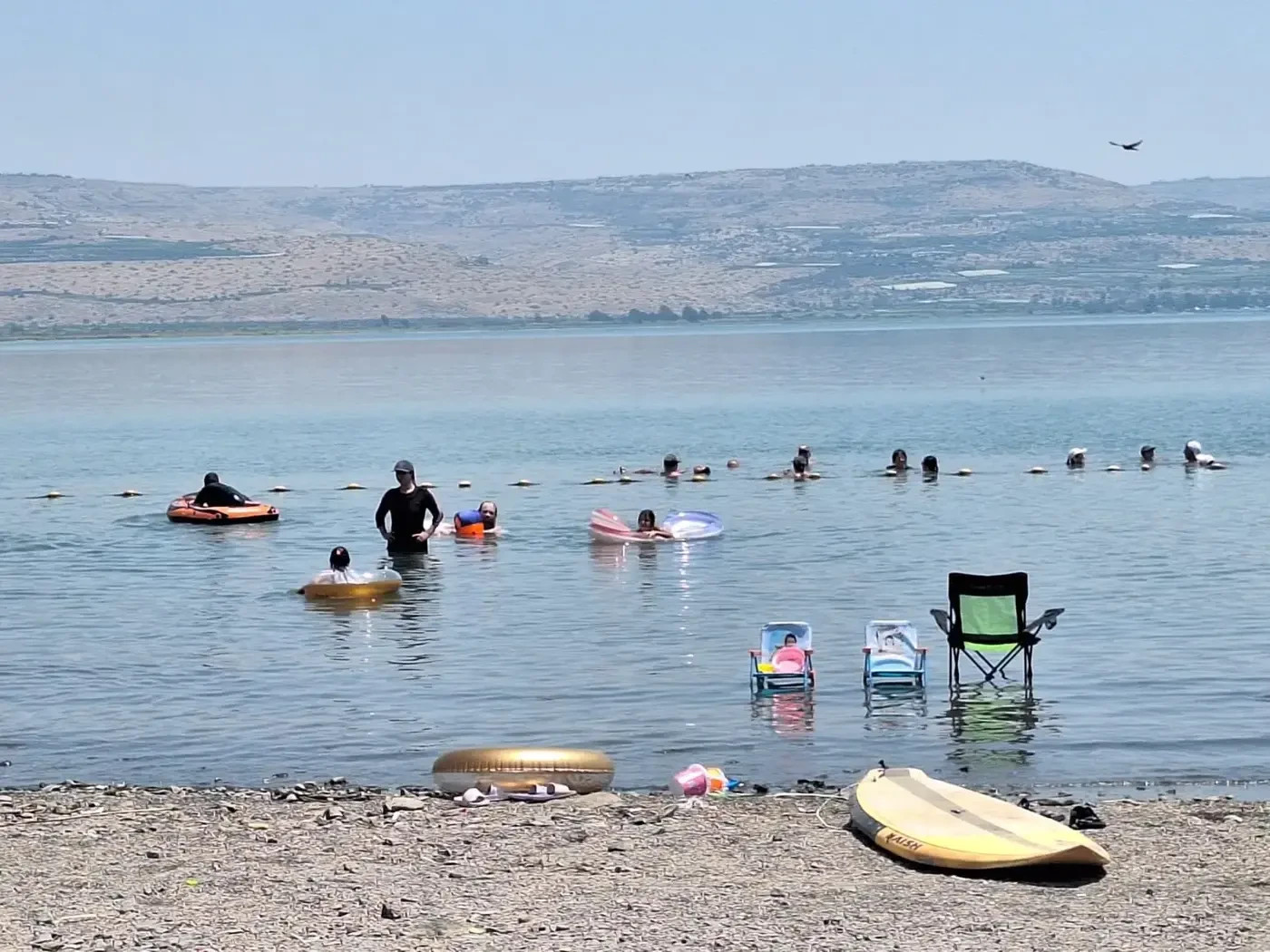
Along with the heatwave, on Sunday morning the water level of the Sea of Galilee was also measured at a height of 213 meters below Mediterranean Sea level. This is a water level height that in the past was defined as the "lower red line." The arrival of the Sea of Galilee's water level at -213 meters is a sort of warning light regarding the condition of the Sea of Galilee. However, over the years, the Sea of Galilee's water level has already dropped to lower points. "We see the recession of the Sea of Galilee every day," says Aviad Ben-Hur, manager of Amnon Beach in the Kinneret Cities Association. "As a result, the staff is required to repeatedly move the lifeguard stations and the Jet Ski cage deeper into the new shoreline. We have experienced similar situations of level drops in the past, and more than once a single rainy winter came afterward that corrected the situation and brought the water back, and we are all hopeful that it will be the same in the coming winter."
Historical negative record for the water level - at the end of summer 2001
Even in the past decade, lower levels were already measured at the beginning of August. For example, on this day eight years ago, the water level was 1.04 meters lower compared to today. In the distant past, the -212 meter level was set as the official lower red line. This line was based mainly on engineering pumping limitations of Mekorot pumps at the Sapir site. Below this height, the operational efficiency of the pumps was impaired and there was concern for system stability.
Following a sequence of severe drought years in the late 1980s, the Sea of Galilee's water level continued to drop and approached -212 meters. In order to continue supplying water for household and agricultural needs and not stop pumping, it was decided to lower the lower red line to -213 meters. At the end of the summer of 2001, the water level reached a historical negative record of -214.87 meters, meaning 1.87 meters below the lower red line. At that time, a new line was also defined: The black line (-214 meters). This is a water level height beyond which pumping is completely prohibited, out of fear of causing ecological damage to the lake and severe harm to the tourism sector.
"Vacationers continue to arrive"
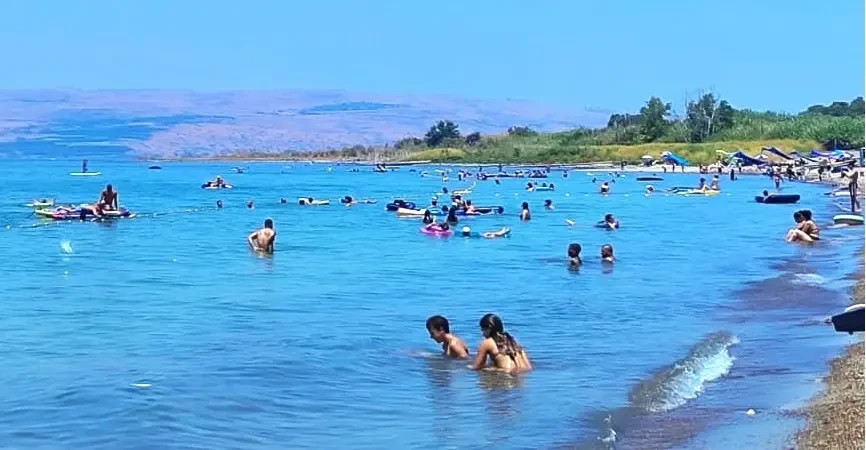
"Despite the heavy heat load, vacationers continue to arrive at Amnon Beach," Ben-Hur adds. "As someone who manages the beach and has worked at the Sea of Galilee for about ten years, this heat is not unusual in my eyes. I have experienced such days and even hotter ones, and almost every summer there are similar temperatures. However, it is clear to me that for vacationers arriving from outside, these are not easy conditions at all.
"In order to protect public health, we operate a public address system covering the entire beach area and reminding bathers every half hour to be sure to drink plenty of water and stay in shaded compounds. For the well-being of vacationers, water fountains with cold drinking water are available at the beach for everyone."