

The air in Jerusalem transitions without warning. One moment you are negotiating the dense, limestone-packed rhythms of the city center; the next, you drop into a valley where the scent of wild sage, ancient olive groves, and mountain pine takes over.
My wife, Adi, and I came down the winding slopes into Ein Kerem on a warm weekend afternoon, seeking something beyond mere leisure.
In our work documenting wellness travel and regenerative tourism, we have found that true healing lives where the earth is allowed to speak through its layers, and where a community builds spaces designed to contain, restore, and elevate the human spirit.
What we found is a village that functions as an absolute anomaly within the Israeli landscape, an intact historical capsule closer to an ancient Italian or Greek mountainside than to the city above it, a capsule where every house absorbs the holy air of nearby Jerusalem while preserving a pocket of absolute peace.
A profound thread revealed itself throughout: Ein Kerem is structurally and spiritually built, preserved, and energized by women. From its ancient scriptural origins to its modern social enterprises, this valley’s blueprint is one of female empowerment, maternal sanctuary, and radical hospitality.
The threshold of silence: The Khan Ein Karem Boutique Hotel
Our anchor and home base was the Khan Ein Karem Boutique Hotel, a sanctuary hidden among the village’s upper terraces, from which every adventure, historical dive, and restorative encounter we experienced branched outward and returned.
The building is a traditional rural Arab stone house dating to the 1880s, constructed directly into the hillside to use the earth’s natural insulation, a passive therapeutic architecture that predates every modern wellness concept by a century.
What gives its story a particular intimacy is that Tomer, who runs the hotel alongside our host Roy, actually grew up within these very walls until the age of seven.
After the property stood abandoned for many years, they spent two years on a meticulous renovation before opening their five-room boutique hotel in 2021, at the height of the COVID-19 pandemic, an act of faith in the enduring restorative pull of this valley.
The Khan Ein Karem runs as a family business in the fullest sense, offering the kind of personal attention that no chain hotel can manufacture. Roy and Tomer are present hosts who know their guests by name and by nature.
The hotel’s massage therapists extend this philosophy directly into the body.
Rona, a therapeutic massage practitioner with four decades of experience, offers treatments through the hotel that carry the quiet authority of someone who has spent a lifetime in the craft.
Victoria Kortsenshteyn, a certified medical massage practitioner and student of Tuina, welcomes guests to her quiet studio at Beit Hagat, nestled among the greenery of Ein Kerem, where she practices manual therapy with thoughtful care to help release muscular tension, restore ease of movement, and support the body’s remarkable capacity to adapt and heal.
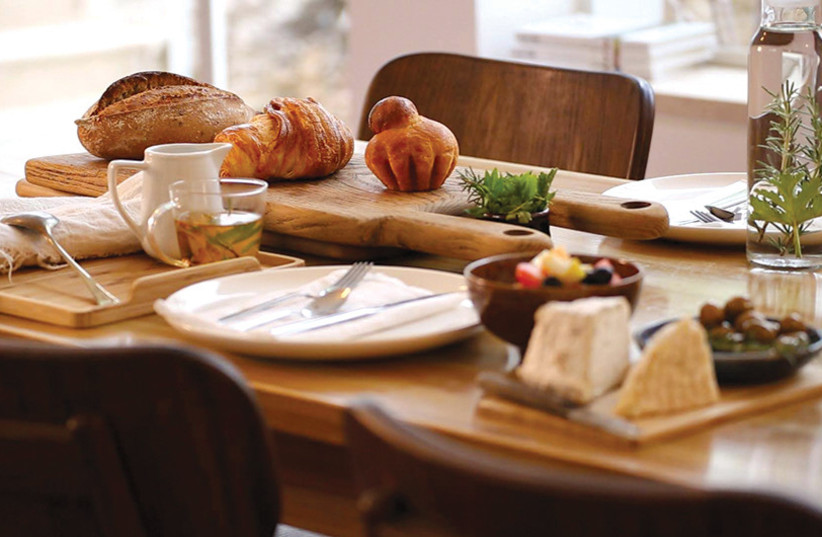
Mornings unfold in the hotel’s dining room over a full prepared spread: eggs, fresh salads, warm breads, local cheeses. The public rooftop terrace opens onto the village’s stone rooftops and the surrounding Jerusalem hills in one unbroken panorama, the kind that makes conversation stop.
“We wanted to reveal the natural dialogue between the new and the old stone,” Roy told us, “showing exactly what is historical and what is contemporary.”
This principle, honoring what exists while breathing new life into it, is itself a healing philosophy, and one that pervades every corner of Ein Kerem.
Ein Kerem draws roughly three million visitors a year. Before October 7, over 70% of the Khan Ein Karem’s guests were international travelers. After the war, foreign tourism dropped to zero overnight, and yet the hotel’s occupancy doubled.
“As the general security situation in Israel gets worse, there is more work here,” Roy told us. “People drive 10 minutes from their home in Geula, and they are in another world.”
He captures the singular spirit of the place in one image: “The mess, the colorfulness, this multiculturalism: the priests walking in the alleys alongside an anthroposophical family where the father walks barefoot with a flute and seven kids behind him, and the Jerusalem tourists. It’s wonderful.”
When coexistence is allowed to function naturally, it becomes its own form of restoration.
Living water: Springs, sanctuaries, and sacred ground
To understand Ein Kerem’s therapeutic energy, one must trace its water. For over three millennia, this valley has been shaped by settlement centered on its natural springs, an ancient infrastructure of physical and spiritual cleansing that every culture here has inherited and added to.
We walked down ancient stone steps toward Mary’s Spring, where Christian tradition places the sacred meeting of Mary and her relative Elizabeth. Upon their embrace near the rushing spring waters, the unborn John the Baptist leaped in the womb with prophetic joy, an event commemorated by the elegant Church of the Visitation on the hillside above.
This scriptural foundation roots the entire village in a narrative of maternal connection, fertility, and the healing power of encounter.
The valley holds ancient mikvaot, Jewish ritual baths dating to the First and Second Temple periods, many of them beneath the floors of modern private residences, their therapeutic function embedded literally within the domestic life of the village.
According to Christian tradition, John the Baptist operated within these same waters to introduce a new model: a lifelong spiritual baptism meant to permanently purify the human soul.
Adventurous travelers can still crawl through a rock-cut tunnel to reach a mikveh at the very source of the local spring, a full-body encounter with the valley’s oldest healing system.
The historical record amplifies what the earth holds. The valley is identified as the biblical Beit Hakerem, mentioned in Jeremiah and Nehemiah, its springs appearing in the Copper Scroll among the Dead Sea Scrolls. Israeli geographer Yehoshua Ben-Arieh called it “the most important village west of Jerusalem.”
When war came in 1948, the Arab residents fled, leaving their stone houses almost entirely intact; into them came Mizrahi Jewish families from Morocco, Iraq, Yemen, and Egypt.
Our host and guide Yuval Zohar holds a further perspective: that Ein Kerem’s original Jewish inhabitants from the Second Temple period never truly left, but converted across the centuries as rulers changed, their descendants building the very terraces we now walk.
Yuval led us through the narrow valley paths to a viewpoint behind the Russian Orthodox Church compound, where a boardwalk runs parallel to the light rail toward Hadassah-University Medical Center. As the sun descended, the brilliant yellow onion domes of the Russian church pierced the golden sky, ancient monastic silence meeting the gentle movement of the city’s modern veins.
“The topography of Ein Kerem forces a gentler flow,” Yuval noted. “The architecture follows the water, creating an environment of inclusive coexistence and mutual respect.”
At the Greek Orthodox Church of St. John, our host Father Khariton embodied that same spirit: while his church holds its own tradition regarding John’s birthplace, they fully recognize and respect the nearby Catholic site.
This modeled coexistence is itself a form of communal wellness, a demonstration that different truths can share the same landscape without competing for oxygen.
Found fabrics and stone stories: The Ancient House and the founding women
A short walk from the springs brought us to The Ancient House, Habayit Ha’atik, tucked in the village’s historic core.
Our host Shoshana, a local poet and former Arabic and Middle East studies teacher, left teaching after a vivid dream in which she found herself weeping in school hallways, and has since devoted her life to oral storytelling, historical preservation, and female-led cultural tourism.
The home is a physical timeline, five separate stone structures connected in one architectural puzzle. Ottoman design gives way in the lower levels to massive Crusader-era vaulted chambers once used as livestock pens.
The home’s greatest discovery came by chance 16 years ago, when the clearing of a concealed pit revealed a beautifully preserved Second Temple-period winepress with an extraordinary floor: a delicate white mosaic, a luxury detail almost entirely unseen in ancient agricultural presses across Israel.
Because wine for the Holy Temple demanded strict ritual purity, treaders first immersed in adjacent mikvaot before stepping onto that floor. Healing through purification has always been this valley’s primary language.
Today, Shoshana operates as a dedicated historical researcher, hosting a storytelling performance called “Sultana’s Love Party” that honors the forgotten Moroccan immigration to Israel.
Cross-referencing and verifying multiple historical resources, she has documented how nearly 10,000 religious Moroccan Jews made the hazardous journey over a 40-year period up until 1842 – long before the secular “First Aliyah” appears in conventional textbooks.
The mosaic floor may be viewed from the stone ledge, but stepping onto it is strictly forbidden.
Walking deeper into the village center, we encountered the “Founding Women of Ein Kerem” murals, vivid paintings dedicated to the Moroccan, Yemenite, Kurdish, and European pioneers who built the modern village in the late 1940s and 1950s.
Kurdish women restored the ancient stone terraces; Moroccan and Yemenite matriarchs established home craft industries preserving traditional textile arts and silverwork.
Shoshana confirmed what the murals make plain: the majority of modern hospitality, agricultural preservation, and tourism initiatives in the village are conceived, owned, and operated by local women. A village built and sustained by maternal energy carries a particular quality of care in everything it offers. That, too, is healing.
Ein Kerem does not announce itself as a wellness destination. It simply is one, the way a spring is simply water. The stone holds the history, the water holds the memory, and the women who built this village hold both.
For the traveler arriving from the noise of the city above, the valley does something no retreat center can engineer: it slows you down through sheer depth.
In Part II will appear the people who live and work inside this place, and the remarkable healing philosophies they practice.
The writer was a guest of the hotel.