
Route 40 serves as one of the primary arteries traversing the Negev Highlands, yet travelers rushing between Sde Boker and Mitzpe Ramon miss a vibrant world just off the asphalt. Tucked along this corridor are Bedouin hospitality tents, scenic hiking trails, family-run farms, off-road tours, and a groundbreaking vineyard resurrecting grape varieties used in winemaking 1,300 years ago.
This journey through the Negev Highlands connects visitors not only to striking desert landscapes, but to the people who shape them. The diverse itinerary spans Bedouin villages where hosting is a way of life, the pale rock formations of Nahal Havarim, a family goat farm, and jeep excursions reaching deep into the terrain. The final stop at Ovdat steps back in time to explore Byzantine-era viticulture reborn. Whether tackled as a day trip or expanded into a multi-day getaway, this stretch proves the drive to Eilat is far more than a road to cross - it is a destination in its own right.

The Tents Route: Knowing the desert through its hosts
The journey begins along the "Tents Route" (Derech Haohalim), a tourism initiative established in 2018 that connects Bedouin hospitality centers between Sde Boker and Mitzpe Ramon. Winding through the villages of Ramat Tziporim, Abde, the Nahal Hava Triangle, and Nahal Aricha, the network provides sustainable income for approximately 14 local families.
Rather than a commercial tourist center, the initiative offers authentic family hosts. Depending on the stop, visitors can enjoy traditional meals, sip coffee and tea, participate in cultural workshops, or join a shepherd on a herd-grazing tour. Experiences take place in the hosts' daily living environments.
Overnight options range from shared Bedouin tents and air-conditioned family khushas to couples' suites and private campsite pitches. The shared tents accommodate up to 25 guests with mattresses, gas stoves, and refrigerators, alongside optional breakfast and dinner. The off-grid living conditions reflect local life, relying on solar power and local water supply.
- Pricing: Shared tent: NIS 100/person; Air-conditioned khusha: NIS 200/adult, NIS 150/child; Couple's suite: NIS 100/person. Dinner: NIS 120/person; Breakfast: NIS 50.

Nahal Havarim: A familiar trail from a different angle
Continuing down Route 40 leads to Nahal Havarim alongside veteran tour guide Ofer Levy, known as "Ofer Hamidbar". Beyond the classic trail, Levy guides visitors through the lesser-known upper section of the stream. A 2.5-kilometer circular route starting at the Bor Havarim parking lot offers an accessible 90-minute walk for families traveling in a single vehicle.
The route descends into the Havarim Cistern (Bor Havarim), follows the dry riverbed, and ascends a flint slope where pale chalk rock gives way to dark, striking flint layers. A longer, linear trail through the upper stream is also available for groups with two vehicles or arranged shuttles. Hikers on either route should carry trail maps or navigation apps and adhere strictly to marked paths.
Photographer Noa Bernat frequently pairs with desert excursions for her Regaim Bitnua (Moments in Motion) workshop. Designed for smartphones rather than professional gear, the hands-on session teaches participants to manipulate light, shadow, composition, reflections, and camera angles. Bernat also offers full-moon night photography and self-expression phototherapy workshops.
- Ofer Hamidbar Tours: Guided and moonlight tours by advance registration via the website.
- "Moments in Motion" Workshops: 60 to 90-minute sessions for all skill levels. Contact: 052-3379031.
Naot Farm: Family, goats, and off-grid lodging
Agriculture and hospitality converge at Naot Farm. Established in 2003 by Lea and Gadi Nakhimov, who relocated from central Israel with their six children to raise goats, the site has evolved into a premier agritourism estate featuring a dairy, farm store, bistro, and accommodations.
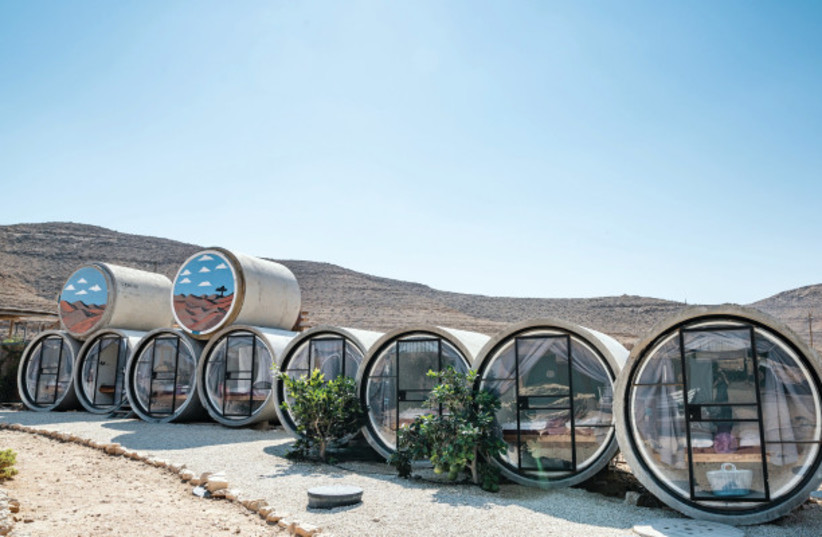
The dairy produces soft, hard, and mold-ripened goat cheeses alongside yogurt, all available at the farm shop or featured in the on-site menu. Guest accommodations comprise six private cabins and 14 cylindrical units in the "Tsavta" complex. Cabins feature private plunge pools, hammock balconies, fire pits, grills, fully equipped kitchens, and delivered breakfasts. Three cabins cater to couples, two to families, and one larger unit sleeps extended groups across five bedrooms.
Day visitors can drop by the Train Bistro, join Friday sunset yoga, or take summer Thursday night scorpion tours led by Ofer Levy.
- Pricing: Cabins: NIS 1,200–1,600/night; "Karon Pipe" units: NIS 490–590/night; Breakfast for pipe guests: NIS 75/person.
- Bistro Hours: Open daily, 9:00 AM – 5:00 PM.

The Sela family: The jeep is the means, not the destination
To reach deep desert expanses inaccessible to standard vehicles, the Sela Family Desert Tours Center offers expert-led off-road excursions. Founded in 1991 by Adam Sela and co-run with his son Nadav, the center navigates the Ramon Crater, Zin Valley, Sde Boker region, High Negev Mountains, and the ancient Nabataean Incense Route.
Here, 4x4 vehicles serve as a gateway to hidden terrain. Guided trips combine driving with scenic stops covering geology, wildlife, archaeology, and regional history. Outings range from 2-hour overviews to 8-hour full-day expeditions, including sunrise crater runs and Ein Akev treks. The center also organizes stargazing, rappelling, guided hikes, field meals, and navigation challenges.
- Jeep Tours: 2 to 8 hours; rates vary by duration, route, group size, and vehicle count.
- Details: 050-5308272

Ovdat: Ancient wine returns to the vineyard
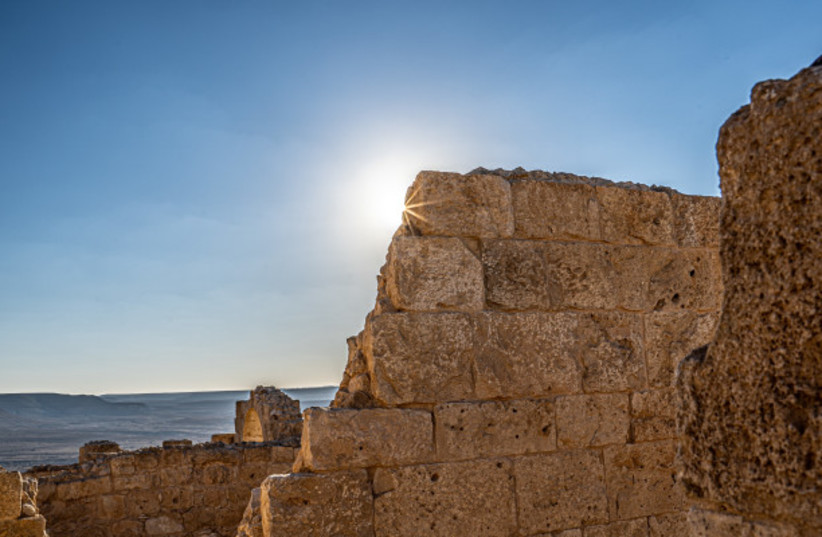
The final stop at Ovdat National Park steps back 1,300 years into the Negev’s agricultural peak. During the Byzantine period, the region flourished as a winemaking hub, cultivating vines in arid conditions through terraces, dams, and runoff channels. Negev wine was exported across the Mediterranean via the ports of Gaza and Ashkelon.
Between 2017 and 2019, archaeological digs at Ovdat uncovered preserved, charred grape seeds. DNA testing linked these seeds to ancient varieties, including Sariqi, Be'er, and Dabouki. Researchers subsequently identified surviving wild remnants of these vines, took cuttings, and in September 2023 planted a heritage vineyard within a restored Byzantine farm at Ovdat.
The heritage plot replicates historical cultivation methods, including bush vines and trellises, alongside a fully restored Byzantine winepress. Within two years, the disease-resistant vines yielded their first harvest: 300 kg of Sariqi, 100 kg of Be'er, and 30 kg of Dabouki. Natural, additive-free wines were produced, successfully recreating authentic Byzantine-era vintages. Future plans involve testing ancient runoff irrigation techniques and aging wine in reconstructed amphorae.
Stopping along the way
While many travelers speed past the stretch between Sde Boker and Mitzpe Ramon, Route 40 provides ample reason to hit the brakes.
From morning coffee in a Bedouin tent and a hike through Nahal Havarim to local cheese tastings at Naot Farm, off-road desert tracks with the Sela family, and a sip of ancient history at Ovdat, the Negev Highlands deliver an unmatched traveler's experience where local tradition, entrepreneurship, and history meet.