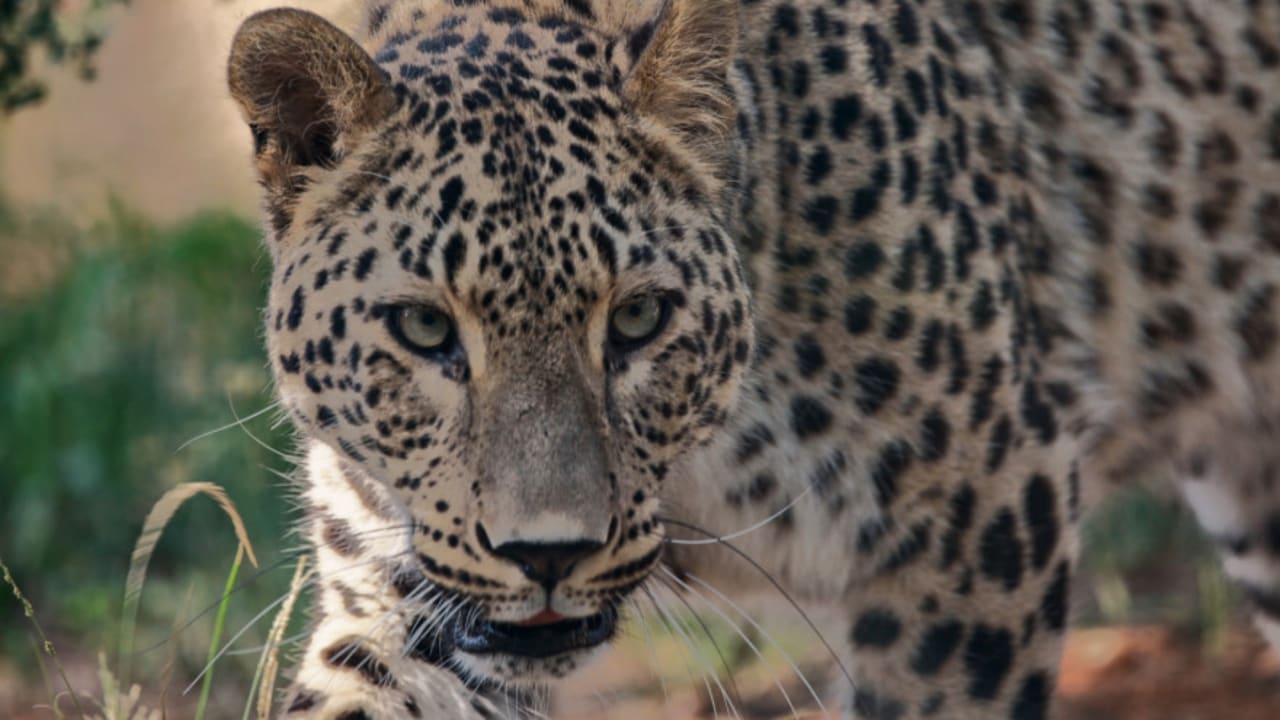
A new resident has arrived at the Safari in Ramat Gan: A young Persian leopard born on June 20, 2024, at the Nordens Ark Zoo in Sweden. There he was named Astroff, and in Israel he was given a new name, Deni, after basketball star Deni Avdija. The leopard arrived in Ramat Gan after a lengthy process of coordination between the Safari and the Swedish zoo. He is designated to become the mate of Noa, the female Persian leopard living at the Safari, where staff hope they will produce cubs in the future.
Deni’s handlers in Sweden described him as a calm and curious leopard who loves to eat, with his favorite food being rabbit meat. At the Safari, staff are just beginning to get to know him, but they say the initial impression matches those descriptions. Deni is accustomed to the presence of handlers and visitors, and back in Sweden he underwent training that acclimatized him to veterinary care, similar to the procedures conducted at the Safari. Staff therefore hope that it will soon be easy to see him in the enclosure.

"We chose to name the leopard after Deni Avdija, who in our eyes represents excellence, perseverance, and hard work," said Safari spokesperson Hilla Feldman Gera. "We hope the new leopard will also contribute in the future to the success of the breeding program and to the conservation of this rare species."
Avdija himself reacted to the gesture: "It is not every day that a leopard is named after you. It is a great honor and a gesture that truly moved me," he said, promising to visit the Safari to meet the leopard.
A gradual process of adjustment
Deni was selected as part of the European Association of Zoos and Aquaria (EEP) conservation and breeding program for Persian leopards. His introduction to Noa will be gradual. During his first few days, he will stay in the night shelter to adjust quietly to his new environment, its sounds, its smells, and the care team. Only when he feels secure will he step out into the enclosure in stages. Even then, the two will not meet immediately: First, Deni will get used to Noa’s scent and her presence nearby, and only later, depending on the behavior of both leopards, will the process of bringing them together begin.

Noa arrived at the Safari from France in 2022. She was named after singer Noa Kirel and her song "Pantera," (female panther) in the days leading up to the Eurovision Song Contest where Kirel represented Israel. Before that, a Persian leopard named Cyrus lived at the Safari, having arrived from the Athens Zoo in 2018 and also participating in the European breeding program. Cyrus died at the end of 2025 from an intestinal disease.
The struggle to save an endangered species
The Persian leopard is one of the largest subspecies of leopard, living primarily in mountainous regions. Most of its global population is in Iran, and it can also be found in Afghanistan, Armenia, Azerbaijan, Georgia, Turkey, Turkmenistan, Pakistan, parts of Iraq, and other areas in Central Asia. Its population has diminished significantly, and today it occupies only 16%-28% of its historical range. According to estimates, between 750 and 1,044 Persian leopards remain in the wild, of which 450 to 626 are adults. The population continues to decline, and the subspecies is classified as endangered.
Zoos also play a role in reintroducing the leopard to the wild. In Russia, a breeding and rehabilitation center was established that received leopards from Iran, Turkmenistan, and European zoos. The leopards were raised there with minimal human contact to prepare them for hunting and independent survival. Since 2016, leopards have been released into the wild in various areas of the Caucasus, and their survival in new locations is being monitored. Zoos maintain a population that is coordinated from both a genetic and demographic standpoint. They supply individuals for breeding and reintroduction programs and serve as a backup population for the subspecies.