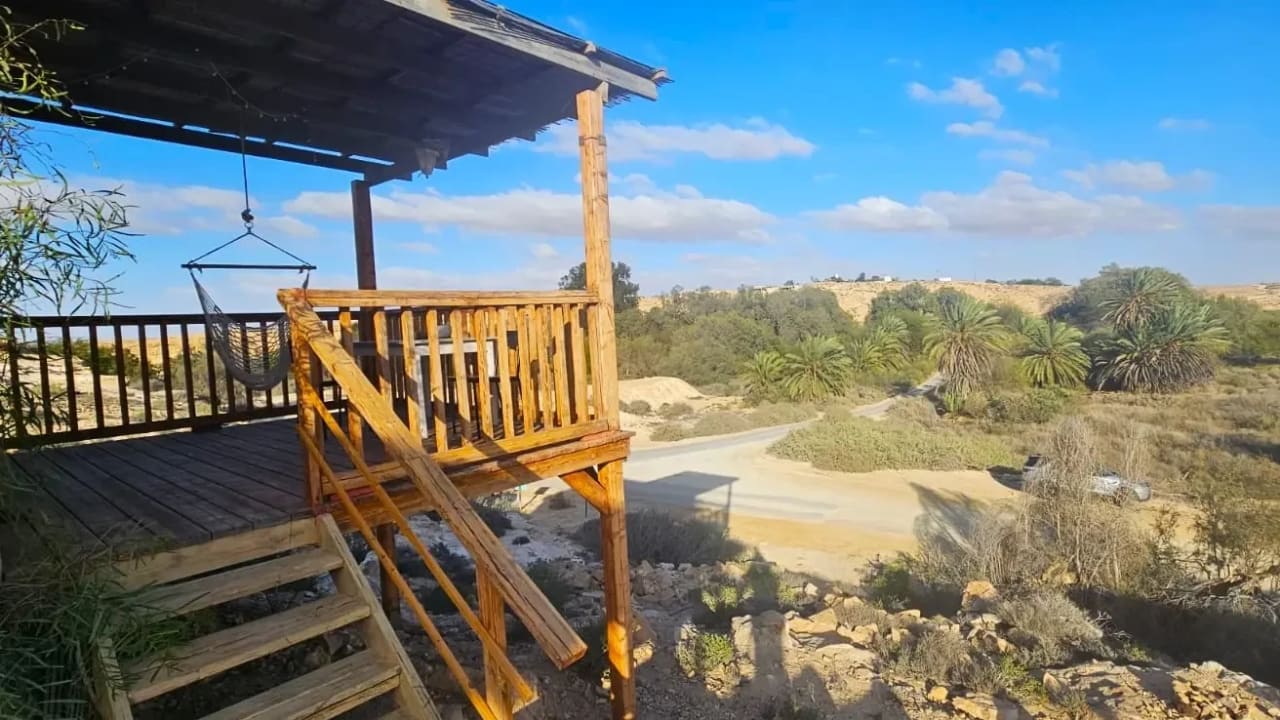
The desert community of Ezuz, located near the Egyptian border and the Nitzana enclave, is heading toward a significant transformation: The management of the Israel Land Authority (ILA) has approved the framework for regulating the community and turning it into a tourist village, which will include hundreds of accommodation units, a hotel, and commercial and business complexes supporting tourism. The move is intended to regulate existing construction and activity at the site and allow its future development, while preserving the community's isolated and unique character.
The decision was adopted at an ILA management meeting on October 14, 2026, chaired by acting ILA director Yehuda Eliyahu. Ezuz is located within the Ramat Hanegev Regional Council, about 12 km. south of Nitzana and about 3 km. east of the Egyptian border.
From a grazing lookout to a tourist village
Ezuz was established in 1983 following a government decision, initially as a grazing lookout inhabited by five families. Over the years, it developed into a type of community settlement with unique characteristics, and currently 18 families accepted through the Jewish Agency reside there.
Guest complexes and tourism businesses developed on the initiative of residents operate in the community, built over the years without full planning authorization. This activity shaped the character of the site, where desert quiet, distance from population centers, and an isolated environment form part of the tourist appeal.
An initial plan to regulate the community was promoted in the early 2000s, but was not implemented. Consequently, a new plan was advanced, designed to authorize existing construction and expand development possibilities for Ezuz as a tourist village.

316 accommodation units, a hotel, and an archaeological park
The plan spans an area of about 800 dunams (198 acres) and includes 83 residential lots, on which 174 housing units are planned, alongside tourism and commercial lots and 316 vacation units. In addition, the plan includes a hotel, sports and recreation areas, and complexes for businesses supporting tourism activity.
Under the approved framework, existing residential and guest complexes will be authorized, and the creation of mixed-use lots will be enabled, allowing residential living alongside tourist accommodation, workshops, cafes, restaurants, and galleries.
The planning takes into account the topography of the area, the nature of isolated desert tourism, and the location of archaeological sites. Among other things, plans call for establishing an archaeological park in open areas, in coordination with the Israel Antiquities Authority.
ILA officials emphasized that the division of lots is intended to allow economic and tourism development without harming the characteristics that made Ezuz a community with a different character from other community settlements.
'Infrastructure for the continued development of the community'
ILA acting director Yehuda Eliyahu said: "The regulation of the community of Ezuz, after many years in which it operated without planning authorization, is a significant step that provides an answer to the existing reality and lays an infrastructure for the continued development of the community. The Israel Land Authority is working to promote planning that will enable the regulation of the existing situation, address the needs of residents, and maximize the tourism and economic potential inherent in the site. With God's help, the move will strengthen local tourism and business activity, encourage the creation of employment sources, and establish Ezuz as a community with a significant contribution to the development of the Negev."
Shai Karap, director of the ILA's Southern Region, said the move is a significant step in strengthening the Negev and advancing it as Israel's development reserve, expressing the authority's commitment to the national vision of developing the South.

Ramat Hanegev Regional Council head Eran Doron also welcomed the decision: "The regulation of the community of Ezuz is important news for settlement in Ramat Hanegev and for strengthening settlement in the Nitzana enclave. This is an example of the pioneering spirit of families who chose to establish their home in the heart of the desert and build a unique community. Today's decision is a significant step after many long years, and it will allow the regulation of existing structures and create a horizon for the continued growth of the community, while preserving its special character."
Doron added that alongside the regulation, investment in infrastructure and services is required to allow communities in the Negev to grow, noting that much work remains to promote settlement and develop the region.