
At a time when Israel is facing complex challenges from the war, rising living costs, and growing uncertainty among Jewish communities worldwide, the Aliyah and Integration Ministry is seeking to highlight another reality: opportunities, renewal, and a strengthening connection between Israel and Jews considering building their future in the country.
Rising antisemitism and concerns over Jewish safety in various countries do not eliminate the challenges facing potential immigrants, but they have reinforced Israel’s role as a home open to Jews seeking to build lives, study, work, and integrate.
Aliyah and Integration Ministry Director-General Dganit Sankar-Langa does not ignore the obstacles facing aliyah, but she rejects the notion that immigration to Israel is in decline. Instead, she remains optimistic about the future.
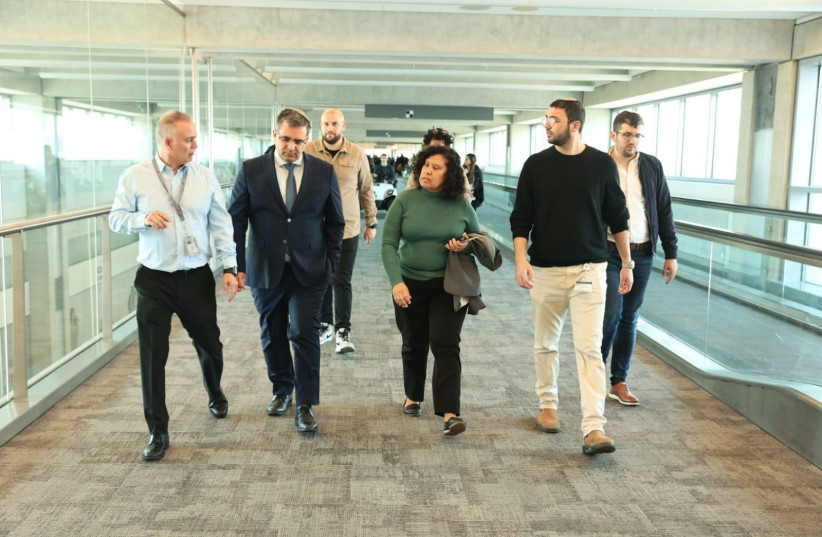
Last week, Sankar-Langa welcomed approximately 150 new immigrants at Ben-Gurion Airport who arrived on six Nefesh B’Nefesh flights from North America. The flights were organized in cooperation with the Aliyah and Integration Ministry, the Jewish Agency, Keren Kayemeth LeIsrael, and Jewish National Fund USA.
In a special holiday interview with Walla, Sankar-Langa said the data reflects a system undergoing change. While the number of Israelis returning to the country has declined and aliyah numbers have not risen sharply, she said interest is growing among Jews in France, Britain, South Africa, and Australia, along with demand for study, employment, and absorption programs tailored to different communities.
According to estimates, approximately 15.5 million Jews currently live around the world, with more than half residing in Israel. Around six million Jews live in the United States alone, meaning the potential pool of future immigrants from the US is measured in the millions, even though the number of people who ultimately make aliyah remains relatively small.
Sankar-Langa said encouraging aliyah requires more than broad appeals to immigrate. She said Israel must create practical pathways that allow people to envision a future in the country, including English-language academic programs, support for scientists, early connections with employers, and assistance frameworks for immigrant families and soldiers.
The goal, she said, is to transform aliyah from a distant possibility into a realistic plan that people can prepare for, carry out, and succeed in.
"Generally speaking, our average number of immigrants over the past decade has ranged between 20,000 and 30,000 per year, except for the exceptional period involving Russia and Ukraine," Sankar-Langa said.
According to her, Israel is expected to receive between 18,000 and 20,000 immigrants in 2026.
"We are seeing a very significant increase from France. We expect to reach around 5,000 immigrants from France by the end of the year, a number not seen in many years. We are also seeing a large increase from Britain, as well as more aliyah from South Africa and Australia."
Sankar-Langa said the two primary barriers preventing more Jews from immigrating to Israel today are the cost of living and the country’s security situation.
However, she believes the difficult circumstances facing Jewish communities abroad will influence aliyah trends in the coming years.
"I think we will see the impact on aliyah within a year, two years, or three years," she said. "There is very strong academia here, strong communities, and the possibility of Jewish education and Jewish life. These are major factors drawing people to Israel, alongside the barriers that hold people back, mainly the cost of living and the security situation."
From US campuses to Israeli universities
One area where the ministry sees significant potential is higher education.
Against the backdrop of growing concerns over antisemitism and hostility toward Israel on some US university campuses, the ministry is working to expand English-language academic programs in Israel.
The issue has become increasingly relevant for Jewish families considering where to send their children for higher education, particularly as some students and parents have expressed concern over campus environments where anti-Israel and antisemitic incidents have increased.
According to Sankar-Langa, around 5,000 immigrant students are currently studying in Israel at any given time.
In recent years, English-language academic programs, which began at Reichman University and other institutions, have expanded to additional institutions, including the Technion, Ben-Gurion University, and Ariel University.
"We meet American Jewish families, including those that are very deeply rooted in the United States, who are increasingly examining the possibility of academic studies in Israel," she said.
"We are trying to allow young people to begin their studies here in English and later integrate into Israel."
Another area of focus is bringing senior scientists and researchers to Israel.
According to Sankar-Langa, the "Or" and "Bereshit" programs, developed in cooperation with Prof. Dan Shechtman, aim to attract leading researchers by offering selected scientists research positions and grants that can reach approximately NIS 1.5 million, and in some cases up to NIS 1.7 million, over a period of three to five years.
"Although these are only a few dozen scientists, each one of them is a diamond," she said. "These are people we do not want to lose as part of the brain drain."
Against the backdrop of global concerns over academic environments, the ministry is seeking to expand opportunities for English-language studies in Israel.
Teachers and doctors are already a priority
With a background as a senior officer in the IDF Manpower Directorate, Sankar-Langa describes the Aliyah and Integration Ministry as "the human resources department of the State of Israel."
The ministry, she said, is no longer focused only on encouraging immigration in general terms. Instead, it is working to identify professionals abroad whose skills Israel needs and connect them with employers before they arrive.
A new initiative launched together with the Education Ministry and Nefesh B’Nefesh aims to recruit Jewish teachers from abroad, particularly in English and the sciences.
"We are planning aliyah fairs for teachers abroad," she said.
"The idea is that before they arrive, they will already know that they have been accepted by the Ministry of Education, which school they will work at, which municipality they will live in, and how their children will integrate into the education system. The goal is that one week after their arrival, they will already be able to start working."
According to Sankar-Langa, the shortage of English teachers is especially noticeable in central Israel, where English speakers often have more financially attractive career options and therefore fewer choose teaching as a profession.
The ministry is also focusing on bringing medical professionals to Israel.
Sankar-Langa said that more than 1,000 doctors have immigrated to Israel over the past two years.
Some of them, particularly those from the United States, continue working in both countries and divide their time between Israel and their previous places of employment.
Estimates suggest approximately 1,300 doctors have left Israel since October 7, 2023.
The figure highlights the broader challenge facing Israel and the complexity of the ministry’s work.
The ministry is also working to recruit professionals with expertise needed in Israel’s defense industries, infrastructure sector, and major national projects, including the light rail and metro systems.
"We go out with companies to employment fairs abroad and identify people with expertise that Israel does not have enough of," she said.
"There are professionals around the world who have accumulated experience in railway systems spanning hundreds of thousands of kilometers, experience that almost does not exist here."
"The goal is that one week after their arrival they will already be able to start working."
Immigrant soldiers face challenges after discharge
The war also exposed gaps in the support provided to immigrant soldiers and their families.
According to Sankar-Langa, immigrant soldiers receive a support system from the IDF during their service, but after they are discharged, they can sometimes find themselves without sufficient assistance.
The government recently approved a plan under which the Aliyah and Integration Ministry, the Defense Ministry, and the Diaspora Affairs Ministry will establish a support framework for immigrant soldiers, reservists, and their families.
"We are trying to see how to provide and make assistance accessible both to the soldier himself and to the family, to siblings and wives," she said.
She described the case of the wife of an immigrant who was called up for two months of reserve duty and had to manage her workplace and household responsibilities alone, without the extended family and community networks that many veteran Israelis rely on.
"They do not necessarily have supporting organizations, and they do not always have the support system that others receive. We are investing a great deal of thought in this."
Around one million Israelis abroad, but fewer are returning
While the ministry is working to encourage Jewish immigration to Israel, data presented this week to the Knesset’s Immigration, Absorption and Diaspora Affairs Committee highlights another challenge: bringing back Israelis who have already left the country.
According to estimates, around one million Israelis, including children born abroad to Israeli parents, currently live outside Israel.
Data from the Knesset Research and Information Center shows that between 2005 and 2024, approximately 141,000 returning residents came back to Israel, averaging about 7,000 per year.
However, in 2025, only 4,483 Israelis returned, compared with 10,903 in 2009, representing a decline of 58%.
In 2024, the number was even lower, with only 3,793 returning residents.
According to estimates, around one million Israelis, including children born abroad to Israeli parents, currently live outside Israel.
Sankar-Langa, 58, was born in the moshav of Nehora in the Lachish region to parents who immigrated from Iraq and India and were among the founders of the area.
She served in the IDF for 24 years in manpower, planning, and budget positions, retiring with the rank of lieutenant colonel. She continues to serve in the reserves.
After leaving the military, she entered public service and began working at the Aliyah and Integration Ministry in 2012.
Over the years, she held several positions, including director of absorption and community affairs in the Tel Aviv and Central District and deputy director-general for encouraging aliyah and supporting returning residents.
In June 2022, she was appointed director general of the ministry for the first time. During that period, she helped manage the major wave of immigration that followed Russia’s invasion of Ukraine.
Following the October 7 attack, Sankar-Langa was appointed head of the People and Community Division at the Tekuma Directorate, which was established to rehabilitate communities near the Gaza border.
"That was the mission of my life," she said.
"It was as if everything I had done before prepared me for this terrible and important role."
After approximately a year and a half at the Tekuma Directorate, she became deputy director general of the Israel Museum. In May, she accepted an offer from Immigration and Integration Minister Ofir Sofer to return as director general of the Aliyah and Integration Ministry.
Sankar-Langa holds a bachelor’s degree in sociology, economics, and political science from Bar-Ilan University and a master’s degree in business administration from Ben-Gurion University.
She lives in Givat Shmuel, is married to Elchanan, and is the mother of four children and a grandmother.
Her husband, a lieutenant colonel in the reserves, has also served hundreds of days of reserve duty since October 7.
'Every Jew should know that they have a home here'
Sankar-Langa emphasizes that the ministry’s primary responsibility is to assist people who are not Israeli citizens and choose to immigrate to Israel, rather than prevent Israelis from leaving the country.
However, the data on Israelis who have left and those who have returned reflects a broader national challenge that extends beyond the ability of any single government office to address.
"That was the mission of my life."
"Our responsibility as a state is to ensure that every Jew who wants to immigrate knows the path and knows that there is someone who will support them in their absorption in Israel," she said.
"Even ten years after aliyah, we can still speak with them, check whether there are problems at school, with recognition of degrees, or with Israeli bureaucracy."
Asked whether the state’s vision is for all Jews around the world to eventually live in Israel, Sankar-Langa said the goal is not to demand that every Jew move to the country, but to ensure that Israel remains an available option.
"The vision is that every Jew will know they have a home here. To say that everyone will be in the State of Israel is too ambitious. Our role is to put the possibility of aliyah on the table, accompany immigrants, and provide them with a response that is suited to the community they came from."
Looking ahead to the next five years, Sankar-Langa remains optimistic about the future of aliyah.
"I think we will see an increase in aliyah. It will happen when the war calms down and when we know how to bring more tailored, precise, and appropriate programs. I also hope that we return to normalcy around the world, because Jews deserve to live wherever they choose. We need to create an alternative and a full choice for every Jew, how to manage their life and where to live."
The Aliyah and Integration Ministry is focusing on bringing Jews from France, Britain, South Africa, and Australia, while also recruiting scientists, teachers, and doctors and providing support for immigrant soldiers and their families.
At the same time, Knesset data highlights the difficulty of bringing back Israelis living abroad, with the number of returning residents in 2025 down 58% from 2009.