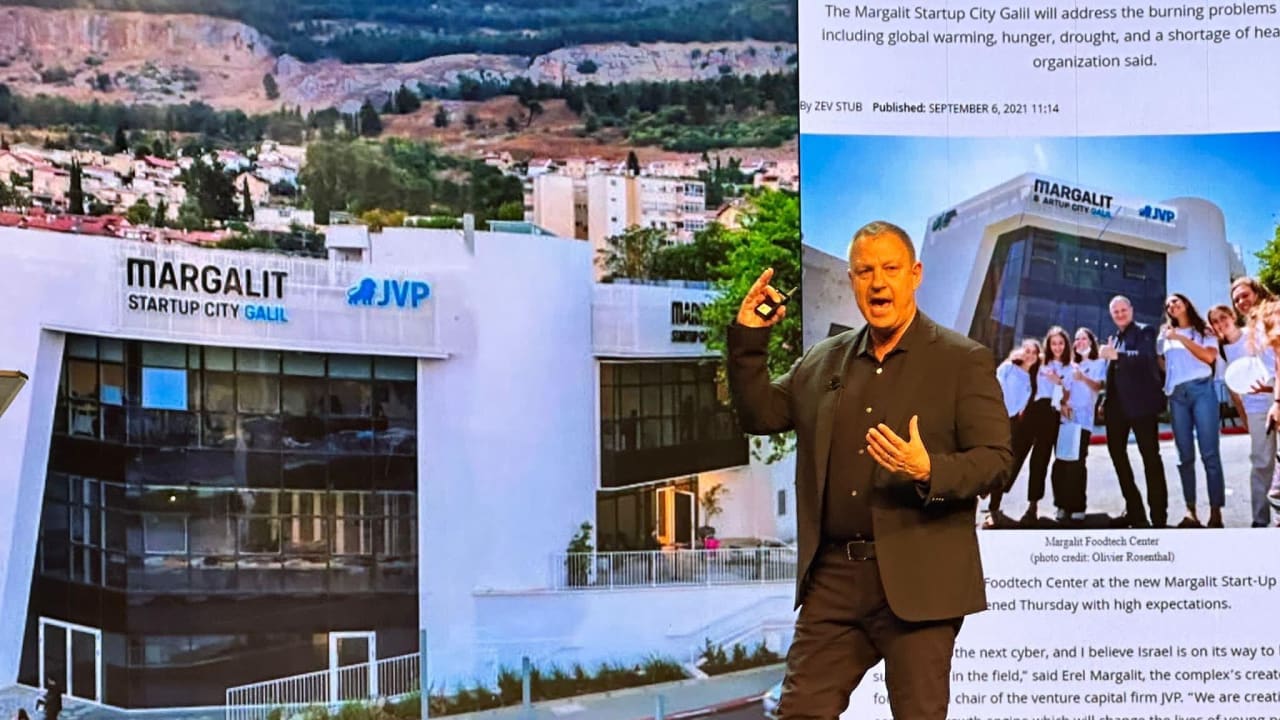
A long-term development plan aimed at turning the Galilee into a major center of innovation, employment and community growth was presented last week at a gathering of business leaders and American Jewish community figures in New York.
The meeting, hosted by Erel Margalit at Margalit Startup City in SoHo, focused on building an economy in northern Israel that can attract companies, entrepreneurs, investment and young families following nearly three years of war and disruption.
The strategy, led by Margalit Startup City Galil, combines technology, research, academia, advanced agriculture, local business development, education and culture.

“The day after begins now,” said Margalit, founder and executive chairman of Jerusalem Venture Partners and Margalit Startup City.
“If we simply restore the Galilee to what it was before the war, we haven’t solved the problem. We need to create new growth engines, high-quality jobs and opportunities that will encourage people to build their future in the region.”
From wartime disruption to regional growth
The initiative began before the outbreak of the war, when Margalit promoted the creation of an innovation-based economy connecting research institutions, universities and industry in northern Israel.
More than a decade ago, he began advancing plans for a technology incubator in Kiryat Shmona, with a focus on food technology, advanced agriculture and climate technology.
The war placed that model under severe pressure. Northern communities were evacuated, businesses closed, start-ups moved their operations elsewhere and entrepreneurs, researchers and students were dispersed across Israel.
Margalit Startup City Galil subsequently worked with the Israel Innovation Authority, MIGAL Galilee Research Institute, Tel-Hai University and JNF-USA to keep the region’s innovation ecosystem operating.
Companies that relocated received mentorship, operational support, assistance applying for grants and investment, and introductions to strategic partners and international markets, according to the organizers.
Education, leadership and community programs also continued during the war in an effort to maintain connections between residents, businesses and regional institutions.
According to figures presented at the New York meeting, 32 start-ups have returned to the Galilee. More than 100 start-ups had operated in the region before the war.
start-ups secure grants and create jobs
Participants were told that the Galilee innovation center has evaluated more than 150 start-ups from the Galilee and Golan Heights in recent years.
Companies supported by the center have created more than 50 jobs and received approximately $3 million in grants from the Israel Innovation Authority. The initiative also connects entrepreneurs with mentors, investors and industry experts.
Dr. Noam Yosef, CEO of Gaia, the Galilee Innovation Center established by Margalit Startup City, JVP and MIGAL with support from the Israel Innovation Authority, said the goal was to create companies rooted in the region.
“Over the past several years, together with the Israel Innovation Authority and partners from industry, academia and the investment community, we’ve built an infrastructure that enables entrepreneurs and technology companies to grow from within the region,” Yosef said.
“Even during the war, we continued supporting companies, raising resources, connecting founders with investors and strategic partners, and opening doors to new markets.”
Yosef said the center was seeking to develop internationally competitive companies in food-tech, advanced agriculture and climate technology.
start-ups operating within the ecosystem include YoEgg, WonderVeggies, DYGO and Greeneye Technology.
The New York gathering included Ilan Kaufthal of the Russell Berrie Foundation, along with representatives of JNF-USA and UJA-Federation of New York, organizations that have supported development projects in the Galilee.
Margalit also invited executives from American technology, cybersecurity, software and industrial companies. Organizers said they hoped the executives would provide professional expertise, international connections and investment opportunities.
“These leaders bring decades of experience building companies, developing breakthrough technologies, creating international partnerships and scaling organizations,” Margalit said.
“Our goal is to channel that experience into building the next generation of growth in the Galilee.”
Local businesses, education and culture
The development plan also includes small and medium-sized businesses, including manufacturers, farmers, restaurants, retailers and family-owned companies.
Participants discussed expanding Galilocals, an initiative established to strengthen local businesses throughout northern Israel and connect them with customers and new markets.
Community programs are another component of the strategy. More than 55,000 children and teenagers have participated in educational, leadership and volunteer programs operated by the nonprofit Bakehila across 27 communities and 75 schools, according to figures presented at the meeting.
Galiladies, another regional program, works to develop women’s leadership and connect women with entrepreneurship, business and civic initiatives.
Jacqui Schneider, vice chair of Women for Israel at JNF-USA, said the projects offered grounds for optimism about the region’s future.
“We’re proud to support the extensive work being led by the center for the benefit of the entire region,” Schneider said. “The initiatives already underway and those now taking shape give us real optimism about the future of the Galilee.”
The meeting also featured plans for StartArt, a performing arts and cultural center intended to serve Galilee residents.
Or Nadav Argov, director of strategic partnerships at Gaia and Margalit Startup City Galil, said cultural institutions would play an important role in encouraging younger residents to remain in the region.
“We believe real regional growth happens when, alongside the companies being built here, local residents are given opportunities to develop skills, build networks and become active partners in the region’s economic, social and cultural future,” Argov said.
“Creating a regional performing arts and cultural center is the next step in that vision. It will be a significant addition for Galilee residents and especially for the younger generation choosing to build their future there.”
Schneider said attracting families and businesses would require investment in both technology and community infrastructure.
“Our mission is to strengthen and develop northern Israel by creating communities that attract young families, businesses and jobs,” she said. “Investing in people and communities is just as important as investing in technology.”