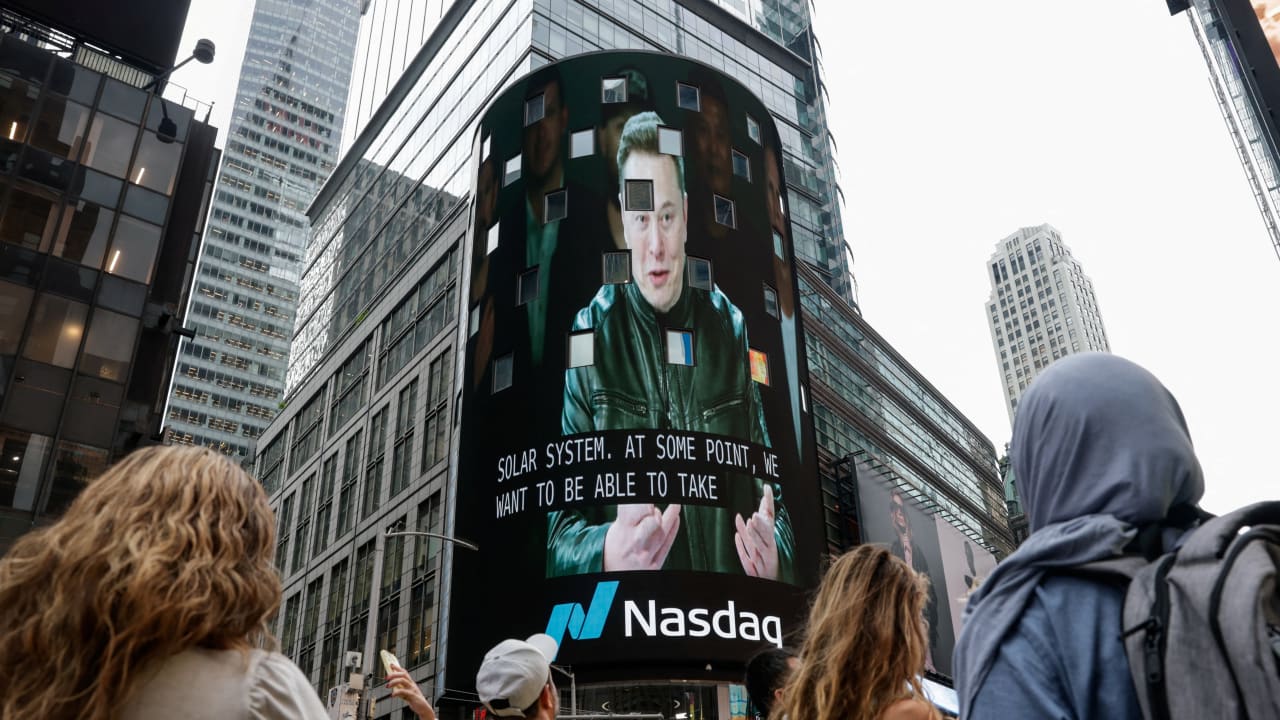
Elon Musk said on Sunday that his rocket company, SpaceX, could bring in $1 trillion in revenue by 2030, making the statement two days after the company went public, valuing it at over $2 trillion.
"And I would be surprised if revenue is not greater than $1T in 2031," he wrote on his social media platform X, replying to journalist and financial commentator Jon Erlichman.
SpaceX became the sixth-largest US firm on Friday, cementing Musk's status as the world's first trillionaire.
However, the company still makes far less money than similarly valued tech giants like Broadcom and Amazon.com.
In 2025, SpaceX's revenue jumped to $18.67 billion from $14.02 billion a year earlier, but the company swung to a net loss of $4.94 billion from a profit of $791 million.

Some Wall Street analysts are cautious about the company's growth.
Goldman had estimated that SpaceX's revenue would exceed $470 billion in 2030, while Morgan Stanley projected it would reach nearly $330 billion, according to a Wall Street Journal report from earlier this month.
Musk's road to the trillion dollars
SpaceX opened on Monday with a stock valuation of $160, following the Friday Initial Public Offering (IPO), which valued the company at over the $2 trillion.
While Musk became the world's first trillionaire only after the IPO, there is a key point in his career that can be marked as the moment when he started aiming towards the trillion: Buying X/Twitter.
Musk bought the social media platform in 2022 for $44 billion, rebranded the company, and eventually launched Grok, an artificial intelligence model that used the platform as its training ground.
To develop Grok, Musk then launched xAI, the AI company that eventually became X’s main company in a merger that valued the combined company at approximately $113 billion.
The subsequent merger with SpaceX valued the company at $250 billion, representing a net gain of $206 billion in valuation relative to the initial $44 billion required to buy Twitter.