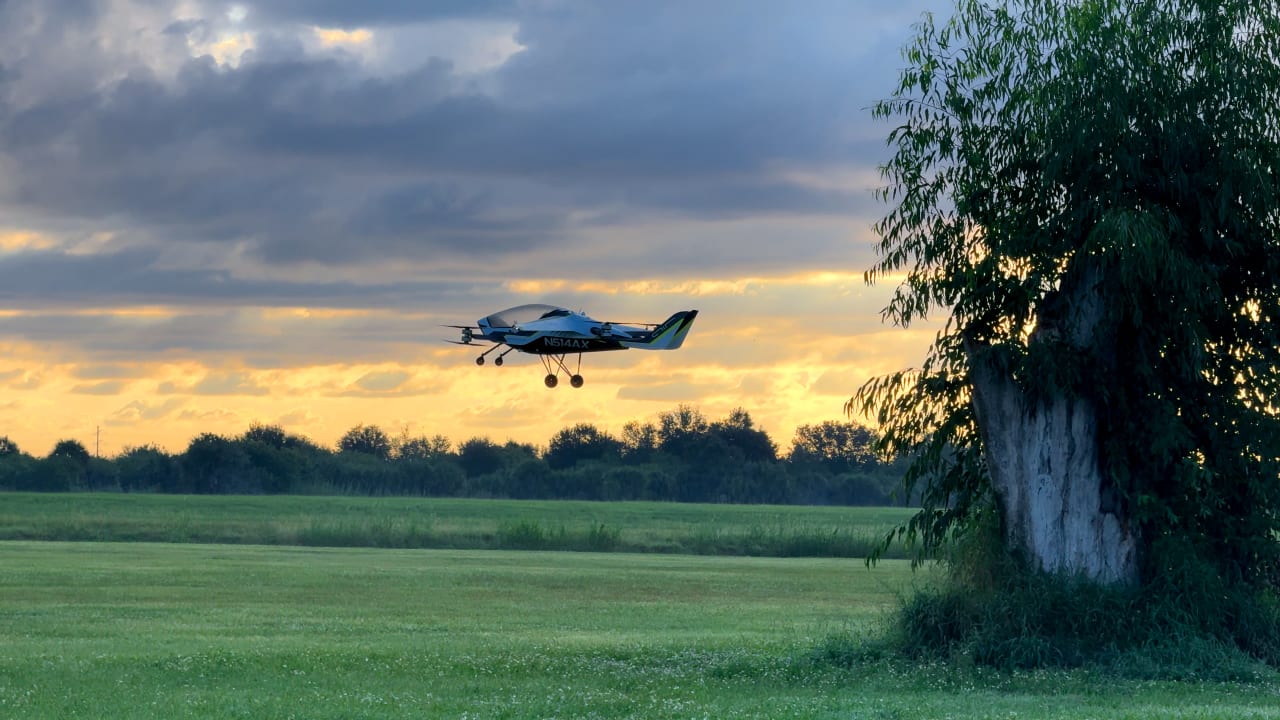
I need to be in Tel Aviv for a 9 a.m. meeting. By car, it will take an hour and a half that I don't have. Instead, I open an app and order a flying taxi. It lands near my house within a few minutes. There’s no pilot. I get in, it lifts off and joins a low-level air corridor reserved for exactly this kind of traffic. I open my tablet and prepare for my meeting while the aircraft handles the rest. The corridor isn't too congested this morning. Twenty-five minutes later, I land near my destination. I walk in rested, prepped, and on time.
None of that is available to me yet, in Tel Aviv or almost anywhere else. However, it's closer to reality than most people realize. So, let’s demystify this industry, because the gap between the hype and the reality is unusually wide in both directions.
eVTOL stands for electric vertical take-off and landing. Strip away the acronym, and it’s an aircraft that takes off and lands like a helicopter, but it is powered by batteries and multiple electric motors instead of a single turbine. That last part matters more than it sounds. A traditional helicopter has one point of failure at its rotor. Most eVTOL designs use distributed electric propulsion – several independent rotors – so that if one or two fail, the aircraft can still land safely using the others. That redundancy is a big part of why the industry believes it can eventually get comfortable removing the pilot, not just electrifying the aircraft.
Where you can already fly today
This is the part that surprises people most: Commercial eVTOL passenger service already exists and has for over a year. China's EHang received the world’s first Air Operator Certificates for pilotless, human-carrying aircraft in March 2025, and its EH216-S has been flying ticketed passengers on tourism routes in Guangzhou and Hefei ever since, with tens of thousands of demonstration flights logged.

Thailand has authorized EHang to fly real passengers, including its own civil aviation chief, under a supervised regulatory sandbox designed to lead toward eventual full commercial approval.
In the Gulf, Dubai and Abu Dhabi have positioned themselves as the next launch markets, betting on regulatory agility and brutal summer heat that makes a 90-second aerial hop more attractive than sitting in traffic. Joby has an exclusive agreement to begin service in Dubai. Archer is targeting Abu Dhabi.
In the United States, the FAA finalized Part 194 – its dedicated certification rule for this entire aircraft category – in late 2024, and in March 2026 launched the eVTOL Integration Pilot Program covering eight projects across 26 states, with the first flights, Joby’s, scheduled to begin in Texas this month.
One important caveat, though. Almost everything operating commercially or about to launch outside China is piloted, not autonomous. The vision in my opening story, a genuinely empty cockpit, is real in Guangzhou today. Everywhere else, it's still a few years out.
It's also worth being honest about pace because the industry's numbers and the regulator's numbers tell different stories. The FAA’s latest Aerospace Forecast projects that in the first year after AAM aircraft enter commercial service, expected to begin with this month’s Texas flights, there will be just seven aircraft flying a combined 24,600 departures, on an assumption of roughly 28 trips per aircraft per day. By 2028, the agency expects these figures to grow to as many as 80 eVTOLs flying around 335,000 services annually.
Now, let’s compare that to the manufacturers’ own targets: Archer says it will build 650 aircraft in 2028 alone, partly for the Los Angeles Olympics, while Beta’s Vermont factory is designed to eventually turn out 300 aircraft a year. That gap, between a cautious regulator and an ambitious factory floor, is worth remembering every time a headline makes this sound imminent.
The FAA also expects the use cases to arrive in order: airport shuttles first, then cargo routes over existing infrastructure, then urban air taxis for commuters, and only later, medical transport, which faces its own added hurdles: aircraft retrofitting, extra certification, and a dedicated charging infrastructure.

Who’s actually building this
Joby Aviation is widely considered the furthest along on the Western side, backed by roughly a billion dollars from Toyota and now in the fourth of five stages of FAA type certification.
Archer Aviation is its closest rival, with manufacturing backing from Stellantis, a route partnership with United Airlines, and an order book above $6 billion. Archer was also first to win full FAA acceptance of its means-of-compliance package. In a sign of how fast this competitive landscape is consolidating, Boeing agreed in August 2026 to fold its autonomous eVTOL unit, Wisk Aero, along with its Insitu and SkyGrid subsidiaries, into Archer in an all-stock deal, taking roughly a 20% stake in Archer in return.
Wisk had been the most credible Western bet on full autonomy from day one, rather than piloted-first, so the deal effectively hands that technology and ambition to Archer.
EHang remains the clear leader in actual autonomous operations, the only company with a fully completed certification stack for pilotless passenger flight, albeit under China's CAAC rather than the FAA.
Beta Technologies focuses on cargo and medical logistics, and completed a roughly $1b. IPO in November 2025 that valued the company at about seven billion dollars.
Eve Air Mobility, backed by Embraer, as well as AutoFlight, which flew the world's first intercity eVTOL route in China in 2025, round out the group with genuine, non-vaporware progress.
Worth noting closer to home: Israeli company AIR has already delivered a production cargo eVTOL, and cargo may reach real scale before passenger service does, since it sidesteps the hardest certification hurdle of all, keeping a human alive inside the aircraft.
Worth naming, too, the companies that didn’t make it, or nearly didn't. Volocopter and the original Lilium both ceased operations, and Hyundai’s Supernal paused its program after a leadership shake-up and major layoffs, before partnering with Korea Aerospace Industries in May 2026 to attempt a restart.
This is a capital-intensive industry. Some public companies are reportedly burning well over $100 million a quarter before carrying a single paying passenger, and not everyone survives to the finish line.
Between now and my Tel Aviv commute
Four things, mainly, stand between the here and now and my commute to Tel Aviv. First, batteries: Current lithium-ion energy density limits range, payload, and safety margins, especially given how power-hungry vertical take-off is. Better chemistries like lithium-sulfur are progressing, but they aren’t yet standard.
Second, certification for autonomy specifically: Regulators are comfortable – or close to it – certifying a piloted electric aircraft. However, removing the pilot is a much harder safety case, which is why every announced Western launch in 2026 still has a human in the pilot seat.
Third, airspace integration: My imagined low-level corridor doesn't exist yet at scale anywhere. Building the digital air traffic system that lets dozens of aircraft, including autonomous ones, share a city’s low-altitude airspace safely is as much of an engineering project as the aircraft themselves.
Fourth, infrastructure and public acceptance. Vertiports need to be built, permitted, and connected to the grid. Noise complaints and safety skepticism remain real obstacles wherever one has been proposed.
Do I believe we’ll get there?
Yes. Tens of thousands of real passenger flights have already happened. I believe that every one of the four obstacles mentioned above is an engineering and regulatory problem. Those get solved with time, capital, and flight hours logged safely.
The honest timeline, given where certification and infrastructure actually stand, is piloted service expanding through the second half of this decade, with a genuine shift toward autonomous operation in the early-to-mid 2030s. This is not next year, but it is within our generation.
I don’t know yet whether my own Tel Aviv commute will be solved by an eVTOL in my lifetime. But the aircraft that would do it already exists, has already flown paying passengers, and is no longer the part of this story that anyone in the industry is actually worried about.