Ukrainian President Volodymyr Zelensky attended an annual memorial ceremony to commemorate the tens of thousands of Jews massacred by Nazis at Babyn Yar on Tuesday, which happened 85 years ago on September 29 and 30, 1941.
Several Jewish Ukrainian leaders, including those from the Chabad community, were present at the event. The ceremony was organized by Ukraine's Presidential Office, the Babyn Yar memorial complex, and the Federation of Jewish Communities of Ukraine.
"We must remember the terrible things that happened here many years ago, and now they are happening again, this time at the hands of the Russians," Zelensky said.
"Thank you very much for being with us here today, and thank you for praying for Ukraine, for Ukrainians, for all those who have been killed in Ukraine, for the tragic moments we have endured, and for the Jews who were tortured and murdered. Never again!" Zelensky stated.
Representatives from about 50 countries attended, including Israel's Ambassador to Ukraine Roi Rosenblit. Zelensky thanked the ambassadors and the international community for their "help in fighting against the terrible things the Russians are doing to us, to humanity, and to civilization."
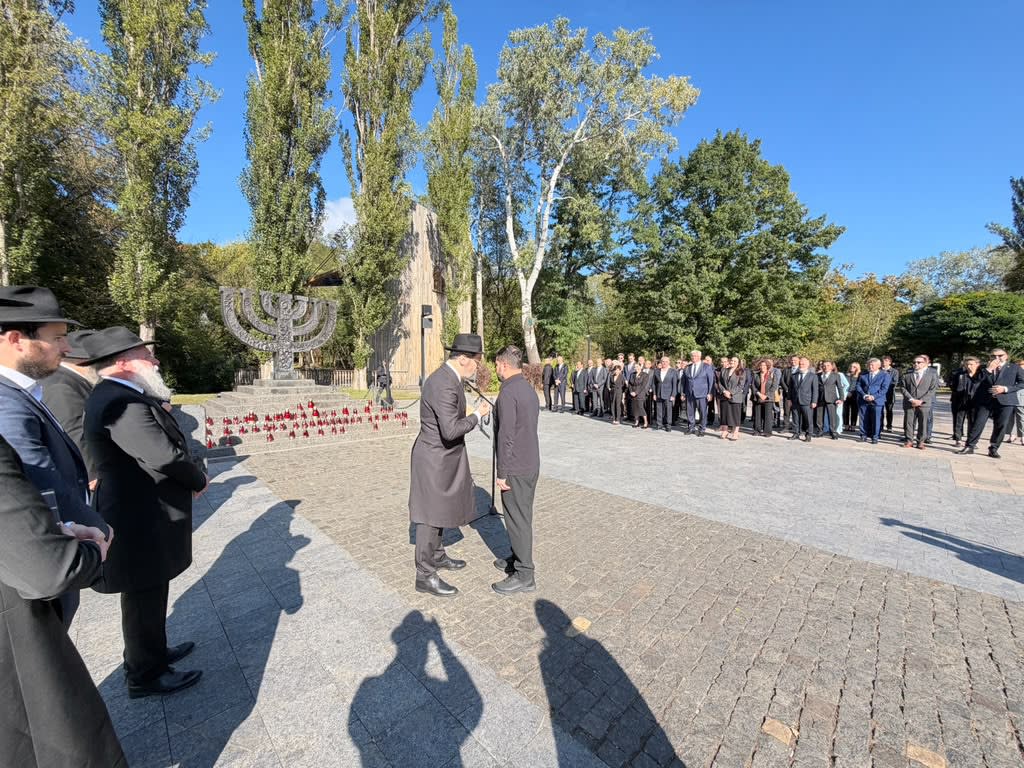
Ukrainian security forces deployed special air-defense systems and snipers positioned around the site due to concerns over a possible attack, particularly threats posed by Russian drones.
Zelensky discusses arrangements for remains of Israeli teen killed in Kyiv to be returned to Israel
While attending, Zelensky discussed Daniel Umansky, an Israeli child who was killed by a Russian drone strike in Kyiv last week, with the FJCU, particularly regarding the arrangements to transport his remains to Israel for burial.
One of the attendees, who has been running Jewish community and educational institutions in Kyiv for nearly 30 years, discussed her grandmother, who was murdered in Babyn Yar.
"Grandmother Sonia was murdered in her fifties. We were unable to find a photograph of her, but we recently located a testimony at Yad Vashem containing her details," Rebbetzin Devorah Leah Levenhartz said.
"It turns out that before her murder, she lived not far from where we ourselves lived, and she now gets to be part of the thriving Jewish community we established...It is almost impossible to comprehend," she added.
"The tragedy of Babyn Yar is an absolutely tragic and bloody example, and today we are meeting on the 85th anniversary of the tragedy of Babyn Yar," Zelensky said in his address.
"This tragedy reminds us how painful it is to lose our family and loved ones, and how the value of human life can be diminished," he added.
"I want to thank you for understanding the value of life. That is, of course, felt especially strongly in Ukraine during this shameful, unprovoked war by Russia against Ukraine, against society, against people, and against life itself," he continued.
What happened in the Babyn Yar Massacre?
On September 29-30, 1941, the Nazis gunned down nearly 34,000 Jews in Babyn Yar in what would later be considered the first massacre of the Jews in the Holocaust.
Babyn Yar is located near Kyiv, which the Nazis took control of on September 19, 1941. A few days later, there was a large explosion at the German command post that killed many German soldiers. The Nazis blamed the explosion on the Jews, intensifying their hatred, so when the SS troops entered Kyiv, the city's Jews were immediately marked for destruction.
Between September 29 and 30, nearly 34,000 Jewish men, women, and children were marched to the ravine of Babyn Yar, stripped and machine-gunned into a mass grave, which was immediately covered, burying some of the victims alive.
The grave was filled with thousands more bodies over the next two years. The total is unclear, but at least 100,000 people were murdered at Babyn Yar over two years. The victims were primarily Jewish, but they also included communists, Soviet prisoners of war, and Roma people.
Despite the tragedy that occurred at Babyn Yar, it took the Soviet Union 25 years to acknowledge the massacre. After trying unsuccessfully to build a sports stadium over the mass grave in 1961, the Soviet Union constructed a small obelisk to stand at the site.
In 1974, a 15-meter memorial statue was erected, but still, there was no hint of the fact that Jews had been murdered at Babyn Yar, as the identification of the victims was vague and did not mention the word 'Jew.'
Only in 1991, 50 years after the massacre, when Ukraine declared independence, was the identity of the victims properly recorded on the memorial, recognizing the massacre of Jews at the site.
Ariella Marsden contributed to this report.