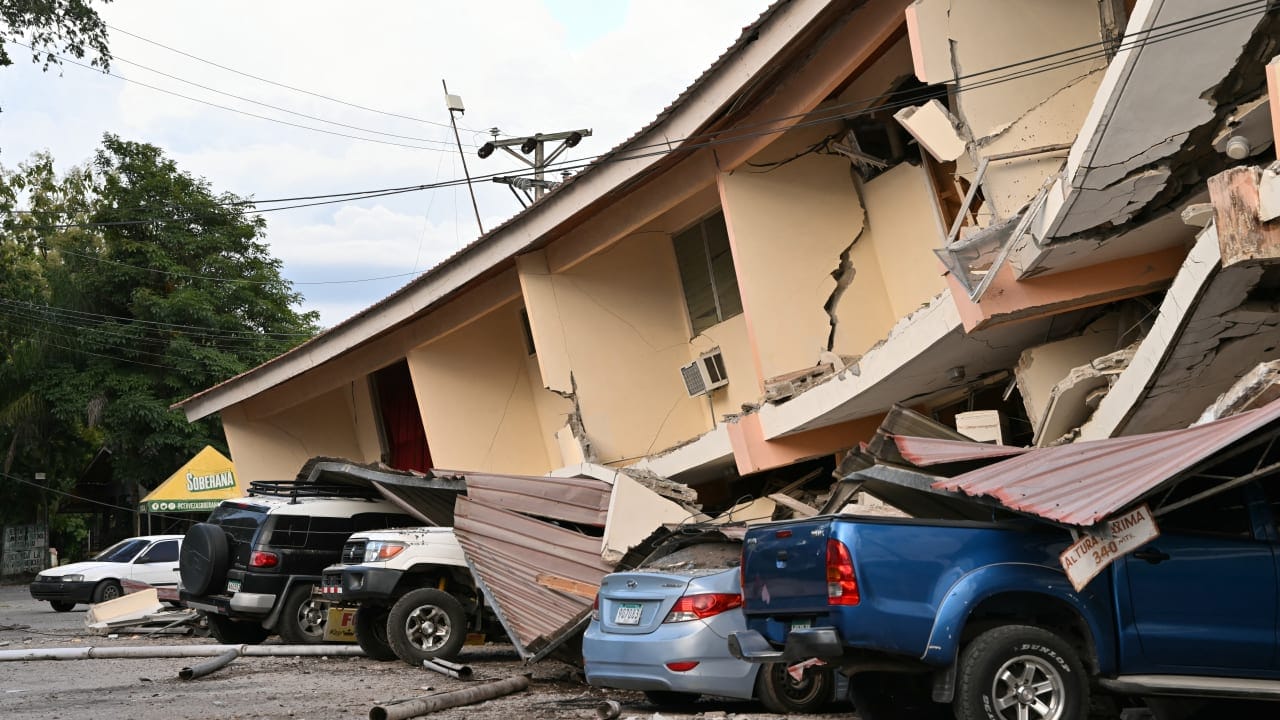
As a magnitude 7.7 earthquake shook Panama on Friday, Israeli Nurit Goren Elfant and her family felt lucky to be outside as their house, like many others in the area, collapsed.
Speaking to N12 News on Saturday, Elfant described the destruction and damage caused by the quake and subsequent aftershocks, some reaching up to magnitude 5.8.
“It happened a few minutes before one in the afternoon. It was something you can’t even imagine,” she recounted. “The ground shook at a level you don’t see in movies, and for 13 consecutive hours, there were tremors every few minutes. We were lucky to have been outside when our house was destroyed.”
Much of southern Panama was cut off from the internet in the aftermath of the quake, including in the coastal town of Playa Venao, an area where Elfant told N12 many Israeli families live. Only those who have access to satellite internet have been able to connect to the outside world.
“Some of these families lost everything,” Elfant continued, describing the experience of her fellow Israeli expats. “Everything completely collapsed.”

A tsunami warning sends families to higher ground
A Tsunami warning was issued during the tremors, leading to many of the families moving to higher ground in the mountains. Elfant’s family returned to lower ground earlier than others, but some of those who stayed got stuck in the mountains due to roads being blocked with debris and bridges collapsing.
Elfant told N12 that Israeli families were among those stuck up on the mountain on Friday afternoon as Shabbat approached.
A community that comes together
The Israeli community managed to organize a Shabbat meal despite the conditions.
"The rabbi of the Chabad house went up to the mountain; they took the food they had left at the Chabad house and what they could salvage from the supermarket, which was completely destroyed, and they set up an impromptu Shabbat meal there and a big kiddush for the entire Jewish community," Elfant said.
"I think there were over 200 people there. They stayed to sleep outside there. They are still without water and electricity, so we don't know what's happening to them."
Elfant’s family has been able to help some neighbors with two buses they previously converted into homes. "Because a bus can absorb shocks, we sleep in it and let other families live with us. Right now, five families live here on our farm. We have solar electricity, but there is no electricity in Vanu and the entire area," she explained to N12.
According to N12, the water supply in the area has been severely damaged, and people have little access to potable water. "Our well, which is 42 meters deep, has completely mixed up and is mainly producing basalt," says Nurit. "Because of the tremors, all the water tanks that people had for emergencies were flooded. We had a three-cubic-meter water tank that exploded."
To drink water, Elfant said she and her family will have to collect water from a stream or rainwater and boil it. They hope to get through the next month and rebuild their home.
The Environment and Climate Change portal is produced in cooperation with the Goldman Sonnenfeldt School of Sustainability and Climate Change at Ben-Gurion University of the Negev. The Jerusalem Post maintains all editorial decisions related to the content.