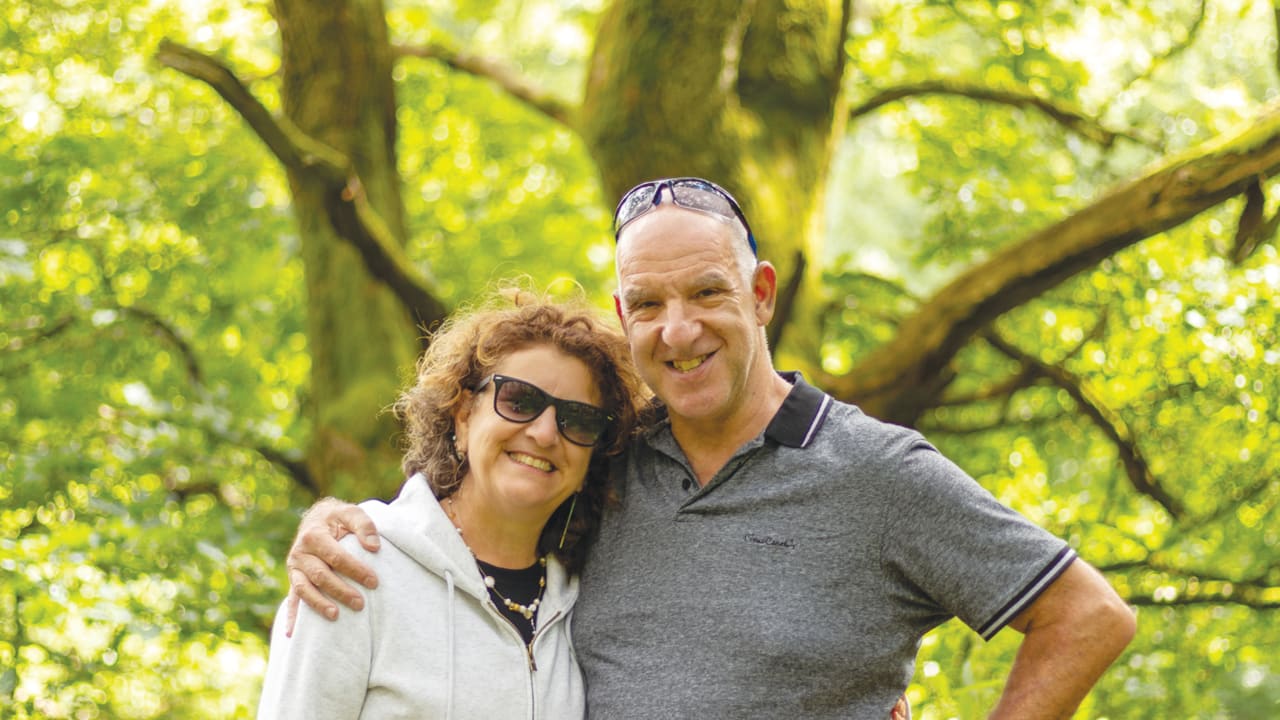
‘Stevie is everywhere, and he’s nowhere, and I find myself looking for him, and he’s not there,” said Esther Marcus wistfully.
Marcus, a resident of Kibbutz Alumim, which was attacked on October 7, and whose husband Stevie passed away just three months later of a broken heart, never dreamed that she would need to utilize her skills as a therapist in maintaining her own resilience in the face of the personal tragedy that she had to face.
The 61-year-old Marcus, born Esther Blau, is soft-spoken and reserved, grew up in the London neighborhood of Golders Green, and was raised in an Orthodox, Zionist family. She was a member of the Bnei Akiva youth movement and participated in its post-high-school hachshara (preparation) program in Israel on Kibbutz Lavi.
Encouraged by her father to remain in Israel (her mother acknowledged that she needed to spread her wings but said that there was always a place for her at home if her aliyah did not succeed), she made aliyah in 1984 at the age of 19 and studied at the Hebrew University, where she received her bachelor’s degree in social work.
Shortly after receiving her degree, Esther was surprised to receive a draft notice from the IDF. “At the time, the law was that if you came on aliyah before age 20, you could be drafted into the army. But no shaliach (representative) in England had told me about it,” she recalled with a smile. “I was 23 at the time, somewhat older than the other women who had been drafted.”

Despite her misgivings, Esther joined not only out of obligation but also from a sense of idealism.
“I really believe that religious men and women should join the army, because I think it’s an opportunity to blend and for religious people to meet non-religious people, and a way to show that you can be religious and you can go into the army. Those are my values, and those are my principles,” she shared.
Esther is glad that she had the opportunity to join the IDF: “Looking back, it’s remarkable that I did because it led me to where I am now.” She took an officer’s course with other psychologists and social workers and became a mental health officer (kabanit), serving from 1989 until 1992.
Esther & Stevie: Their story
In 1990, she met Stevie Marcus, a devoted soccer fan and AC/DC aficionado who had made aliyah in 1984 and was part of a group of young people (garin) living on Kibbutz Alumim, a religious kibbutz founded in 1966 in the Gaza Envelope.
“He was the only one in his garin that wasn’t married,” said Esther, with a smile. “They suggested to him to take a year off to search for a wife, and he came to Jerusalem, and that’s how we met. He was on this mission to find a wife, and he succeeded.”
Esther and Stevie married in 1991, and she joined him in Alumim, traveling to Jerusalem daily for the last six months of her army service. They raised their four children there. She worked in Sha’ar Hanegev for 12 years as a social worker, and then spent four and a half years working in a rape crisis center in Beersheba.
During that time, she received her master’s degree in social work and art therapy. She also provided individual and group therapy to teenage girls at a boarding school in Kibbutz Saad. For the past 10 years, she has been the clinical director of the Resilience Center Clinic in Sdot Negev.

Stevie started out working in irrigation in the kibbutz and moved on to the dairy farm, where he was the assistant director. “Stevie was a very passionate person,” said Esther. “With anything and everything, he went right into it. He really learned, trained, and understood. He was in charge of herd health, and over the years, the dairy farm grew.”
In addition to his formal job, Stevie took on voluntary tasks in the kibbutz, working on metal recycling, handling safety regulations, and serving as banquet manager for bar mitzvahs and weddings. In recent years, he became interested in photography and became a self-taught expert through YouTube, posting his creations on Alumim and eventually on social media.
“Stevie loved living on the kibbutz,” said Esther. “He was extremely funny, and he loved whisky.”
October 7
On the weekend of October 6 and 7, 2023, Esther was celebrating her 59th birthday with her husband and two of her children – her newly married son and his wife, along with her daughter, son-in-law, and their two young children.
“I had gotten up very early on the morning of Oct. 7,” said Marcus. “I was up before the alarms started. I remember seeing my neighbor go off for a run, and then, within minutes, we heard all the sirens and the ‘tzeva adom’ warning.”
She explained that over the years, the alarm system had become more sophisticated, such that individual sirens would sound for each kibbutz in the area. On that morning, she recalled, all of the alarm sirens from each kibbutz sounded at once, and the words ‘tzeva adom’ (code red) were sounded repeatedly.
“We knew that something was different this time, and then we received messages ordering us to go into our safe room,” she said.
The eight family members quickly went into the safe room. When she heard the message that they needed to make sure that the children were quiet, Marcus set up her computer for her two-year-old grandchild to watch television, which would keep him quiet during the emergency. Her daughter held the younger grandchild most of the day.
In the meantime, Stevie was on the phone speaking with the Thai and Nepalese workers in the dairy farm.
“They were telling him that they saw the terrorists come in,” said Marcus. “We could hear him on the phone saying to them, ‘Go into the safe room, go into the safe room.’ He was trying to calm them down, saying that it would be okay and that the army was coming.”
Marcus, whose job is to match therapists with people in need, was already receiving phone calls from worried residents asking what was happening. Many of the calls were coming from outside the area, including family members of the Nova survivors who were looking for their children.
Her two children, who were in the safe room, also had friends who had been at the Nova festival, and they were trying to find out what had happened. While they were on the phone, they heard shooting outside.
The emergency squad of Kibbutz Alumim heroically fought the Hamas terrorists, and later that day, the army came in and cleared the area of terrorists. Most of the action took place near the agricultural area of the kibbutz, where the terrorists killed 324,000 chickens, demolished the dairy farm, and destroyed the living area of the Thai and Nepalese workers.
At the end of the day, the residents learned that Hamas terrorists had massacred 22 Nepalese and Thai workers and kidnapped two others.
On Saturday evening, the army came and took Stevie to the dairy farm to see the damage. “He was blown away because it meant that he saw the bodies of the workers,” said Esther. One of the workers, she related, had managed to save himself by moving the ceiling tiles and hiding in the crawl space in the ceiling. Another worker jumped from a window and hid amidst the cow dung for hours.
At 3 p.m. the following day, the residents of Alumim were evacuated and taken to two hotels in Netanya because there wasn’t enough room in a single hotel to accommodate all the kibbutz residents.
“The kibbutz had to start functioning in this emergency situation, but because we have people who are already leading the kibbutz, they really stepped up,” said Marcus.
Resilience tested
Stevie went back to Alumim to help reconstruct the dairy farm, and Esther went straight to work with the Resilience Center. She set up the center in Netanya so that people from Alumim could start receiving assistance. She then set up 10 additional resilience centers with therapists throughout the country for the evacuees in Eilat, the Dead Sea, the Arava, and other locations.
Addressing the subject of resilience centers, Esther pointed out that the concept of resilience centers is believing in people.
“In America, they’re called trauma centers. The focus is on the trauma. In Israel, they’re called resilience centers. The focus is on the resilience. The focus is on knowing that we can bounce back,” she said. “Now we might bounce back wounded and lacking, with various difficulties. But we’re doing it. That’s the Jewish spirit, and that’s the Israeli spirit. You see it again and again. What the soldiers have been through, families like mine, the people in the area, the hostages.”
Two months later, Esther’s resilience was tested again. On the fourth night of Hanukkah, Stevie, who was spending much of his time rebuilding the dairy farm together with a small crew of workers while spending evenings sleeping on a mattress in the kibbutz’s operations center, went to his home to take a shower. It was there that he suffered a massive heart attack and died on his 62nd birthday. His body was not discovered until the next morning.
Esther, who was en route to Alumim for a meeting, received a phone call bearing the tragic news. She notified her children, including one of her sons who was serving in Gaza, but by chance had been allowed to leave to attend another funeral. She also had to break the news to Stevie’s sister and father in the UK, who was 87 at the time, and organize the funeral.
Due to security considerations, the funeral took place at Kibbutz Yavne, where one of their sons lives. During the service, the music of Aerosmith, one of Stevie’s favorite rock groups, played in the background. Stevie was buried in Kibbutz Alumim, as explosions from the war echoed nearby.
Stevie’s death was attributed directly to the war, and Esther was recognized as a war widow by the National Insurance Institute (bituah leumi) and has received benefits from the organization. In 2024, residents began returning to Alumim, but Esther decided to live in Jerusalem while commuting daily to the Gaza Envelope. She returned to Kibbutz Alumim in August of 2025.
How has she dealt with the trauma and grief? “I was definitely in denial for a long time,” she acknowledged.
“The fact that I wasn’t living in the kibbutz and I wasn’t with the community helped me develop even more denial because then I could keep in my mind and have this fantasy that he was still alive and he was still working on the kibbutz.”
“Denial was very powerful, which I’ve always known as a therapist,” she shared. “You can use denial. It’s a defense mechanism, if you know how to use it, for a certain amount of time. I kept working. I was doing a lot of traveling. I have to say the journeys in the car also helped me because I’d be talking to myself. I’d be talking to him.”
Esther was very focused on her work, and she said that helped her survive. “I had to help other people. I had to set up those resilience centers, and my family and close friends kept pushing me through.”

‘Saba Stevie had a camera’
Today, Marcus is memorializing her husband’s photography skills with a 24-page children’s book in Hebrew, titled Saba Stevie had a camera. The book features Stevie’s photographs, with a cartoon-like figure of Stevie on each page to explain the photos.
Esther said that while the purpose of the book is to honor his memory, it also helps people cope with their grief: “It’s my personal story, but there are hundreds of people in Israel, unfortunately, who are now dealing with grief. I can’t believe there isn’t somebody in this country who hasn’t been touched.
“Yes, people die, but the focus is on what he did with his life. The focus is on his photography – the fact that he had a hobby and developed it and left us these treasures, which are his beautiful photographs, which also show us how beautiful the world is while we’re all going through despair and losing faith. One of the biggest challenges that we had was with people who went into depression and felt this sense of despair.”
Esther added that the varied photographic angles of Stevie’s images also play a role.
“It’s like saying you can look at life in this way, or you can look at life in that way,” she said. “And we see his macro photography – you figure out what you want to focus on in your life? There are so many things.”
She recognized that the book is not going to become a best-seller: “I did it more to encourage people to take on a hobby and develop that hobby as Stevie did, and to see the world as a beautiful world, that with what we’ve been going through the last few years, we’ve seen so many awful things. And I think he really taught us that the world is beautiful.”
Esther acknowledged that, while she has her ups and downs in life, she feels fortunate. “I can see it’s brought out the best in my children, in our relationship, in who we are, and with my sister-in-law. For all that, I have so much to be grateful for. I think of these young women who were married for a year, two years, three years, [and lost their husbands].
“When I used to ask Stevie what kept him going in miluim (reserve army service), he’d say, ‘When we’d be on a march, I’d turn around. If someone was behind me, then I was okay because there was someone worse off than me.’ And I adopt that as well.”