
"Berlin has been defiled – shame on a people that considers itself among the world’s civilized.” This was the editorial in the social democratic daily Vorwärts, commenting on a pogrom enacted in the city against the poor emigrant Ostjuden (Galician Jews). This attack took place 10 years before Hitler rose to power.
Victor Sebestyen’s Weimar Germany: Death of a Democracy paints a graphic picture of a liberating republic after the fall of the Hohenzollern monarchy at the end of World War I.
This interesting book tells a familiar story of Berlin, plagued with hyperinflation, antisemitic nationalists, and blinded Stalinists. A place where famous downtown thoroughfares were lined with prostitutes, and cocaine and opium were easy to obtain.
In 1922, a quarter of all German Jews lived in Berlin. A city where homosexuality was quietly accepted despite its legal ban, where literature, films, and music flourished, and where many Jews felt at home.
The period before the machtergreifung – Hitler’s takeover – was known as the “golden years,” when the currency had finally been stabilized in the Weimar Republic under Germany’s first president (1919-1925), the Catholic-born atheist Friedrich Ebert.

It was a Jewish physician, Magnus Hirschfeld, who established here the first LGBT organization in the world.
The Jewish academic Hugo Preuss drafted the constitution for the new republic.
Weimar created a system of democratic representation that had not existed under Kaiser Wilhelm II.
The Wall Street crash of 1929 hit Germany much harder than other countries – and the rest is a history that no Jew can forget.
Hitler's rise to power was not inevitable
The author argues astutely that Hitler was not inevitable. A combination of unprecedented circumstances, moral weakness, political opportunism, and bad luck all played a part.
He tells how Germany by 1916 had become “a silent dictatorship” – a military regime, overseen by Paul von Hindenburg and Erich Friedrich Wilhelm Ludendorff, that preached “final and total victory” in the war against the Allies.
No one – least of all the kaiser – expected a sudden end to the conflict. He blamed the Jews for his eventual abdication.
The war had cost $1.45 trillion in 2025 values. In the summer of 1917, the three democratic parties in the Reichstag had called for a ceasefire in the war.
The generals reacted by forming “the Fatherland Party” and began deflecting responsibility away from themselves. The Jews were blamed for “the stab in the back.”
Already by 1916, Hindenburg and Ludendorff had initiated an inquiry to demonstrate that Jews were underrepresented in the German armed forces. Yet the inquiry proved the opposite: 12,500 German Jews perished in the trenches.
Within weeks of the kaiser’s departure, there was a botched attempt by the Spartacus League to overthrow the republic, led by the Polish-born Jewish revolutionary Rosa Luxemburg.
This was followed by other attempts in which Jews played a prominent part to create a different type of society: Politician, journalist, and revolutionary Kurt Eisner declared a Bavarian Workers and Soldiers Council. The anarchist Gustav Landauer, whose writings influenced Martin Buber, was murdered in Stadelheim prison. German-Russian Communist revolutionary Eugen Leviné headed the second Bavarian Soviet republic.
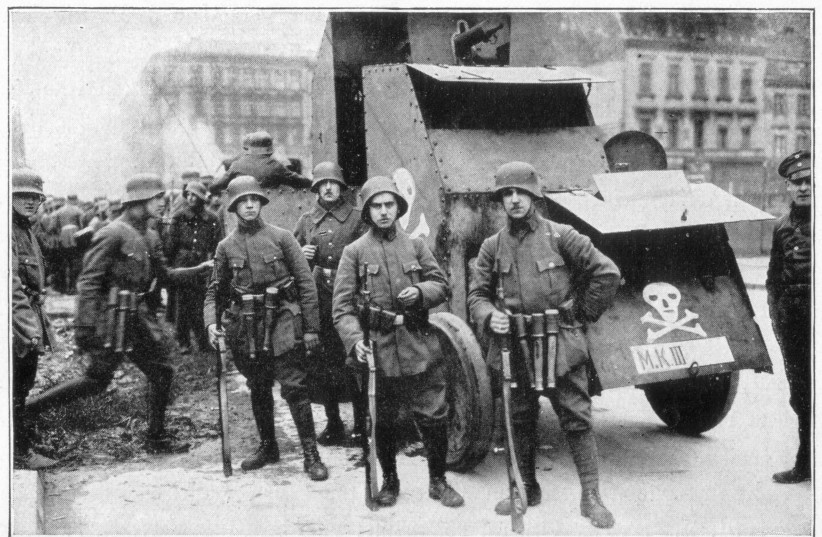
ALL MET untimely deaths at the hands of the Freikorps, embittered antisemitic nationalists who could not understand why the war had ended so abruptly, why the monarchy had disappeared, and why there had been a challenge to traditional Prussian norms.
Ebert willingly used the Freikorps as well as the army to crush any challenge to the Weimar Republic.
The exhausted returning soldiers proved willing recruits for the Freikorps. The author writes: “Their eyes were hidden in the shadow, thrown by the peaks of their caps, sunk in dark hollows, gray and sharp.”
The Bolsheviks in Soviet Russia desperately hoped that revolution would also break out in industrialized Germany and save them from isolation.
Lenin, however, was in despair at all these failed attempts and berated the German revolutionaries, noting: “when the moment may come to storm the railway stations, they would line up in a queue and buy platform tickets.”
Weimar labeled as 'the Jew republic'
The nationalists called Weimar “the Jew republic” and celebrated when the Jewish foreign minister, Walter Rathenau, was assassinated in 1922. He was accused of being one of 300 “Elders of Zion” bent on world domination.
The author argues that the repeated attempts by the Left to gain power by undemocratic means diverted attention from the threat of the Right.
While Berliners had little sympathy for the attempts to establish a Soviet republic in Germany, they were appalled at the violence and thuggery of the Freikorps.
Albert Einstein was on a Freikorps hit list and, like Rathenau, feared assassination. Nationalists demonstrated outside his home and outside his office at the Prussian Academy of Science.
The Nobel Prize winner Philipp Leonard and his colleague Johannes Stark were brilliant thinkers but devout antisemites. They railed against Einstein and “the Jewish style of physics.”
The Bauhaus ideas of Walter Gropius were regarded as “Bolshevist architecture.” Braided hair was “Aryan”; bobbed hair was “Jewish.”
A DISQUIETING conclusion from this work is that if events had taken another course, any mention of Adolf Hitler would today have gained a mere footnote in a history book.
During the Beer Hall putsch in 1923, Hitler and his followers marched to the center of Munich. They refused to obey police warnings and were then fired on. Max Scheuber-Richter, who had linked arms with Hitler, fell dead.
At Hitler’s subsequent trial, the judge, well-known for his hardline nationalism, allowed the future fuhrer full rein to theatrically perform in the courtroom. He received a six-month jail sentence instead of deportation to his home in Austria.
Stalin directed the German Communists to challenge the social democrats and thereby split the vote at every turn. The split allowed Hindenburg to win the presidency on the second vote in 1925. As a committed monarchist, he was determined to destroy the republic.
Hitler's electoral breakthrough
In the early days, the Nazis could not have advanced without generous financial donations to the party coffers. Hitler was funded by the piano manufacturer Carl Bechstein and the Ruhr steel magnate Fritz Thyssen.
All this allowed Hitler to make an electoral breakthrough due to soaring unemployment. Six million were unemployed by mid-1932. Hitler stood against Hindenburg in the presidential election that year and lost. He claimed that the election had been stolen and continued to do so even after a German court ruled that Hindenburg was indeed the victor.
The Berlin correspondent of the British Daily Mail wrote that he saw Hitler as “a man whose power lies not... in his eloquence and his ability to hold the attention of the crowd but in his convictions.”
The aged Hindenburg similarly came around to “understanding” Hitler. He was egged on by his son, Oskar, by Franz von Papen (German chancellor in 1932 and vice chancellor 1933-1934), by the leader of the monarchist German National People’s Party Alfred Ernst Christian Alexander Hugenberg, and by many political notables, in the belief that they would easily be able to control the Nazi leader.
The story of Germany between 1918 and 1933 is painful to contemplate amid a plethora of what-ifs. What if the police bullet had hit Hitler during the Beer Hall putsch and not the man standing next to him?
Sebestyen has painted a vivid picture of the life and eventual death of Weimar Germany. It is an important and illustrative rendition of the events which defined this transient republic.
As the Austrian writer Peter Drucker noted before escaping to the US: “Fascist ideas spread when people refuse to believe in anything.”■
WEIMAR GERMANY: DEATH OF A DEMOCRACY
By Victor Sebestyen
Pantheon
480 pages; $35