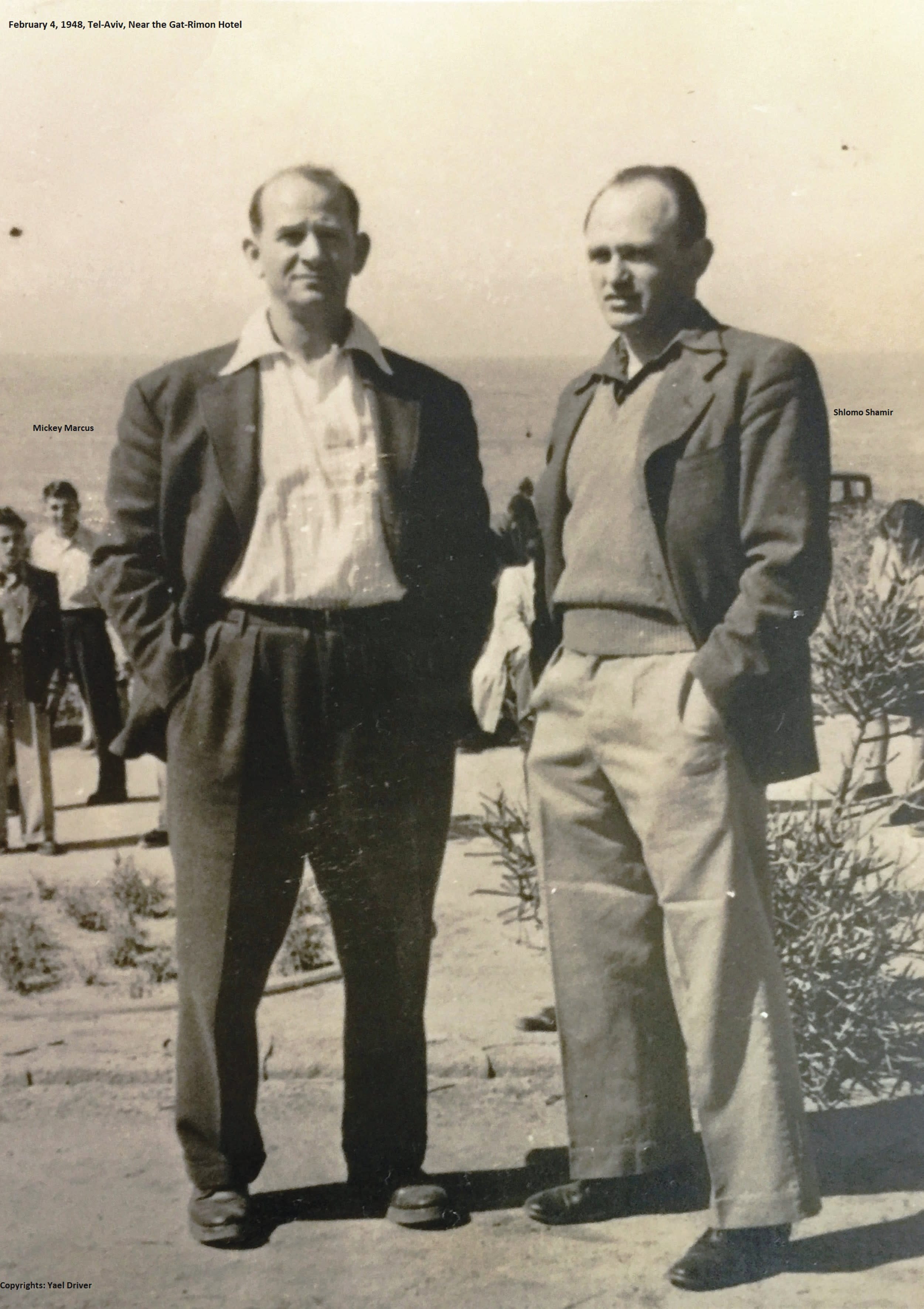
Yael Driver is the daughter of the late Maj.-Gen. Shlomo Shamir, who recruited Colonel David “Mickey” Marcus in January 1948. She maintains that her father was the person closest to the celebrated American army veteran, from the latter’s recruitment and arrival in what was then British Mandate Palestine, until his accidental death on June 11, 1948. Her parents maintained contact with his widow, Emma Marcus, well into the 1960s.
Driver hopes to clear up some misconceptions, even well-meaning ones, related to Marcus’s recruitment, his status as Israel’s first major-General, the battle for Jerusalem, and his actual contribution to the fledgling Israel Defense Forces.
David “Mickey” Marcus (nom de guerre – Mickey Stone) was a rare Jewish graduate of America’s prestigious West Point Military Academy. Born to a secular Jewish family in New York’s Lower East Side, he served in the US Army during World War II. After the war, he served as Chief of the War Crimes Branch of the US War Department and was involved in the Nuremberg Trials, which prosecuted Nazi war criminals.
Driver recounted a conversation documented by her father in which he mentioned talking with Marcus during their flight to Palestine. Shamir asked Marcus why he agreed to become an adviser to the newly created IDF. Marcus’s reply: “Because I have Abraham’s blood in my veins.”
Shamir (then Rabinowicz) served during World War II as an officer in the Jewish Brigade of the British Army, which consisted largely of Jewish volunteers from British-ruled Palestine. After being discharged from the British Army in the spring of 1946, he was appointed by the Haganah and the Jewish national institutions in Palestine as head of the Haganah Mission in the US.
At that time, David Ben-Gurion was head of the Jewish Agency, later to become leader of the provisional government, and then Israel’s first prime minister.
In October 1947, while working in the US, Shamir was tasked by Ben-Gurion with identifying an experienced American general who could serve as an adviser to the fledgling Jewish army.
Shamir’s six years of service in the British Army had exposed him to the workings of a regular army. This provided him and his brothers-in-arms with experience and understanding that a significant number of soldiers in the fledgling IDF, who had not served in a regular army, were lacking.
In November 1947, while searching for suitable advisers, Shamir met Marcus, then a lawyer in New York.
Based on her father’s correspondence, documents, and photographs, Driver confirmed with confidence that Marcus indeed contributed significantly to the success of the War of Independence but not in the way that the star-studded film about his life, Cast a Giant Shadow, implies.
She has suggested that the most important contribution of Marcus was helping to convert a specific but important group of IDF soldiers with no experience in a regular army, and with little respect for authority, rank or military discipline, to accept basic regular army structures and codes of behavior and thereby helping to turn the fledgling IDF into what is today considered one of the most effective and successful armies in the world.
The search for an American General
In December 1946, Shamir was in the US as head of the Haganah Mission. World War II had only recently ended, and the dramatic UN resolution of November 29, 1947, in which the majority of nations voted for a Jewish homeland in Palestine, was yet to take place. But the soon-to-be Israelis were not waiting around as the surrounding Arab nations were openly gearing up for an invasion.
After being summoned back to Palestine for consultation with Ben-Gurion, Shamir consulted with Moshe Sharett, head of the Jewish Agency’s political department, who was stationed in New York. Sharett contacted Murray Gurfein, a distinguished lawyer and federal jurist who, immediately after World War II, had served as an assistant to the US chief counsel at the Nuremberg Trials, where he interacted with Marcus.
This is how Shamir, Sharett, Gurfein, and Marcus ended up having lunch together at a New York restaurant. Within days, Shamir and Marcus reviewed a list of 24 candidates, which was whittled down to five preferred candidates, and eventually down to one: Maj.-Gen. Ralph C. Smith.
Smith was not Jewish and had no connection to the Jewish community. He was a military educator with a storied background and extensive combat experience. He was taught to fly by Orville Wright, of the Wright Brothers. He participated in the Pancho Villa Expedition and was a veteran of World War I and World War II.
He oversaw intensive training for thousands of World War II soldiers, earning him an American Legion of Merit and a French Légion d’honneur award. He also helped create CARE packages for war-torn Europe.
Shamir and Marcus flew to San Francisco to meet with Smith and later drew up an official letter from the Jewish Agency offering him a job as military adviser at a salary of $1,000 per month, plus expenses.
Even though Smith received US government approval for employment as an adviser, Smith’s army pension could have been lost, and he declined the offer.
Marcus, by contrast, had no such pension issue, and when no other suitable adviser could be secured, Marcus accepted the job. His salary was to be $750 per month, plus expenses.
The struggle for unity of command
Marcus arrived in Palestine at the beginning of 1948, still months away from Israel’s independence. One of the first things he noticed about the pre-state, paramilitary defense organizations was that although some soldiers had experience from the British and other foreign armies, others were much more relaxed and informal about military procedures and discipline than would be expected in a regular army.
This was especially true of those in the Palmach’s ranks. When met with the informal nature of these soldiers, Marcus commented, “Every platoon commander is a general.”
It is estimated that about 30,000 Jewish soldiers were veterans of the British Army. This compares to about 4,000 to 5,000 soldiers who were associated with the Palmach, the military group established in 1941 within the Haganah.
Driver describes this latter group of soldiers as “courageous, loyal, and ready to sacrifice their lives,” but said that in contrast to those with regular army experience, they had no concept of rank or structure. They operated more like small, friendly, interchangeable groups, where one day a soldier would be in one group and the next day would belong to a different one.
To help instill basic regular army concepts, Marcus brought with him some US Army manuals on military training, which he adapted to meet the situation at hand. Others had them translated into Hebrew. These later formed the basis for future IDF manuals used by commanders today.
So what did these informal Hebrew-speakers think of the new outsider? Not much to start with, according to Driver, but he quickly won them over.
“There is no doubt that his personality, smiling face, and ability to talk in a friendly way to anybody were contributing factors to his being accepted even by those who didn’t have any respect for military discipline,” Driver explained. She added that he was physically fit and impressed the younger soldiers with his abilities.
The credit for lifting the siege on Jerusalem
Marcus left Palestine at the end of March 1948 and returned to his wife in New York. He came back to Palestine once more in early May 1948. This was just days before the British officially left and the State of Israel was proclaimed an independent country.
From the beginning, Jerusalem was to be the new State of Israel’s capital, but it was under siege by the surrounding Arab countries, having limited food and water supplies, with the threat of starvation being very real.
“Securing Jerusalem and thereby ensuring its recognition as the capital of the new State of Israel was both of crucial importance and urgent. This is manifested by Chief of Operations Yigael Yadin’s telegram ‘at any cost, Jerusalem,’” noted Driver.
The 1966 film Cast a Giant Shadow was a dramatized version of Marcus’s life, starring Kirk Douglas, Yul Brynner, John Wayne, and other notable American stars. A main focus of the movie was the creation of the road that lifted the siege on Jerusalem and enabled convoys of trucks with food and supplies to reach the city.
On May 28, 1948, Ben-Gurion appointed Marcus the “Supreme Commander of the Jerusalem Front and general” with permission to nominate his own staff. Driver maintains that “this appointment was a declarative one. It tragically turned out to be for only two weeks.”
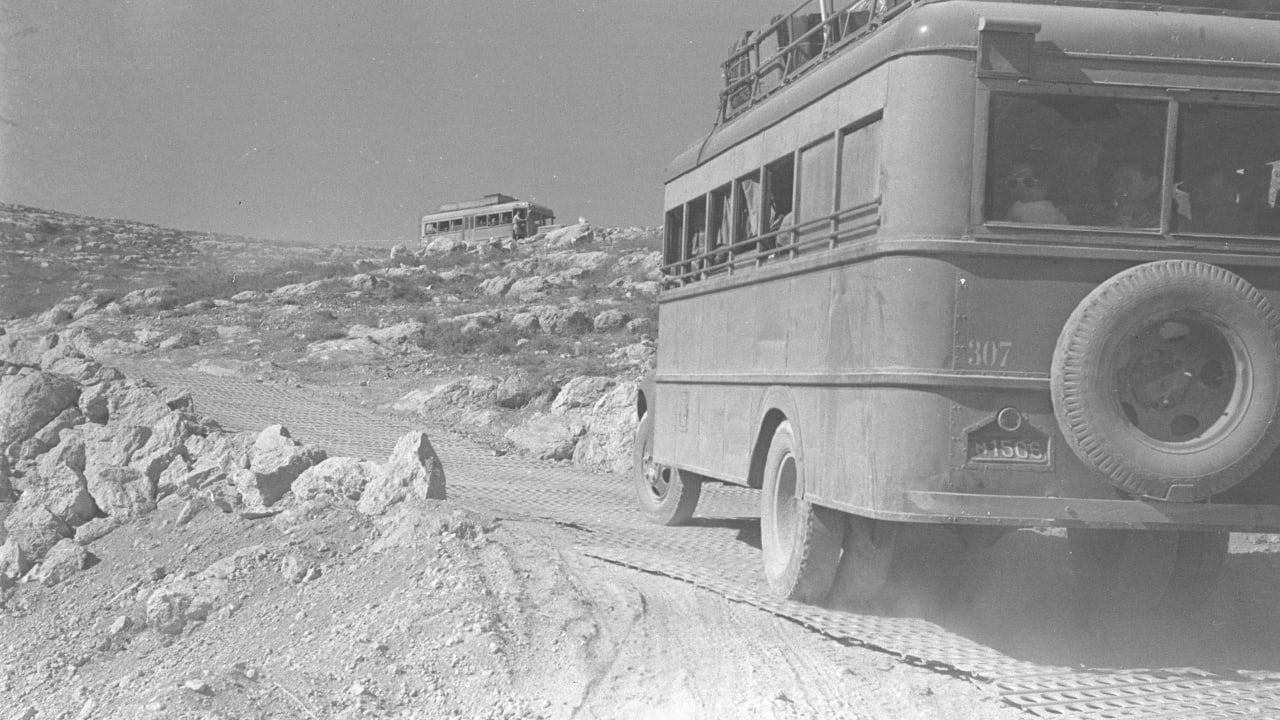
Driver explained that the main road to Jerusalem was controlled at Latrun by the Arab Legion. Therefore, attempts were made to create a new road to break through to Jerusalem, bypassing the enemy. One first attempt was Derech Ha’ayalot (Deer Road), a dirt road forged by the Palmach’s Har’el Brigade.
But this small road was impassable for convoys of heavy vehicles needed to deliver the required amount of supplies to the besieged city.
The second road was Route 7, named after its creators, the 7th Brigade, which was wider and able to accommodate large convoys of vehicles with enough supplies to alleviate the struggling Jerusalem residents. It was also referred to as the Burma Road, after the famous road used by the Allies in World War II to transport supplies from Burma to China.
“This was the usable road that enabled the lifting of the siege on Jerusalem,” Driver said.
In his book …At any cost – to Jerusalem, published in Hebrew in 1994, Shamir attested that Marcus did not participate in the process of planning or building of Route 7. Marcus, having been assigned a Hebrew-speaking secretary, did not speak or write in Hebrew and did not appoint his own staff.
“It is therefore hard to credit him with being a commander, especially during wartime,” Driver said. However, she described Marcus as “a most important unifier and adviser rather than a commander.”
Was Marcus Israel’s first major-general?
So can Marcus be credited as Israel’s first major-general? Driver states that a clear answer is complicated, and one needs to be aware of the full context.
Driver pointed out that when Marcus was appointed to his position, the IDF had not yet introduced formal ranks. Ben-Gurion only determined such ranks two weeks later, by which time Marcus was no longer alive.
In fact, Appendix 1 to IDF General Staff Ordinance No. 10, dated August 11, 1948, announced that the appointment of the first 12 IDF officers to be assigned the rank of major-general would take effect retroactively from August 1, 1948. Marcus was not one of these.
“It’s important to understand that although Marcus was appointed Supreme Commander of the Jerusalem Front on May 28, 1948, as an American citizen, and as an ex-officer in the US Army, he was forbidden to swear allegiance to another flag and officially serve in a non-US Army,” Driver elaborated.
In other words, “he was not allowed to receive an official IDF position even if it were offered, which explains why he was granted the official rank only after his death.”
“All this explains why the rank of major-general was awarded to Marcus posthumously, 14 months after his death,” Driver said. “The announcement about it appeared shortly before August 16, 1949.”
She further explained: “This supports the notion that granting Marcus the rank of major-general in May 1948 was a declarative and symbolic act on Ben-Gurion’s part.
“It was Ben-Gurion who put into effect the concept of unity of command on local commanders, for whom a regular army arrangement was alien and unacceptable,” she noted. “Ben-Gurion achieved this by using a professional figure accepted as neutral, i.e., not a veteran of the British Army and not from the Haganah.
“It is most likely that the granting of this rank to Marcus accelerated the acceptance of the principle of ‘unity of command,’ a principle that Marcus himself emphasized in his very first lecture to the top echelon of the fledgling IDF,” she explained.
“In conclusion, there is nothing wrong with viewing Marcus as the IDF’s first major-general, but it is important to be aware of what lay behind the appointment and what it actually meant in practice.”
Driver was proud to have received permission to visit West Point Cemetery, where she paid respects at Marcus’s grave, calling it a “very moving” experience.
For her, the important thing is ensuring that the memory of people like Marcus, and the other brave men and women who fought and worked for the revival of an independent Jewish nation, are properly credited and remembered for their critical contributions.■