
On the night of November 9, 1938, as Nazi mobs attacked synagogues and Jewish institutions across Germany, Wilhelm Krützfeld intervened. The commander of Berlin’s Police Precinct 16 and his fellow officers protected the New Synagogue on Oranienburger Straße, preventing a fire set by Nazi stormtroopers from destroying the building. Their actions demonstrated the courage and moral responsibility required of police officers confronting hatred.
Eighty-eight years later, the synagogue hosted a commemoration of Kristallnacht under the banner “Not on Our Watch: Operationalizing Never Again.”

The initiative was launched by the International March of the Living in partnership with Gewerkschaft der Polizei (GdP), EU.Pol, Rutgers University’s Miller Center on Policing and Community Resilience, the University of Virginia Center for Public Safety and Justice, and the Jewish Community in Berlin.
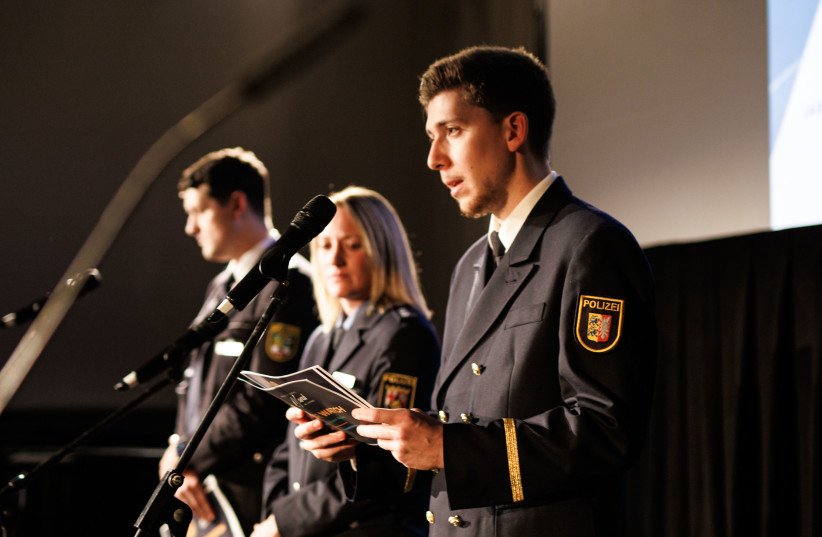
Sven Hüber, Head of the “Jewish Life and the Police” project at the Federal Executive Board of the German Police Union (GdP), introduced Krützfeld’s story. Police officers from three German states then read passages from Zachor (“Remember!”), a book honoring his legacy, titled: "The police station commander with heart“.
Together with Jochen Kopelke, Federal Chairman of the GdP, Hüber presented the book to George Shefi, a survivor of the Holocaust and the November Pogroms. The presentation connected the courage of 1938 with the responsibilities of law enforcement officers today.
Hüber said, “We know about the crimes committed by the German police during the Nazi era. Krützfeld’s story is also part of that history: an example of the decency, values and courage of principled German police officers. Understanding the neighborhood he served helps explain what was at stake.”
Shefi accepted the book and said, “I call on all police officers to follow Krützfeld’s courageous example and never stand by in the face of hate crimes and antisemitism.”
His intervention brought Krützfeld into conflict with his superiors. According to the book, on November 11 he was summoned before Berlin Police President Count Helldorff, who shouted at him and sent him away with threats. Krützfeld defended his actions by citing the synagogue’s protection as part of Germany’s cultural heritage.
Krützfeld lost command after war broke out and was probably transferred in 1940. He was moved repeatedly between precincts and felt watched by the Nazis. He was granted early retirement in 1942 after senior officers hinted at the decisions of the Wannsee Conference.
Krützfeld’s example endured. The police school in Schleswig-Holstein now bears his name.
“‘Never again!’ also means keeping memory alive. That is the purpose of Zachor — and of returning these voices to the synagogue Krützfeld helped save,” said Hüber.
Written in collaboration with March of the Living