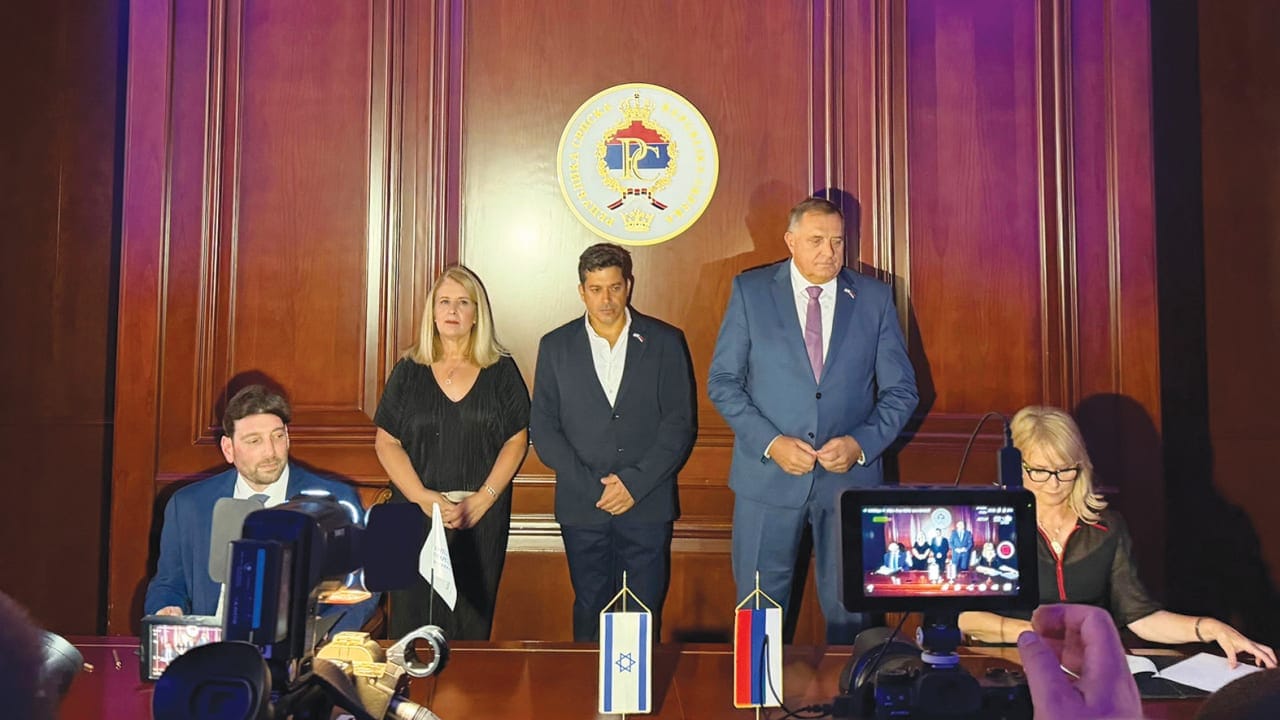
BANJA LUKA, Bosnia and Herzegovina – Sitting in Banja Luka last week, there was little ambiguity about where Milorad Dodik would like the future to lead.
Eight months after we first met in Jerusalem, the longtime dominant figure in Republika Srpska spoke with The Jerusalem Post about Israel, Europe, Islam, the breakup of Yugoslavia, the Bosnian War, and the grievances that have shaped Serbian politics for more than three decades.
Dodik has been around the block in the great game of geopolitics, and in a region where borders, identities, and nationalities have shifted repeatedly within living memory, he has learned to think less in terms of permanence than opportunity.
If the people of Republika Srpska were one day given the opportunity to vote in a referendum on leaving Bosnia and Herzegovina and ultimately joining Serbia, was that a future he thought about, the longtime leader was asked.
“Do I think about it?” Dodik replied. “I dream about it. Absolutely.”

To understand his answer, it helps to first understand the unusual country in which he gave it.
Before the Bosnian War, Bosnia and Herzegovina was one of six republics within socialist Yugoslavia, a federation that for decades held together Serbs, Croats, Slovenes, Bosnian Muslims, and others under Josip Broz Tito.
For nearly four decades, Tito was the only man who could hold the system together, suppressing any scent of nationalism among the constituent republics for the good of Yugoslavia.
But after his death in 1980 and the collapse of Communism later that decade, Yugoslavia began to unravel, as each of the republics sought independence.
Slovenia and Croatia declared independence in 1991, nationalism surged across the federation, and Bosnia – where Bosniak Muslim, Serb, and Croat communities were far more geographically intertwined – became the most dangerous piece of the Yugoslav puzzle.
When Bosnia held an independence referendum in 1992, Bosnian Serbs overwhelmingly boycotted it. Independence nevertheless passed, and within weeks the country descended into war.
Bosnian Serb leaders, backed militarily and financially by Belgrade, established their own republic and army (Republika Srpska), while the Bosnian government fought to preserve an independent state and Bosnian Croat forces pursued their own territorial ambitions.
What followed between 1992 and 1995 devastated the country. More than 100,000 people were killed, and around two million were driven from their homes on all sides of the conflict. Cities were besieged, communities that had lived alongside one another for generations were torn apart, and ethnic cleansing changed the demographic map of Bosnia.
Crimes were committed by all sides, although international courts subsequently established that extensive campaigns of persecution and ethnic cleansing were carried out by Bosnian Serb forces.
The Dayton Peace Agreement ended the war in late 1995, keeping Bosnia and Herzegovina intact while dividing it internally. Republika Srpska received just under half the country’s territory, with most of the remainder forming the predominantly Bosniak-Croat Federation of Bosnia and Herzegovina. To this day, Bosnia still has three members of its presidency to give all factions representation.
Three decades later, Republika Srpska has its own president, government, parliament, police, and public institutions. Serbian flags are ubiquitous, and many of its residents regard Serbia as their national homeland.
It is not, however, a sovereign state. For Dodik, that remains unfinished business, and that is where Israel enters his thinking.
From Jerusalem to Banja Luka
The immediate reason for the Post’s visit was considerably less dramatic than the future of Bosnia.
Israeli and Republika Srpska officials had gathered in Banja Luka to inaugurate the representative office of the Israel Chamber of Commerce, intended to turn a relationship that has grown increasingly warm in recent years into economic cooperation.
Diaspora Affairs and Combating Antisemitism Minister Amichai Chikli traveled from Israel for the occasion. Galit Peleg, completing her term as Israel’s nonresident ambassador to Bosnia and Herzegovina, was also there, along with Zeljka Cvijanovic, the Serb representative of the Bosnian Presidency, and local political and business leaders.
Amir Gross Kabiri, one of the initiative’s driving forces, will head the office.
While it is intended to boost trade, technology and investment, its opening also showcased the increasingly close political relationship between Israel and Republika Srpska – one that has reached unprecedented levels in recent years.
Dodik has deliberately cultivated ties with Jerusalem and told the Post that the idea of establishing the chamber office emerged during his meeting with Prime Minister Benjamin Netanyahu earlier this year, when the Balkan politician was in town for Chikli’s “Generation Truth” conference.
“We maintain a high degree of understanding and support for Israel and, of course, for the Jewish people as a whole,” Dodik told the Post. “We wholeheartedly want to raise those relations to the highest possible level.”
Yet something deeper lies behind Dodik’s attachment to Israel. He sees parallels between Jewish and Serbian history – peoples repeatedly subjected to persecution and both, in his interpretation, learning the consequences of being unable to defend themselves.
That history is particularly powerful in this part of the Balkans. During World War II, much of modern-day Croatia and Bosnia fell under the fascist Ustaše-run Independent State of Croatia, an Axis puppet state that murdered Serbs, Jews, Roma, and political opponents. Jasenovac, its largest concentration camp complex, remains central to Serbian national memory. Of all the nations to suffer during World War II in the Balkans, the Serbs lost the largest percentage of their population.
Dodik believes Israel understands that history and the instinct it created better than most. He visited Kibbutz Be’eri following the October 7 massacre and said the destruction he witnessed there resonated with Serbian historical experience.
“We stood in solidarity over the suffering that occurred in October,” he said, reminding the Post that after October 7, the presidential palace in Banja Luka was emblazoned with the Israeli flag.
“Israel is waging a decisive struggle for its status and for a peaceful and stable environment,” he added. “And, to the extent that we are able, we will support all the efforts Israel undertakes in that regard.
“Israel is fighting to preserve its state and its people,” he told the Post. “Republika Srpska is doing the same.”
The comparison is not without contentious points, however.
Israel is a sovereign state. Republika Srpska is an autonomous entity created within the internationally recognized borders of Bosnia and Herzegovina.
Moreover, the history surrounding Republika Srpska’s creation cannot be separated from the crimes that were committed in establishing and consolidating Bosnian Serb-controlled territory, which are a matter of legal history. International courts found that Bosnian Serb forces carried out systematic campaigns to remove Bosniaks and Croats from areas claimed for a Serbian state through killings, imprisonment, deportation, sexual violence, and the destruction of homes and religious buildings.
For many Bosniaks, therefore, Republika Srpska cannot be viewed simply as the realization of Serbian self-determination. Its territory also carries the memory of those expelled or killed during its creation.
Many Serbs tell the story from the opposite viewpoint. They remember Serbian civilians killed, villages attacked, and families displaced, and point to atrocities committed by Bosniak and Croat forces. There is no doubt crimes were committed by Bosniak and Croat forces, and many Serbs in Bosnia believe international institutions subsequently allowed Serbian crimes to define the war while reducing Serbian victims to an afterthought.
More than 30 years after Dayton, Bosnia has peace, but reconciliation remains another question, and Dodik’s language shows how wide that divide is.
He accused Bosniaks in Sarajevo of harboring a “systemic hatred” toward Jews and Israel, as well as toward Serbs, and his argument widened into a broader criticism of Muslim immigration into Western Europe and what he considers liberal Europe’s failure to defend its own civilization.
His characterization of Muslims is sweeping and, for Bosniaks who themselves suffered mass killing and ethnic cleansing during the war, deeply inflammatory. Yet it offers one of the clearest explanations Dodik gave for why he rejects Bosnia in its present form.
“Bosnia and Herzegovina does not work,” he said. “It would be the same as if you took Israel now and put it into a common state with Iraq, Syria, and Egypt and told [everyone] that you were all one country.
“Is that possible? Of course it isn’t. So why are you doing it to us?”
The shadow of Ratko Mladic
During the Post’s days in Banja Luka, those arguments about history were impossible to separate from something happening around us. Gen. Ratko Mladic, one of the Bosnian Serbs’ most identifiable figures, had only recently died.
As commander of the Army of Republika Srpska during the Bosnian War, Mladic oversaw the forces that captured the UN-declared safe area of Srebrenica in July 1995. In the days that followed, more than 8,000 Bosniak Muslim men and boys were killed.
Judges at the International Criminal Tribunal for Yugoslavia based in The Hague convicted Mladic of genocide over the 1995 Srebrenica massacre, as well as persecution, extermination, murder, deportation, and forcible transfer.
Alongside political leader Radovan Karadzic, Mladic became the international face of the Bosnian Serbs during the ’90s.
Mladić was also convicted of crimes connected to the campaign of sniping and shelling against civilians during the siege of Sarajevo and the taking hostage of UN personnel. His life sentence was upheld on appeal in 2021. He died in The Hague on August 27 while serving a life sentence for genocide, crimes against humanity, and war crimes.
But walk through Banja Luka after his death, and another Mladic is visible.
At a makeshift memorial in the city, candles and flowers sat beside his photograph. Residents who spoke to the Post described not the commander portrayed in the judgments from The Hague, but a soldier who had defended them.
“Mladic defended us when we were under attack,” one resident said. “He fought for Serb rights.”
Some of those honoring him were not even alive during the war.
“Today, these people – young people born after the war – are going into the streets and paying tribute to Gen. Mladic,” Dodik said. “Excuse me, how am I supposed to prohibit that?”
He argues that international condemnation and attempts to criminalize the glorification of convicted war criminals have instead strengthened Mladic’s symbolic importance.
“What the West and the Muslims have done is turn Gen. Mladic into an icon of identification for the Serbs, whatever anyone may think about him,” he said.
The gulf is extraordinary.
The international judicial record describes a commander convicted of genocide and of participating in campaigns of terror and persecution. In Banja Luka, the Post encountered people mourning a general they believed had protected them.
Mladic’s funeral in Belgrade this week demonstrated the power of that competing memory, with thousands turning out for his burial, and the honors afforded him producing outrage in Bosnia and across Europe.
More than three decades after the wars of the Balkans, the dead are still shaping the politics of the living.
Against that historical backdrop, the warmth toward Israel visible in Republika Srpska takes on greater significance.
Peleg, speaking at the opening of the chamber of commerce, recalled that after October 7, the Israeli Embassy wanted to hold a memorial for the massacre victims in Sarajevo but was unable to find a venue willing to host it. Republika Srpska officials stepped in and offered a theater in East Sarajevo.
“From that moment we knew that we could commemorate our loved ones and get all the respect,” she told those gathered.
Here, yet again, is where the intricacies of Balkan politics come into play. Israel maintains diplomatic relations with Bosnia and Herzegovina as a sovereign state. Yet some of its warmest political relationships within Bosnia are increasingly found among leaders in an entity whose dominant political movement has spent years questioning whether that state should continue to exist in its current form.
For Dodik, there is no contradiction.
For Dodik, Israel is a strong example of the kind of relationship he wants Republika Srpska to build abroad – that of close political ties, stronger economic links, and direct engagement with countries he regards as natural partners.
Which brings the conversation back to Serbia.
The people of Republika Srpska are overwhelmingly Serb. They share their language, Orthodox Christianity, cultural traditions, and much of their national history with Serbia. Serbian television is watched, Serbian politics followed, and Serbian sporting victories celebrated. One Banja Luka resident told the Post how Bosnian Serbs always support Serbia over Bosnia in any sporting event where the two may meet.
Yet an international border separates Bosnian Serbs from Serbia. Dodik would like that to change.
His argument, and that of the Bosnian Serbs, rests partly on Kosovo, the southern region, which declared independence from Serbia in 2008. For Serbian nationalists, it created an obvious question: if self-determination permitted Kosovo Albanians to separate from Serbia, why could Bosnian Serbs not choose to separate from Bosnia?
Western governments reject the equivalence, arguing that Kosovo emerged from a different legal and historical process and that Dayton established Republika Srpska as an entity within sovereign Bosnia rather than a state possessing a unilateral right to secession.
For Dodik, this amounts to different rules for different peoples.
“Why can’t we do it if Kosovo can, according to your rules?” he asked.
And then came perhaps the most consequential part of his answer.
“Serbs are aware that if even a small opportunity arose, they would take advantage of it,” Dodik said. “We are preparing for that because nobody knows what will happen.”
For now, no internationally accepted route exists by which such a referendum could produce an independent Republika Srpska, much less union with Serbia, but the aspiration has not disappeared.
After several days in Banja Luka, it became easier to understand why.
Republika Srpska is simultaneously a product of war, a component of a peace agreement and, for many of the Serbs who live there, the closest thing they have had in modern Bosnia to a state of their own.
Its creation is inseparable from some of the darkest crimes of the Yugoslav wars. Its people also carry their own memories of Serbian suffering and displacement. Its institutions emerged from Dayton, but the national aspirations that preceded Dayton did not simply vanish when the agreement was signed.
That is the world in which Dodik’s admiration for Israel makes sense.
He looks at the Jewish state and sees a people that learned through catastrophe that survival cannot be entrusted to others. He looks at Republika Srpska and believes Serbs learned the same lesson.
His critics see nationalism that threatens the peace settlement that ended Europe’s bloodiest conflict since 1945, historical revisionism surrounding the crimes committed by Bosnian Serb forces, and rhetoric toward Muslims that makes reconciliation more difficult with every generation. Dodik sees a people whose statehood remains incomplete.
The chamber of commerce office inaugurated in Banja Luka last week is a small institution against that enormous historical backdrop. It may bring Israeli businesses, investment, tourists and technology to Republika Srpska, but it also gives Banja Luka another tangible connection with the country Dodik repeatedly invokes as an example of national survival.
The question that has followed Republika Srpska from the battlefield to Dayton and through the three decades since is whether Bosnia’s Serbs ultimately see their future inside Bosnia – or whether, given the opportunity, they would choose another one.
For Dodik, at least, there is no uncertainty. He is just waiting for the opportunity