
Two years after an Argentine judge ordered a Spanish dictionary to drop a definition of “Jewish” as “miserly or usurious,” the institution responsible for the dictionary has yet to comply — frustrating the Jewish groups that brought the case.
The definition reflects a long history of associating Jews with greed and moneylending, a stereotype reinforced by literary figures such as Shakespeare’s Shylock and by centuries of anti-Jewish prejudice. The Royal Spanish Academy, the Madrid-based language-standardization institution that is ignoring a September 2024 order by a federal judge here, has defended its dictionary as a record of how words are used, including pejorative meanings.
Jewish groups argue that preserving the definition perpetuates an antisemitic trope.
“We understand that the dictionary reflects how some people use language, but it is also true that many people learn through the dictionary,” Ariel Siedler, a member of the Latin American Jewish Congress (CJL) who monitors online discrimination, told the Jewish Telegraphic Agency last month. “That is why adding that definition seems negative. The aim was to avoid reinforcing discrimination, which would be perpetuated through the dictionary."
The 2024 order came a month after CJL and DAIA, Argentina’s Jewish political umbrella organization, filed a criminal complaint against Santiago Muñoz Machado, the academy’s director, and other officials. It accused them of “inciting hatred against the Jewish community through the discriminatory definition of the term ‘Jew’.”
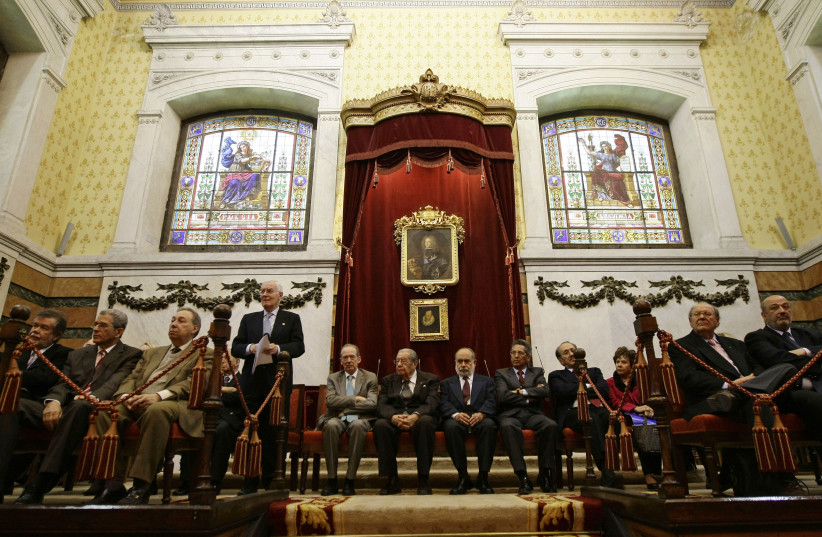
When the ruling came down, Muñoz Machado told EFE, the Spanish state-run news agency, that he would examine the ruling even though it is unenforceable in Spain, out of respect for the Argentine courts and the CJL’s parent body, the World Jewish Congress.
“It is a judge’s ruling; therefore, we receive it with the utmost respect — all the more so given that the petitioners behind it include the World Jewish Congress,” he told EFE. Nonetheless, he said then, he still held to what he had told the CJL in 2023, when he responded to the Jewish body’s direct request to remove the definition.
“If the [academy] defines ‘Jew’ as ‘miserly,’ it is because that’s how people use the word,” he said. He emphasized that dictionaries document language rather than invent it, and that deleting a definition would not necessarily prevent people from using the expression.
The academy’s online Dictionary of the Spanish Language lists five meanings for “judío” (Jew/Jewish). The first definitions are “Hebrew,” a person “who professes Judaism,” a “native of Judea, a country of ancient Asia,” and “belonging or relating to Judea or the Jews.”
The fifth describes it as a person who is “miserly or usurious.”
In 2021 — the year the CJL first complained to the academy — it began to add that this usage is “offensive or discriminatory,” according to IEDRA, a website that tracks Spanish language usage.
English-language dictionaries routinely include antisemitic meanings of “Jew” while also noting that such usage is offensive.
Defenders of the Spanish academy’s dictionary said the work’s educational role should prevail. “The dictionary serves to explain and understand. Without collecting the various meanings that a word can have, it would be impossible to properly read ancient or modern texts,” Arturo Pérez-Reverte, an academy member and a Spanish novelist, told El País in 2024, when the Argentine court issued its ruling. “The RAE dictionary is not the normative police of the language, but the notary that draws up a record of how the language was used and how it is used now.”
There is a precedent for the academy removing an offensive definition. Spanish lawyer Borja Luján Lago in 2023 got the academy to modify the entry for the word “lawyer,” which included the definitions “talkative” and “chatty.” Panama’s Jewish community, hearing of his success, tapped Luján Lago to persuade the academy to remove the offensive “Jewish” definition. More than 20 Jewish groups in the United States and Latin America signed onto the effort.
Based in Madrid and founded in 1713, the academy is the leading authority on the Spanish language, coordinating linguistic standards with 22 other academies, mostly in Latin America.
Approximately 636 million people worldwide are Spanish speakers, according to the Instituto Cervantes’ 2025 report. The countries with the largest Spanish-speaking populations include Mexico (138 million), the United States (65.5 million), Colombia (53.1 million), Spain (48.9 million) and Argentina (47.5 million).