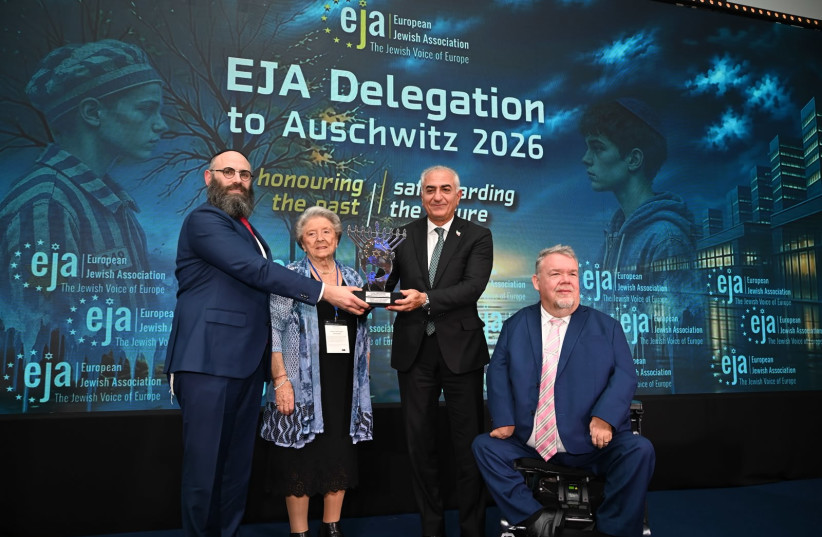
Exiled Iranian Crown Prince Reza Pahlavi received the prestigious King Solomon Award at the European Jewish Association (EJA) memorial dinner in Krakow, Poland, on Monday evening, ahead of its delegation’s visit to Auschwitz.
The annual conference gathered international diplomats, Jewish community leaders, and journalists to address rising antisemitism and global security threats.
Accepting the recognition, Pahlavi reflected on the historic ties between the Persian and Jewish peoples and talked about the shared responsibility of democratic nations to confront contemporary tyranny and ideological extremism worldwide.
Islamic Regime wants to 'finish what Hitler has done,' Pahlavi warns
Earlier on Monday, Pahlavi addressed reporters and international delegates at an EJA press conference, warning that the current regime in Tehran poses an active, existential menace to global stability and human dignity. Framing the ruling Islamic Revolutionary Guard Corps apparatus as a unique threat requiring decisive action, he drew a direct link between historical fascism and the ideology behind the current Iranian regime.
He said that the international community is repeating the fatal error of ignoring explicitly stated genocidal intentions.
“When you hear ‘never again,’ this regime, in its viral sense, wants to finish what Hitler has done,” Pahlavi stated.
According to the crown prince, “You have a regime that has the combination of the three worst forms of governments all at once. It is totalitarian in some respect. It is racist in some respect. It is fascist in some respect. And yet, nothing has been done to counter it.”
He called for a moral awakening, saying that unchecked ideological extremism inevitably expands beyond its borders to imperil all humanity.
Upon receiving the King Solomon Award, Pahlavi recalled the 25-century-old relationship between Persians and Jews, rooted in the legacy of Cyrus the Great, who liberated Jewish captives from Babylon and facilitated the rebuilding of the Temple in Jerusalem.
Building upon his previous historic visit to Israel, where he met with national leadership and prayed at the Western Wall, Pahlavi said that lasting regional normalization cannot be fully realized while Tehran remains under clerical dictatorship.
He proposed elevating existing diplomatic agreements into a comprehensive framework he called the “Cyrus Accords,” noting that “without Iran as a partner in that process, there is no way the Abraham Accords could have stood on their own.”
Under this vision, a secular, democratic Iran would serve as a cornerstone of regional security, economic integration, and Judeo-Persian partnership, restoring bonds that predated the 1979 Islamic Revolution.
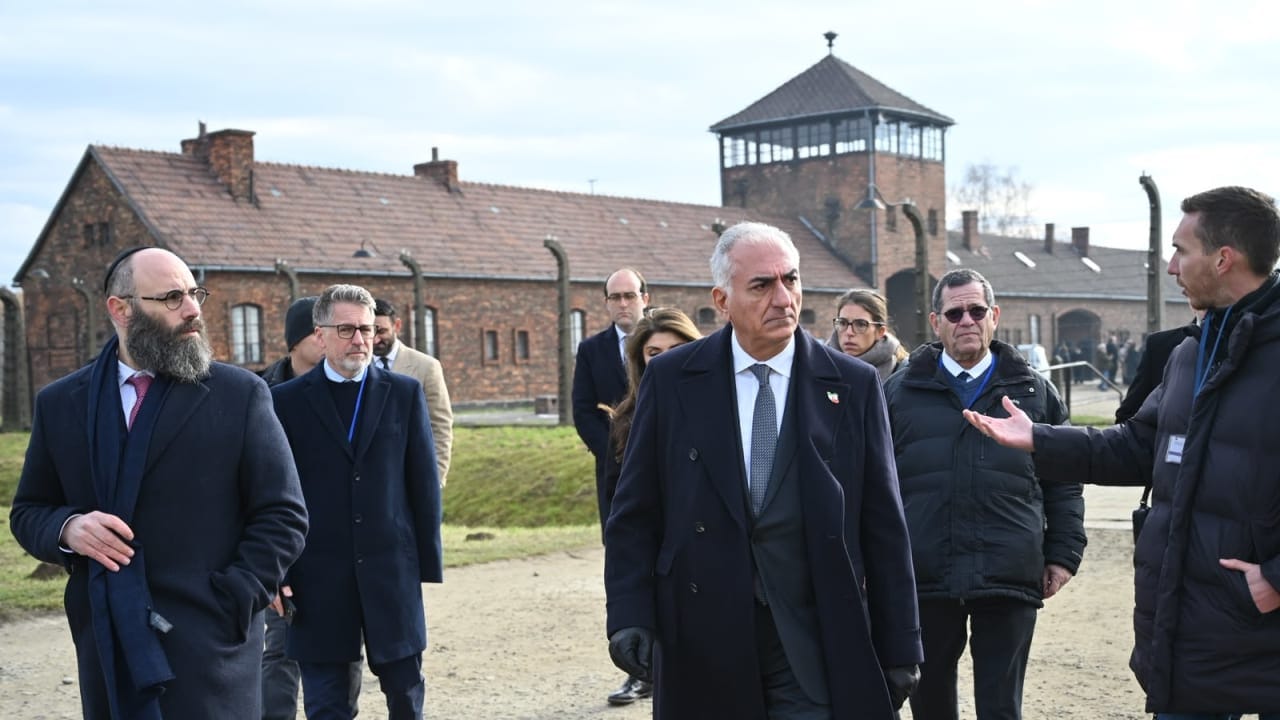
The symposium concluded with the international delegation’s formal visit to the Auschwitz-Birkenau state museum and memorial on Tuesday. Pahlavi attended an official ceremony at Birkenau alongside his wife, Yasmine, joining prominent diplomats and Jewish community figures.
Delivering an address at Birkenau, EJA chairman Rabbi Menachem Margolin reflected on the solemnity of the site, stating, “Here, in this place, words are almost too much. We stand at Birkenau. There are no tombstones here, no names upon the Earth.”
“Those who built this place wanted more than just our death; they wanted us to be completely erased ... They failed, because we are here, Jews from across Europe, children and grandchildren of survivors, standing alongside the leaders of European nations on this very soil. That, in itself, is an answer,” Margolin continued.
Pahlavi expresses solidarity with Jewish community
Pahlavi also spoke at the memorial service, expressing solidarity with the Jewish community: “We stand with you ... to ensure that this never, ever happens again.” He emphasized what he described as the collective imperative of unity and moral clarity, adding, “We stand together, not only to honor those we have lost, but to ensure a future of peace and brotherhood, and an end to evil.”
Following the speeches, Pahlavi walked through the historic grounds and laid a wreath to honor the millions of Holocaust victims, reinforcing his calls throughout the conference for global vigilance, solidarity, and moral leadership in the face of modern extremism.