
Yashar party leader and former IDF chief of staff Gadi Eisenkot has emerged as the leading opposition candidate seeking to oust Prime Minister Benjamin Netanyahu ahead of the October election.
Receiving rapid, widespread support at a crucial juncture, Eisenkot is well positioned to become the country’s next prime minister in the country’s first elections since the Oct. 7 Hamas attacks in 2023.
In his first in-depth interview to an English news outlet ahead of the elections, Eisenkot broke down to the Magazine his plans for the country as prime minister, what his security approach would be, and his stance on Oct. 7 failures – while also opening up on the loss of his son and two nephews who fell in battle during the Israel-Hamas War.
Eisenkot rose through the IDF’s Golani infantry brigade and was OC Northern Command, before serving as chief of staff from 2015 to 2019. His military career put him at the center of Israel’s confrontation with Iranian forces and their allies in Syria, a threat he identified in the interview as his foremost concern.
He entered politics in 2022 with Benny Gantz’s National Unity party. After Oct. 7, Eisenkot joined Netanyahu’s emergency government and sat as an observer in the war cabinet. He and Gantz left the government in June 2024. Eisenkot later broke with Gantz and founded Yashar, Hebrew for “straight” or “upright,” in September 2025.

A Channel 12 poll conducted Tuesday projected 23 seats for Yashar, 20 for the Likud, and 13 for Naftali Bennett’s B’Yachad. It gave Zionist parties opposed to Netanyahu 54 seats, short of the 61 needed for a Knesset majority without Arab parties. Eisenkot led Netanyahu, 41% to 38%, when respondents were asked who was better suited to be prime minister, though that difference is within the poll’s reported margin of error.
The numbers sharpen the question we put to him: How does he form a government while ruling out the Arab parties?
Eisenkot has presented himself as a unique candidate, offering a more reserved personality compared with the outgoing, outspoken figures who have dominated Israeli politics.
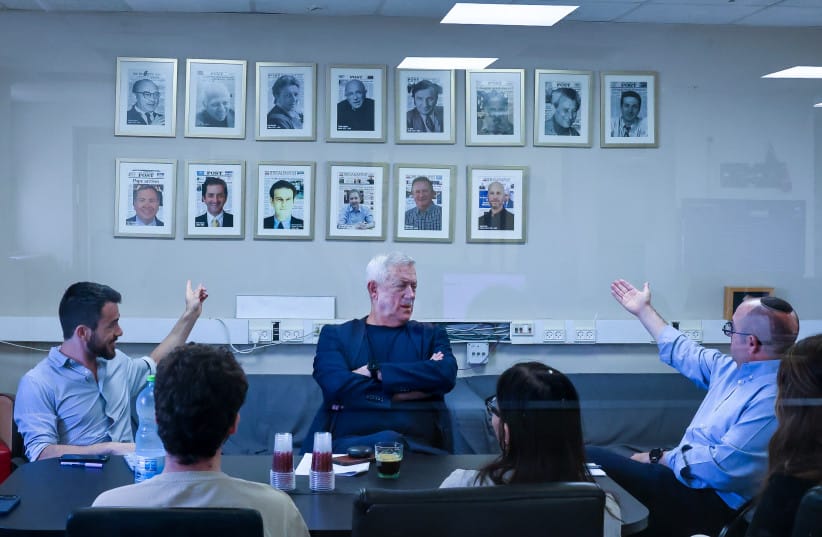
He arrived at The Jerusalem Post studio with the mannerisms that have come to characterize him, sitting at the edge of his seat and speaking calmly throughout the nearly hour-long interview.
Amid the countless theories and claims that there was a betrayal on Oct. 7, Eisenkot said that there was no possibility that this was the case.
“Unequivocally, there was no betrayal.... I know the people [and the system]. There is no chance that someone betrayed.”
Addressing Oct. 7 failures
“What there was, however, was deep negligence, arrogance, contempt, lack of professionalism – first of all by the military echelon, and afterward by the political echelon,” Eisenkot elaborated.
“And the most serious thing, in my view, is that all the cabinet ministers... are running again in the upcoming elections, except [then-defense minister Yoav] Gallant. This is inconceivable,” he said.
He told the Magazine that one of his top priorities would be to establish an official state commission of inquiry to probe government failures on Oct. 7.
“A state commission of inquiry must be established that will examine the last 10 years, from when I started my position,” he said.
Eisenkot himself became a bereaved father during the war, losing his son Gal two months into the war in Gaza. That same week, he lost a nephew, along with another nephew who fell in fighting a year later.
Speaking of his son, Eisenkot said, “The desire to contribute and do more for the country – there is no doubt that his fall... motivates me to act to be worthy of the heavy price that we paid, both as a country and as a family.
“He is with me every day,” he said.
Eisenkot's coalition redlines
Eisenkot also laid out some of his coalition redlines to the Magazine, saying that the two major Arab-led parties running – Ra’am and the Joint List – are not viable coalition partners.

“I decided that in the next government, I would see as a partner anyone who accepts Israel as a Jewish democratic state, the values of the Declaration of Independence, and the obligation of service.
“About a month ago, more or less, I understood that there is also a part of them [the Arab parties] that does not see Hamas as a terrorist organization.
“And I said that in the basic guidelines of the next government, it will be written that whoever does not accept that Hamas is a terrorist organization, that it needs to be dismantled and destroyed, will not be a partner in the next government.
“And therefore I do not see an Arab party that accepts my principles.”
When asked how he believes he could form a government when recent polling shows both blocs unable to form a coalition without the Arab parties, he said: “I believe the majority we receive will be much larger than what the polls currently show.
“We will continue working until the election to bring the opposition bloc to 63-64 mandates, together with my partners in the bloc, [B’Yachad leader Naftali] Bennett, [Yisrael Beytenu leader Avigdor] Liberman, and [The Democrats leader Yair] Golan.
“I said that I do not rule out any Zionist party. I see as a partner anyone who meets the four principles I have set.”
Regarding Ofer Winter, who chairs the right-wing People of Israel party that recently emerged, which has backed Netanyahu, Eisenkot said that “there is a contradiction in his positions.
“In the end, he [Winter] chooses to perpetuate the rule of the person who was in power on Oct. 7.
“He says he will go with whoever passes a conscription law, yet he chooses to go with someone who promoted draft evasion. I don’t see him joining any coalition.”
Stances regarding the West Bank
Eisenkot also spoke on his stance regarding Finance Minister Bezalel Smotrich, who leads the far-right Religious Zionist Party and has strongly pushed to expand West Bank settlements.
“I will tell you a secret: I have family in Judea and Samaria, in [the West Bank settlement] Yakir, and some of them vote for him [Smotrich]. I therefore do not personally disqualify him.
“But Smotrich expresses highly problematic positions. I cannot accept his support for a draft-evasion law. He also called for refusal to serve.
“I am also deeply concerned by Judea and Samaria. Four years ago, Netanyahu took the Civil Administration and handed it to Smotrich, and took the police and handed it to [National Security Minister Itamar] Ben-Gvir.
“He undermined the [IDF] Central Command commander’s ability to exercise sovereignty and responsibility.”
When asked what he would do to change the situation in the West Bank, especially amid the spike in Jewish settler violence in the area, Eisenkot said that after entering office he would immediately “reverse” the situation and change who was in charge.
“The Civil Administration would return to military coordination, and police activity in Judea and Samaria would again be coordinated by the military command,” he said.
“Administrative orders would be restored against those who riot and harm the settlement enterprise. First and foremost, they harm the State of Israel,” Eisenkot continued.
When asked if he would consider firing the head of the Mossad, Roman Gofman, and Shin Bet (Israel Security Agency) Director David Zini, who are both Netanyahu appointments, Eisenkot said that while the two were “both very good commanders,” they were “incorrect appointments.”
“Now they have been appointed to positions. From here, it [the matter] will be examined through their performance,” he said.
One prime minister: Eisenkot nixes the idea of a rotation government
Eisenkot also ruled out the possibility of a rotation government, in which coalition partners would alternate serving as prime minister.
“I see one prime minister, whom the people decide on and elect, and he puts forward a work plan for four years, and he is prime minister for four years,” he elaborated.
Eisenkot also said that after the elections, the leader of the largest party should be the candidate for prime minister.
He said he had held that position before his rapid rise in the polls, when he was polling at “six seats, and Bennett had 26.”
The Yashar party leader said he had told Bennett and Liberman, “Let’s establish a clear rule: The head of the largest party is the candidate for prime minister.
“I have not changed my mind. They are the ones who changed their minds,” he added.
Change and repair: What would Eisenkot do differently from Gantz?
Comparisons have been drawn between Eisenkot and his former political partner Gantz, another former military chief once seen as one of Netanyahu’s strongest rivals, who has since lost public support.
When asked what would make him different from Gantz, Eisenkot paused and said: “I feel a very deep sense of commitment.
“If I believed someone else could defeat Netanyahu today, I would say that I should not run.
“The personal price I paid through the death of my son, two nephews, and the broader pain throughout the country give me a deep sense of mission.
“I want to bring change and repair. I do not want to say that someone appeared to me in a dream, but my inner feeling is that I now have the ability to defeat Netanyahu, bring Israel to a place representing 70% of its residents, and forge an alliance of those who serve.
“There is a commitment and a mission here to change things and return the country to normality. I look at my children, grandchildren, friends, and young people. I am doing this out of deep inner conviction. I do not have an obsession with becoming prime minister.”
Foreign affairs strategy and policies
Regarding his policies and strategy for foreign relations and defense, Eisenkot said his outlook is that “Israel is today facing the greatest strategic complexity since the establishment of the state.
“Therefore, difficult decisions are required, not simple ones, both externally and internally.
“The thing that concerns me most among the external threats is Iran.... My concern is that their lesson to us will be this: They have 440 kilograms of enriched uranium. They will put in centrifuges, and they will race to 90% and shock the world with the production of a nuclear explosive device.”
When asked if Israel had been able to achieve its military objectives throughout the current government’s term, Eisenkot had a direct response.
“No, unfortunately,” he said.
Elaborating further, Eisenkot continued that only “one of the war objectives was achieved: returning the hostages.
“Netanyahu initially opposed including that objective, and I forced it upon him on the ninth day of the war,” he added.
Eisenkot also said that he would invest in US-Israel relations, which he said he saw as crucial.
“I saw it from [former US president Joe] Biden to [US President Donald] Trump. These are special relations that are a necessity for Israel.
“The fact that Netanyahu, ‘Captain America,’” he said jokingly, “is bringing Israel to the lowest point in relations with American society.”
Eisenkot also said that he has not been in touch with Netanyahu during his campaign and after the establishment of his party.
When asked if he was in contact with US officials, Eisenkot responded directly, “The answer is yes. I won’t elaborate beyond that.”
He also expressed support for Trump’s actions in brokering the deal that secured the release of some of the hostages.
“But the most important thing is the peace among us. And that, in my view, is the biggest challenge for the government.”
“Peace, from Egypt to Jordan, is not something that can be taken for granted. We need to strengthen it and cultivate it.”
Dwelling with others: Israel's international standing
Asked how he believes he could improve Israel’s international standing, Eisenkot said that his approach would be different from Netanyahu’s stance, which he argued has put Israel into isolation.
He criticized Netanyahu for saying in 2025 that Israel needs to become a “super-Sparta.”
“We do not want to be ‘a people that dwells alone,’” he said, quoting the Bible.
“We need to be a strong country. And the challenge here is to be a strong Jewish state, a model state,” he added.
“The first steps require national agreement. The next government will have to make very difficult decisions. The first is a universal service law. Everyone must serve: haredim and Arabs. Arabs would perform National Service, while Bedouin service in the IDF would be expanded significantly.”
Drafting haredim
Regarding the issue of drafting haredim into the military amid the IDF’s severe manpower crisis, Eisenkot said that in addition to passing legislation to enforce haredi conscription, he would end the existing arrangement under which rabbis can grant exemptions through a lawyer.

Eisenkot said he would increase benefits for reservists and soldiers and revoke any state incentives granted to those who evade service.
Eisenkot has also called for a more “realistic plan” for drafting haredim into the IDF, under which 3% of haredim would be eligible for exemptions from service. He noted that this would be similar to exemptions currently granted to outstanding musicians and athletes.
This approach has drawn criticism from other opposition party leaders in the bloc who have called for no exemptions.
“Today, an annual cohort is approximately 70,000 people, so 3% is about 2,200.... Israel can permit that.
“At the height of the War of Independence, David Ben-Gurion refused to end the studies of 400 exceptional [Torah] scholars, saying, ‘Under no circumstances. We are a Jewish state.’
“I believe in that. I am not religious, but I grew up in a traditional family and have profound respect for Judaism and tradition.”
Eisenkot also said he would require all Israeli children to study through the state education system, which teaches core curriculum subjects such as math and English.
“Whoever is not in state education – secular, religious, haredi, Arab – will not receive funding from the state,” he said.
He said the reform of the country’s education system would take four years and involve putting “a lot of money into the education system in order to improve it.”
Eisenkot’s distinction for voters
When asked what makes him different from the other parties in the opposition bloc, he said that though he has respect for them, “I think what is different is the trust that the citizens of the country place in me.”
“Trust in my motives for wanting to become prime minister, my leadership, my experience, my responsibility, my personal example, and what I communicate to people.
“I believe I can create greater solidarity than any other prospective leader of Israel and rally the broadest possible public,” he said.■