
Israel risks squandering the growing economic potential of its Arab citizens by treating their elected representatives as illegitimate partners in government, Prof. Dan Ben-David, president of the Shoresh Institution for Socioeconomic Research, argued in an analysis released Wednesday against the backdrop of coalition negotiations.
Drawing on figures showing rising educational attainment and greater household investment in education, Ben-David argues that the political debate over Arab parties’ participation in government overlooks changes already taking place within Arab society.
The October 27 election gave Ra’am and the Joint List a combined 19 Knesset seats, alongside 48 for Gadi Eisenkot’s bloc and 53 for Prime Minister Benjamin Netanyahu’s outgoing coalition. The result has made the question of cooperation with Arab parties central to efforts to form an alternative government.
Opposition leaders refuse partnership with Arab parties
Yet parliamentary strength has not translated into agreement on a governing partnership. Yisrael Beytenu chairman Avigdor Liberman has backed Eisenkot for prime minister while ruling out a minority government dependent on Arab party support. Opposition leaders agreed Tuesday to pursue a “Zionist government,” while Democrats chairman Yair Golan met Joint List leaders to coordinate efforts to replace Netanyahu.
The disagreement concerns not only who can form a government, but the conditions under which Arab parties will be accepted as partners. Eisenkot has set conditions concerning Israel’s Jewish and democratic character and the elimination of Hamas’s military and governing capabilities. Arab parties’ demands for influence over policing, housing and public investment therefore sit alongside disagreements over national identity and the Israeli-Palestinian conflict.

Ben-David brings an economic argument to that debate: continued political marginalization, he contends, risks wasting an opportunity created by Arab families’ growing investment in their children’s futures.
“The signs have never been clearer: Arab citizens want to be part of Israeli society, and they are demonstrating this through their actions,” he said.
According to the figures presented by Shoresh, the share of Muslim women aged 35-54 holding an academic degree rose from 4.7% in 2004 to 22.9% in 2024 - nearly a fivefold increase.
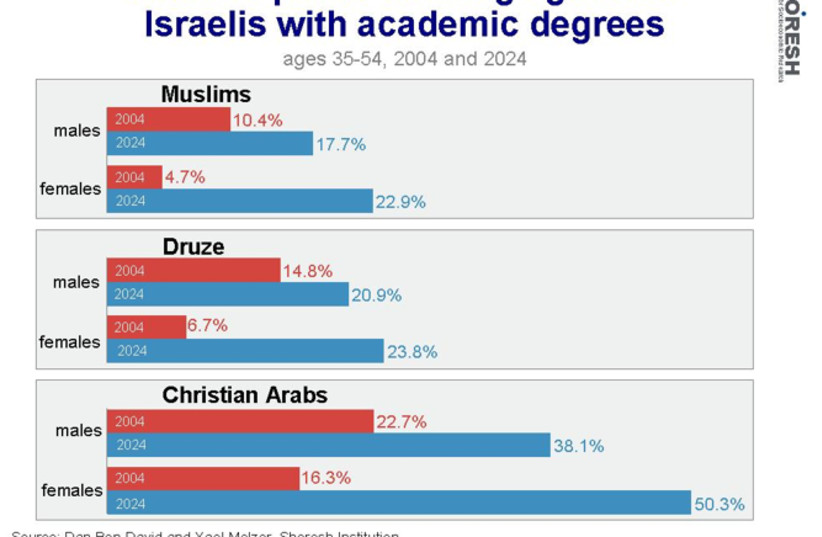
Among Christian Arab women in the same age group, the proportion increased from 16.3% to 50.3%, while among Druze women it rose from 6.7% to 23.8%. Degree attainment among men also increased, though more moderately, the institute said.
Education accounted for 4.8% of Arab household expenditure in 2021-2023, compared with 3.7% in 2011-2013. That is an increase of about 30% in education’s share of the household budget; it does not establish how much spending increased in shekel terms.'
Ben-David said families were seeking to compensate for shortcomings in public education through private schools, Jewish schools in mixed cities and private tutoring.
Those efforts coexist with substantial gaps in school performance. According to Shoresh, Arabic-speaking students in Israel scored below students in six of the seven Arab countries participating in the 2025 PISA international assessment.
Arabic speakers account for 23% of Israel’s first-grade pupils, according to the institute, making their education and future employment significant to the productivity of the wider economy.
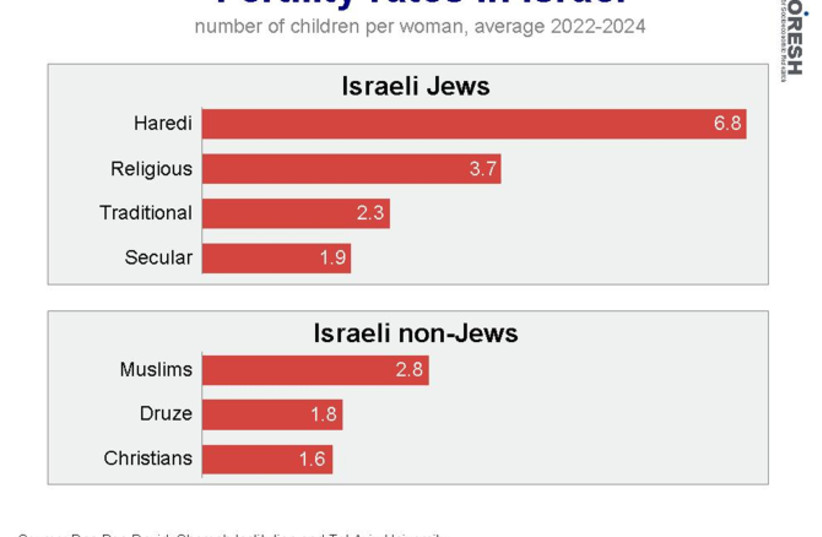
The analysis also points to changing demographics. The fertility rate among Muslim women stood at 2.8 children per woman in 2022-2024, down approximately 40% over two decades, according to Shoresh. The corresponding rates were 1.8 among Druze women and 1.6 among Christian Arab women.
Ben-David sees these trends as part of a broader socioeconomic change, even as gaps in education and infrastructure and the crime crisis continue to obstruct economic advancement.
“Yet precisely now, as the political establishment discusses forming the next government, some continue to treat representatives of the Arab public as illegitimate partners,” he said. “This is not only political blindness but also economic shortsightedness.”
“The cost of the decisions made now will affect all of us long after the next government is formed.”